Nadda: CCEA Approves NIPU-2026 Urea Investment Policy
Synopsis
The CCEA, chaired by PM Modi, approved NIPU-2026 on 15 July 2026, introducing transparency reforms, investor-friendly returns, and foreign-exchange risk mitigation for new gas-based urea plants — projected to save over ₹250 crore per plant and cut India's fertilizer import dependence.
Key Takeaways
The Cabinet Committee on Economic Affairs (CCEA) , chaired by PM Narendra Modi , approved the National Investment Policy for Urea–2026 (NIPU-2026) on 15 July 2026 .
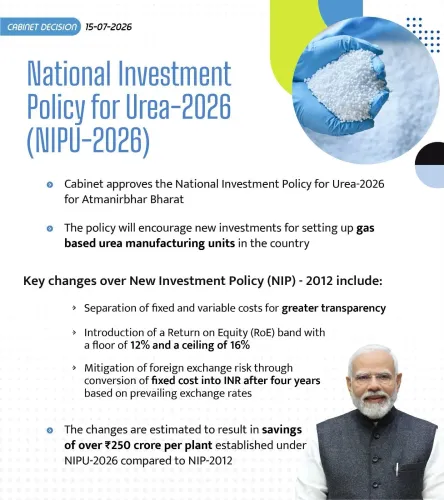
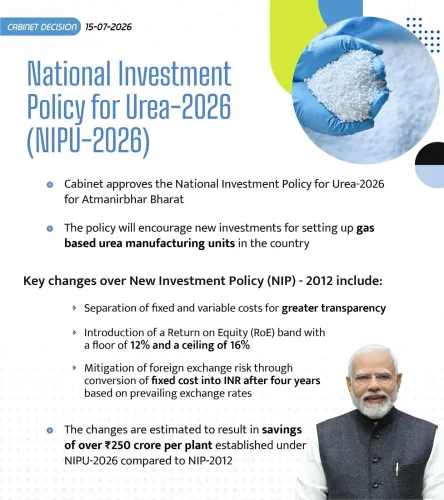
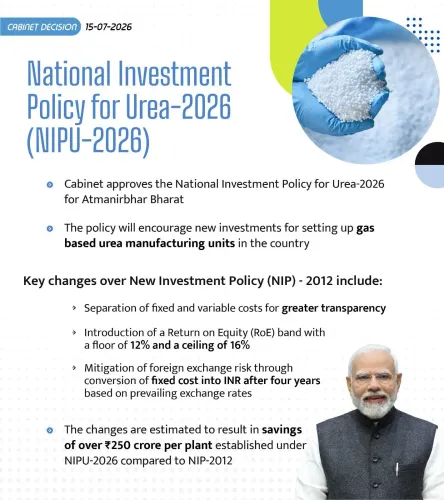
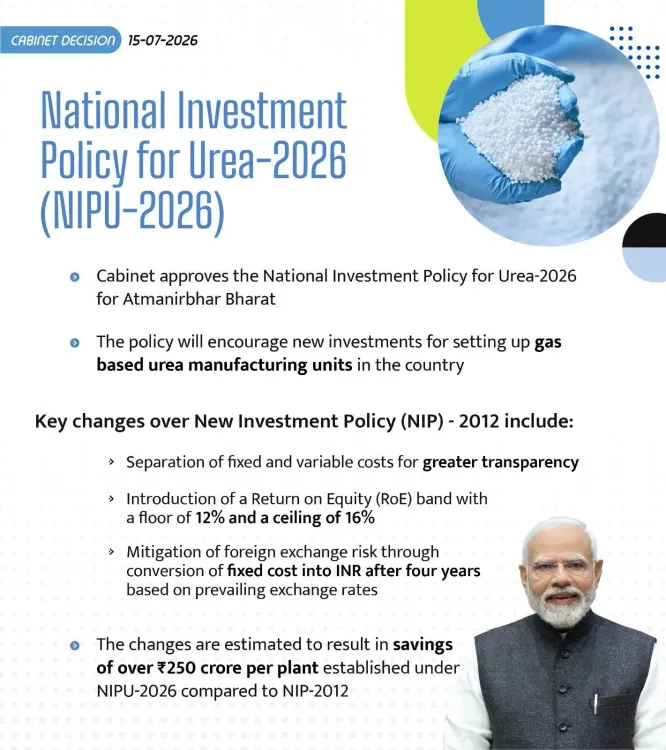
NIPU-2026 introduces greater transparency, an attractive return framework for investors, and measures to mitigate foreign exchange risk in the urea sector.
The policy is projected to generate savings of over ₹250 crore for each new urea plant established under its framework.
It aims to encourage new gas-based urea manufacturing plants across India to reduce the country's 30–40 percent import dependence on urea.
The policy advances the Atmanirbhar Bharat objective of self-reliance in agricultural inputs, building on earlier reforms dating to the New Investment Policy 2012 and New Urea Policy 2015 .
Domestic farmers and the government's fertilizer subsidy bill are the primary long-term beneficiaries of expanded domestic urea capacity.
Union Minister of Chemicals and Fertilizers J. P. Nadda announced on Wednesday, 15 July 2026 that the Cabinet Committee on Economic Affairs (CCEA), chaired by Prime Minister Narendra Modi, has approved the National Investment Policy for Urea–2026 (NIPU-2026), a sweeping reform aimed at boosting domestic urea manufacturing and reducing India's dependence on fertilizer imports.
Context
Nadda, who also serves as Union Health Minister and BJP national president, shared the announcement on X, stating that the policy 'introduces key reforms, including greater transparency, an attractive return framework for investors, and measures to mitigate foreign exchange risk.' The approved policy is expected to generate savings of over ₹250 crore for each new urea plant while securing long-term fertilizer availability for farmers across the country.
The policy specifically targets the establishment of new gas-based urea manufacturing plants nationwide, with the twin objectives of drawing fresh investment into the fertilizer sector and cutting import bills that have long strained the government's subsidy expenditure.
Policy Backdrop
India currently meets roughly 30–40 percent of its urea requirement through imports, leaving the sector exposed to global price swings and foreign-exchange volatility. Successive administrations have sought to address this structural gap through a series of incremental reforms. The New Investment Policy 2012 first introduced assured buy-back and pricing incentives to attract private capital, while the New Urea Policy 2015 revised the pricing formula and deepened incentives for gas-based plants.
Between 2015 and 2018, the government approved the revival of five closed urea plants at Gorakhpur, Sindri, Talcher, Barauni, and Ramagundam under public-private models. NIPU-2026 continues this trajectory, adding a foreign-exchange risk-mitigation framework and an enhanced return structure to improve project viability for new entrants.
The policy also aligns with the broader Atmanirbhar Bharat initiative — launched in 2020 — which identified fertilizers as a strategic sector requiring domestic self-sufficiency to safeguard food-grain production and reduce import dependence.
Stakeholders and Impact
Farmers stand to benefit most directly: a stable, domestically produced urea supply insulates agricultural input costs from global commodity shocks, which in recent years have caused sharp, disruptive price spikes. The government's fertilizer subsidy bill — one of the largest line items in the Union Budget — is also expected to ease over time as domestic capacity expands and import volumes decline.
For fertilizer investors and domestic gas suppliers, the new return framework and risk-mitigation measures address long-standing concerns about project bankability in a sector where output prices are administratively controlled. Industry groups and potential project developers are expected to study the detailed NIPU-2026 guidelines before submitting bids or investment proposals.
What's Next
The immediate focus will be on the release of detailed NIPU-2026 guidelines by the Ministry of Chemicals and Fertilizers, followed by industry bids and project proposals for new gas-based plants. Analysts will also watch whether the policy is accompanied by changes to gas allocation norms or the urea subsidy regime in the next Union Budget or subsequent CCEA meetings. A successful rollout could materially reduce India's annual urea import bill and strengthen the government's Atmanirbhar Bharat credentials in the agriculture sector.
Point of View
But it goes further than its predecessors by directly addressing foreign-exchange risk — a concern that has historically deterred private investors in a sector where output prices are government-controlled. By framing the policy under the Atmanirbhar Bharat umbrella, the government signals that fertilizer self-reliance is now a national-security priority, not merely an agricultural subsidy management exercise. The approval also reinforces J. P. Nadda's dual role as the political face of both health and chemicals portfolios, giving him a high-visibility economic win. Whether NIPU-2026 translates into actual greenfield capacity will depend on how quickly detailed guidelines are issued and whether gas allocation policy keeps pace with new plant demand.
NationPress
14 Oct 2026
Frequently Asked Questions
How much will NIPU-2026 save per urea plant?
According to the government announcement, NIPU-2026 is expected to generate savings of over ₹250 crore for each new urea plant established under the policy.
Why does India need a new urea investment policy?
India imports roughly 30–40 percent of its urea, exposing farmers and the government's subsidy bill to global price volatility. NIPU-2026 aims to build domestic gas-based capacity to reduce this import dependence.
What is the connection between NIPU-2026 and Atmanirbhar Bharat?
Atmanirbhar Bharat, launched in 2020, seeks self-reliance in strategic sectors. Fertilizers are a key pillar because domestic urea production directly supports food-grain security and reduces foreign-exchange outflows.
Who approved NIPU-2026 and when?
The Cabinet Committee on Economic Affairs (CCEA), chaired by Prime Minister Narendra Modi, approved NIPU-2026 on Wednesday, 15 July 2026. Union Minister J. P. Nadda announced the decision on X.