Nadda credits Modi govt for shielding farmers from global fertilizer crisis
Synopsis
Union Minister J. P. Nadda credited the Modi government for shielding Indian farmers from global fertilizer price shocks caused by the Ukraine war and West Asia crisis, providing urea at Rs 300 per bag against a global peak of over Rs 3,000, backed by large-scale subsidies, supply diversification, and anti-hoarding action.
Key Takeaways
Nadda attributed global fertilizer shortages to the Ukraine war , the West Asia crisis , and Gulf region instability.
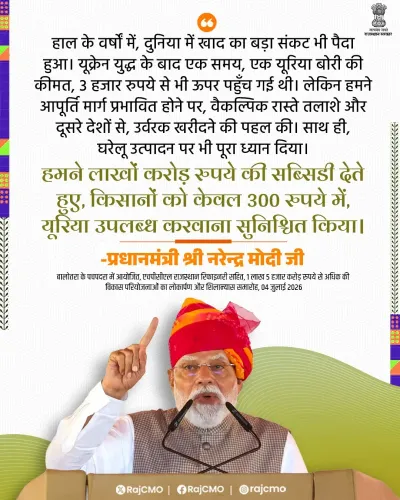
Global urea prices reportedly crossed Rs 3,000 per bag during the Ukraine conflict; India held the retail price at Rs 300 per bag for farmers.
The government channelled lakhs of crores of rupees in subsidies to bridge the gap between global and domestic urea prices.
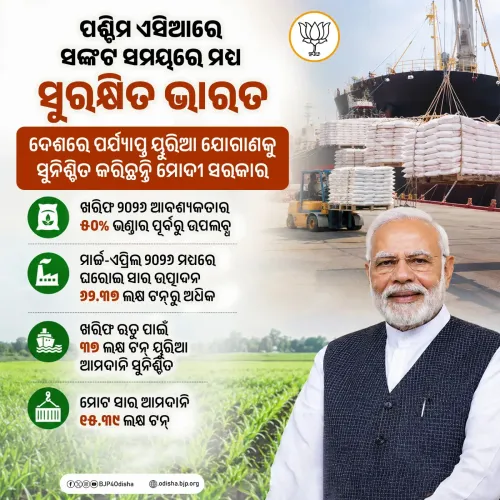
India diversified fertilizer procurement through its embassy network and accelerated domestic production when global supply chains were disrupted.
The government also promoted natural farming as a sustainable alternative and enforced strict measures against hoarding and black-marketing .
The post is framed as a tribute to Prime Minister Narendra Modi , signalling a political communication effort around agricultural welfare.
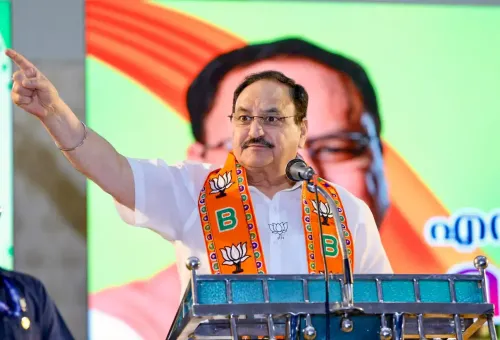
Union Health Minister and BJP national president J. P. Nadda on Saturday, 4 July 2026, highlighted the Narendra Modi government's measures to protect Indian farmers from the fertilizer supply shocks triggered by global conflicts, citing the Ukraine war, the West Asia crisis, and unrest in the Gulf region as the primary drivers of international price volatility.
Context
In the post, Nadda attributed the global fertilizer shortage to three overlapping crises: the Russia-Ukraine war, the West Asia conflict, and instability in the Gulf region. He stated that during the Ukraine war, the price of a single bag of urea on the global market had climbed to over ₹3,000 rupaye [more than Rs 3,000 per bag]. Despite that, he said, the Indian government provided the same urea to farmers at just Rs 300 per bag by channelling what he described as lakhs of crores of rupees in subsidies.
The post is framed as a tribute to Prime Minister Narendra Modi, closing with the phrase 'Aadarniya Pradhanmantri Shri @narendramodi ji' [Honourable Prime Minister Shri Narendra Modi]. It was accompanied by a video, suggesting a campaign-style communication around agricultural welfare.
Policy Backdrop
India has maintained an administratively fixed retail price for urea for decades, with the difference between the market rate and the controlled price absorbed by the central government through the Urea Subsidy Programme under the Ministry of Chemicals and Fertilizers. The Nutrient Based Subsidy Scheme, introduced in 2010, extended a per-nutrient subsidy framework to phosphatic and potassic fertilizers while keeping urea under full price control.
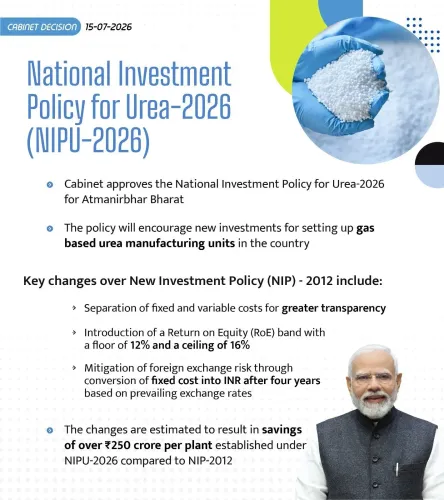
After 2015, the government revived several shuttered urea manufacturing plants and introduced a New Investment Policy to expand domestic production capacity. A nationwide Direct Benefit Transfer system for fertilizers was rolled out in 2016-17 to reduce diversion and improve targeting of subsidies to actual cultivators.
When the 2022 Ukraine conflict disrupted global fertilizer supply chains — Russia and Belarus together account for a large share of global potash exports, and Ukraine and Russia are major urea exporters — India accelerated procurement through diplomatic channels, diversifying sourcing across multiple countries via its embassy network, according to the post.
Stakeholders and Impact
The primary beneficiaries cited are Indian farmers, who depend heavily on urea for paddy, wheat, and sugarcane cultivation. Fertilizer importers and domestic manufacturers also figure in the policy calculus, as the government simultaneously pushed to raise domestic production to reduce import dependence — a goal aligned with the broader Atmanirbhar Bharat framework.
Nadda also noted that the government promoted natural farming as a sustainable alternative and took strict action against hoarding and black-marketing of fertilizers during the supply crunch, steps that directly affect rural retail supply chains and district-level enforcement machinery.
India's fertilizer subsidy bill has been one of the largest line items in the Union Budget in recent years, reflecting the scale of fiscal commitment required to hold retail prices steady against global volatility. The approach mirrors the government's response to the 2011-12 Arab Spring-era commodity spike, but at a significantly larger fiscal scale given the duration and breadth of post-2022 disruptions.
What's Next
Attention will now turn to the next Union Budget for the fertilizer subsidy allocation and any new import diversification agreements that may be formalised. Progress on nano-urea plant capacity — seen as a longer-term strategy to reduce conventional urea demand — and the scaling of state-level natural farming programmes will be closely watched as indicators of whether India can structurally reduce its exposure to global fertilizer price shocks rather than absorbing them through subsidy each cycle.
Point of View
000), the BJP is framing its subsidy expenditure not as a fiscal burden but as a protective shield, a framing that has proven effective in agrarian belts. The reference to diplomatic procurement through embassies and domestic production revival also feeds the Atmanirbhar Bharat narrative, positioning India as strategically resilient rather than merely reactive. As fertilizer subsidy allocations come under scrutiny in future budgets, this kind of pre-emptive communication builds public justification for continued high spending on agricultural inputs.
NationPress
3 Oct 2026
Frequently Asked Questions
Why is urea so cheap in India compared to global prices?
India fixes the retail price of urea through a central government subsidy programme, with the difference between the global market rate and the Rs 300 per bag retail price absorbed by the Union Budget. During the Ukraine war, this subsidy gap widened sharply as global urea prices rose steeply.
How did the Ukraine war affect fertilizer prices in India?
The Ukraine-Russia conflict disrupted global supply chains for urea and other fertilizers, pushing international prices sharply higher. India managed the impact through increased subsidies, diplomatic procurement from alternative supplier countries, and a push to expand domestic production.
What is India's urea subsidy programme?
India's urea subsidy programme is a central government scheme under the Ministry of Chemicals and Fertilizers that keeps the retail price of urea administratively fixed at around Rs 300 per bag. The government pays manufacturers and importers the difference between the actual cost and the controlled price.
What is the Nutrient Based Subsidy scheme?
The Nutrient Based Subsidy scheme, launched in 2010, provides a fixed per-nutrient subsidy on phosphatic and potassic fertilizers. Urea remains under separate full price control and is not covered under this scheme.
What is natural farming and why is the Indian government promoting it?
Natural farming refers to chemical-input-free agricultural practices that rely on locally available biological inputs. The government promotes it as a sustainable alternative to reduce dependence on imported fertilizers and to lower input costs for farmers over the long term.