Rijiju: Cabinet OKs ₹14,448 Cr Varanasi Elevated Corridor
Synopsis
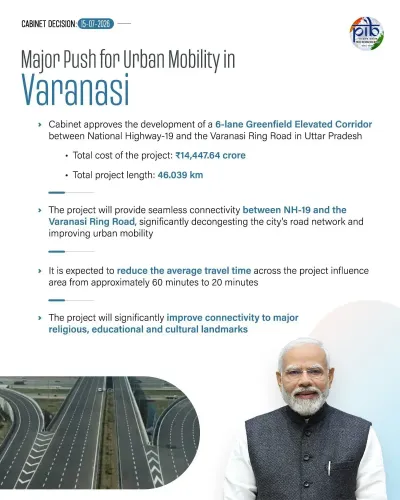
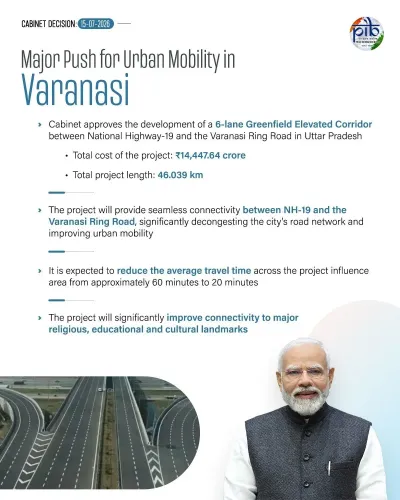
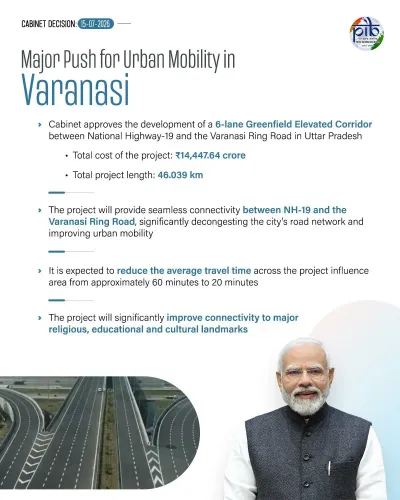
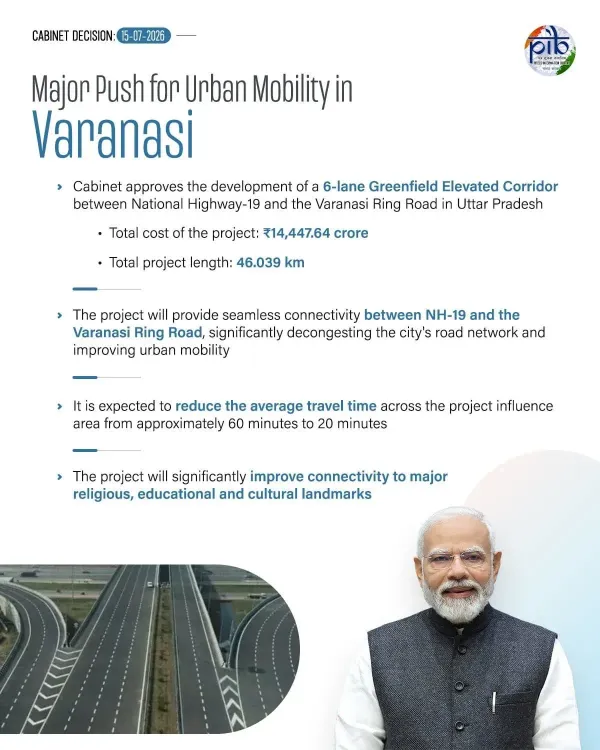
The Union Cabinet has approved a 6-lane Greenfield Elevated Corridor between NH-19 and the Varanasi Ring Road in Uttar Pradesh at ₹14,447.64 crore under the Hybrid Annuity Model, as announced by Parliamentary Affairs Minister Kiren Rijiju on 16 July 2026.
Key Takeaways
The Union Cabinet approved a 6-lane Greenfield Elevated Corridor linking National Highway-19 and the Varanasi Ring Road in Uttar Pradesh .
The total capital cost is ₹14,447.64 crore , to be funded under the NH(O) budget head.
The project will be executed on the Hybrid Annuity Model , sharing financial risk between the government and private developers.
The corridor includes ramps, loops, and foot overbridges in addition to the main elevated carriageway.
The approval was announced by Union Minister Kiren Rijiju on 16 July 2026 under the hashtag #CabinetDecisions .
NHAI is expected to manage tendering and land acquisition, which will determine the project's implementation timeline.
Union Parliamentary Affairs Minister Kiren Rijiju announced on Thursday, 16 July 2026 that the Union Cabinet, chaired by Prime Minister Narendra Modi, has approved the development of a 6-lane Greenfield Elevated Corridor connecting National Highway-19 and the Varanasi Ring Road in Uttar Pradesh, at a total capital cost of ₹14,447.64 crore under the Hybrid Annuity Model (HAM).
Context
The approved project encompasses not just the elevated corridor itself but also ramps, loops, and foot overbridges, making it a comprehensive urban-connectivity package for one of India's most congested arterial stretches. The funding will flow through NH(O) — the stand-alone national highway operations budget — rather than the main Bharatmala Pariyojana umbrella, a mechanism the government has used for targeted connectivity works. Rijiju described the decision as being taken under the 'visionary leadership' of the Prime Minister.
Varanasi, the ancient city in eastern Uttar Pradesh, is also the parliamentary constituency of PM Modi, and has been a consistent recipient of central infrastructure investment since 2014. The corridor is designed to ease movement between the national highway network and the ring road that encircles the city.
Policy Backdrop
The Hybrid Annuity Model was formally adopted by the Ministry of Road Transport and Highways in 2016 to distribute construction and traffic risk between the government and private developers. Under HAM, the government pays a portion of project costs as annuity during construction and operations, while the developer raises the rest, reducing the immediate burden on the exchequer. It has since become the preferred route for large-ticket elevated corridors and bypasses across India.
National Highway-19 — formerly designated NH-2 — is a critical artery of the Golden Quadrilateral network, linking Delhi to Kolkata and passing through the heart of Uttar Pradesh. The Varanasi Ring Road Phase-I received in-principle approval as far back as 2018 as part of broader efforts to decongest the city. The latest cabinet decision marks a significant financial commitment to that long-gestating vision.
Uttar Pradesh has consistently received a large share of Bharatmala-era highway approvals, reflecting both the state's population density and its strategic importance to the national road network. Successive Union Cabinets have used HAM to accelerate construction timelines while limiting upfront fiscal outgo.
Stakeholders and Impact
The most immediate beneficiaries will be Varanasi's daily commuters and freight operators who currently navigate severe congestion at the NH-19 junction points leading into and out of the city. The elevated corridor, with its dedicated ramps and loops, is intended to allow through-traffic to bypass surface-level bottlenecks entirely. Foot overbridges included in the design signal an attempt to integrate pedestrian safety into the project.
Private highway developers and construction firms will be eligible to bid under the HAM framework, which has historically attracted strong participation from mid-to-large infrastructure companies. The National Highways Authority of India (NHAI) is expected to oversee tendering and land acquisition, both of which will determine how quickly ground-level work can begin.
What's Next
The immediate milestones to watch are the tendering schedule to be issued by NHAI and the pace of land acquisition along the corridor alignment. Land acquisition has historically been the single biggest source of delay for urban elevated road projects in Uttar Pradesh. Progress updates could surface during the next session of Parliament, where the Ministry of Road Transport and Highways routinely fields questions on project timelines. If procurement moves swiftly, the ₹14,447.64 crore project could serve as a template for similar greenfield elevated corridors on other congested national highway stretches across the country.
Point of View
447.64 crore elevated corridor in Varanasi fits a well-established pattern: large HAM-funded highway packages in politically significant constituencies that also carry genuine infrastructure need. The choice of NH(O) funding rather than Bharatmala allocation gives the project administrative flexibility but also places it outside the stricter oversight framework of that programme. For the BJP government, the announcement is a high-visibility infrastructure win in the Prime Minister's own constituency ahead of what remains a competitive political calendar in Uttar Pradesh. The real test will be land acquisition speed — the perennial chokepoint for urban elevated corridors in the state — and whether NHAI can issue tenders within the fiscal year.
NationPress
16 Jul 2026
Frequently Asked Questions
What is the Varanasi Greenfield Elevated Corridor project approved by the Cabinet?
The Union Cabinet approved a 6-lane Greenfield Elevated Corridor, including ramps, loops, and foot overbridges, connecting National Highway-19 and the Varanasi Ring Road in Uttar Pradesh at a total cost of ₹14,447.64 crore.
What is the Hybrid Annuity Model used for this highway project?
The Hybrid Annuity Model (HAM) is a public-private partnership framework introduced in 2016 where the government pays a portion of project costs as annuity instalments, while the private developer finances the rest, reducing upfront government expenditure.
Why is Varanasi receiving so many central infrastructure projects?
Varanasi is the parliamentary constituency of Prime Minister Narendra Modi and has been a priority recipient of central infrastructure investment since 2014, including highway, waterway, and urban renewal projects.
What is NH-19 and why does it matter for Varanasi?
National Highway-19, formerly NH-2, is a key artery of the Golden Quadrilateral network linking Delhi to Kolkata. It passes through Uttar Pradesh and is a major source of traffic congestion at Varanasi's city limits.
Who announced the Cabinet approval of the Varanasi corridor?
Union Parliamentary Affairs Minister and senior BJP leader Kiren Rijiju announced the Cabinet decision on 16 July 2026 via a post on X under the hashtag #CabinetDecisions.