Rijiju: Cabinet Clears Semicon 2.0 at ₹1,27,500 Cr
Synopsis
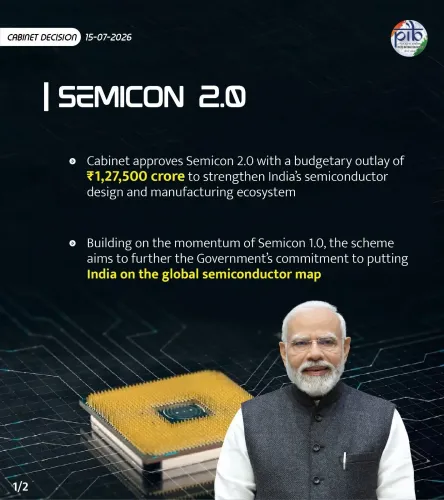
The Union Cabinet chaired by PM Modi has approved Semicon 2.0, committing ₹1,27,500 crore to build India's semiconductor design and manufacturing ecosystem — a major escalation from the ₹76,000 crore Semicon India programme launched in 2021.
Key Takeaways
The Union Cabinet , chaired by PM Narendra Modi , approved Semicon 2.0 on 16 July 2026 .
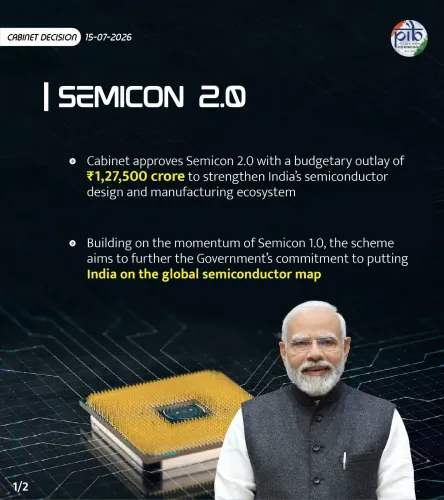
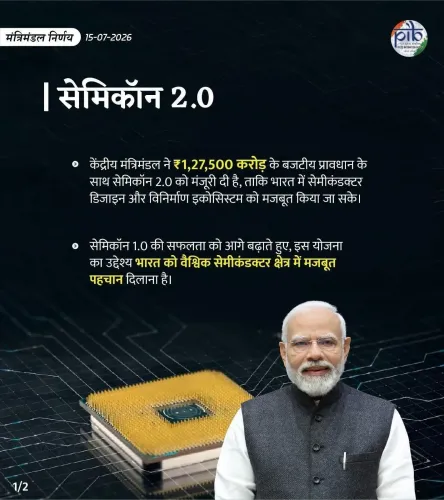
The programme carries a total budget outlay of ₹1,27,500 crore , covering semiconductor design and manufacturing.
This is a significant increase over the ₹76,000 crore committed under the original Semicon India programme approved in December 2021 .
The approval was announced by Union Parliamentary Affairs Minister Kiren Rijiju as part of #CabinetDecisions .
The programme targets end-to-end chip capabilities — design, fabrication, and assembly — to reduce India's dependence on imported semiconductors.
Project-level approvals for fabrication plants and global foundry partnerships are expected in the months ahead.
Union Parliamentary Affairs Minister Kiren Rijiju announced on Thursday, 16 July 2026 that the Union Cabinet, chaired by Prime Minister Narendra Modi, has approved Semicon 2.0 — a comprehensive programme for India's semiconductor design and manufacturing ecosystem — with a total budget outlay of ₹1,27,500 crore.
Context
Rijiju, posting on X, described the Cabinet decision as 'a major boost to India's semiconductor ecosystem.' The approval of Semicon 2.0 marks a significant escalation in the government's ambition to build end-to-end chip capabilities on Indian soil, covering both design and manufacturing. The announcement was part of a broader set of Cabinet decisions taken at Wednesday's meeting.
The ₹1,27,500 crore outlay is a substantial step up from the ₹76,000 crore committed under the original Semicon India programme approved in December 2021, which had set out to establish semiconductor and display manufacturing facilities across the country.
Policy Backdrop
India's semiconductor push began in earnest in 2021 under the India Semiconductor Mission (ISM), itself part of the broader Atmanirbhar Bharat framework championed by PM Modi. The ISM provided design-linked incentives, support for fabrication units, and backing for assembly, testing, marking and packaging (ATMP) facilities.
Successive Cabinet approvals since then have sought to attract global chipmakers and build domestic capacity, responding to worldwide chip shortages that exposed the risks of heavy dependence on East Asian supply chains. Semicon 2.0 represents the next generational push in that policy lineage, with a significantly larger financial commitment signalling a more mature and expansive programme architecture.
Stakeholders and Impact
The programme is expected to benefit a wide range of actors — from global chip manufacturers and electronics firms seeking to diversify production bases, to domestic startups working in semiconductor design. India's growing consumer electronics, automotive, defence and telecommunications sectors are all heavily dependent on imported chips, making domestic capacity a strategic priority.
For Arunachal Pradesh and other frontier states, improved electronics manufacturing capacity also carries national security implications, as reliable domestic chip supply underpins defence electronics. Broader industrial clusters in states such as Gujarat, Telangana, Karnataka and Tamil Nadu — which have already attracted semiconductor-adjacent investments — stand to gain from expanded incentive structures under the new programme.
What's Next
The Cabinet approval sets the policy and financial framework; project-level clearances for individual fabrication plants, design centres and assembly units are expected to follow in the coming months. Partnerships with global foundries and further announcements on specific facility locations will be closely watched by the industry. The scale of the ₹1,27,500 crore commitment signals that the government intends Semicon 2.0 to be a decade-defining industrial programme, positioning India as a credible node in global semiconductor supply chains.
Point of View
27,500 crore — nearly 68 percent larger than the 2021 programme — signals that the Modi government is doubling down on semiconductor self-reliance as a core pillar of industrial policy, not merely a crisis-response to global chip shortages. The escalating outlay reflects both the lessons absorbed from the first phase of the India Semiconductor Mission and an intensifying geopolitical calculus around supply-chain resilience. By anchoring the announcement in a Cabinet decision rather than a sectoral ministry note, the government is signalling whole-of-government ownership. Whether execution matches ambition will depend on how quickly project-level approvals and global foundry partnerships materialise.
NationPress
14 Oct 2026
Frequently Asked Questions
What is Semicon 2.0 India?
Semicon 2.0 is a Union Cabinet-approved programme to develop India's semiconductor design and manufacturing ecosystem, with a total budget outlay of ₹1,27,500 crore. It was approved on 16 July 2026 under the chairmanship of PM Narendra Modi and builds on the earlier Semicon India programme launched in 2021.
What is the budget of Semicon 2.0?
The Union Cabinet has approved a total outlay of ₹1,27,500 crore for Semicon 2.0. This is higher than the ₹76,000 crore committed under the original Semicon India programme approved in December 2021.
What was India's earlier semiconductor scheme?
India's earlier semiconductor initiative was the Semicon India programme, approved by the Union Cabinet in December 2021 with an outlay of ₹76,000 crore. It aimed to establish semiconductor and display manufacturing facilities and was administered through the India Semiconductor Mission.
Who announced Semicon 2.0 Cabinet approval?
Union Parliamentary Affairs Minister Kiren Rijiju announced the Cabinet approval of Semicon 2.0 on X on 16 July 2026, describing it as 'a major boost to India's semiconductor ecosystem.'
Why is India investing in semiconductor manufacturing?
India is investing in semiconductor manufacturing to reduce its heavy dependence on imported chips, integrate into global supply chains, and respond to the risks exposed by worldwide chip shortages concentrated in East Asia. Domestic chip capacity also has strategic importance for defence electronics and the broader Atmanirbhar Bharat initiative.