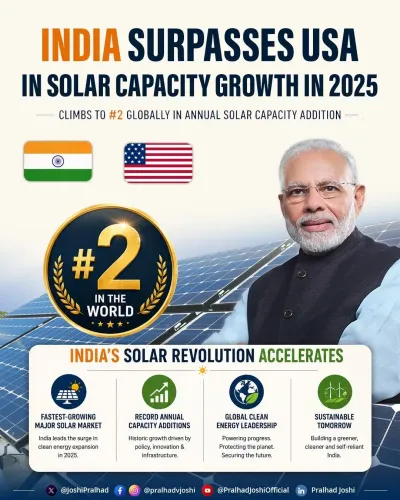
Kishan Reddy: India overtakes US as world's No. 2 solar market
Synopsis
Union Coal and Mines Minister G. Kishan Reddy announced on 17 June 2026 that India has surpassed the United States to become the world's second-largest solar market, citing a 30.7 GW achievement under PM Modi's leadership and the government's commitment to sustainable development.
Key Takeaways
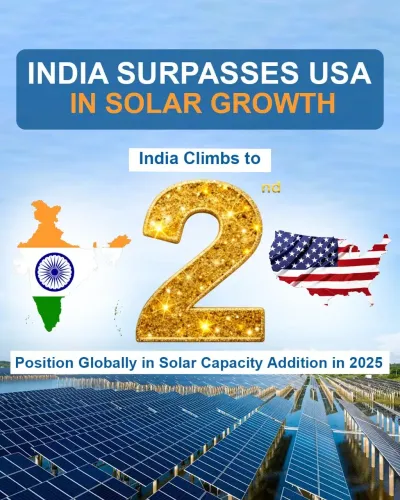
Kishan Reddy , Union Minister of Coal and Mines, announced on 17 June 2026 that India has overtaken the United States to become the world's second-largest solar market.
The minister cited a figure of 30.7 GW as the milestone reflecting this achievement.
India's solar expansion is anchored in a national target of 500 GW of non-fossil fuel capacity by 2030 , as committed under updated NDCs in 2022 .
The Jawaharlal Nehru National Solar Mission , launched in 2010 , was a foundational policy that set and later expanded India's solar targets.
Official verification of the ranking and capacity figure is expected from MNRE ; the claim has not yet been independently confirmed.
The milestone, if validated, could strengthen India's position in international climate negotiations ahead of COP31 .
Union Coal and Mines Minister G. Kishan Reddy on Wednesday, 17 June 2026 declared that India has overtaken the United States to become the world's second-largest solar market, citing an installed capacity milestone of 30.7 GW added in the current cycle. The minister attributed the achievement to the leadership of Prime Minister Narendra Modi and described it as a landmark in India's clean-energy journey.
Context
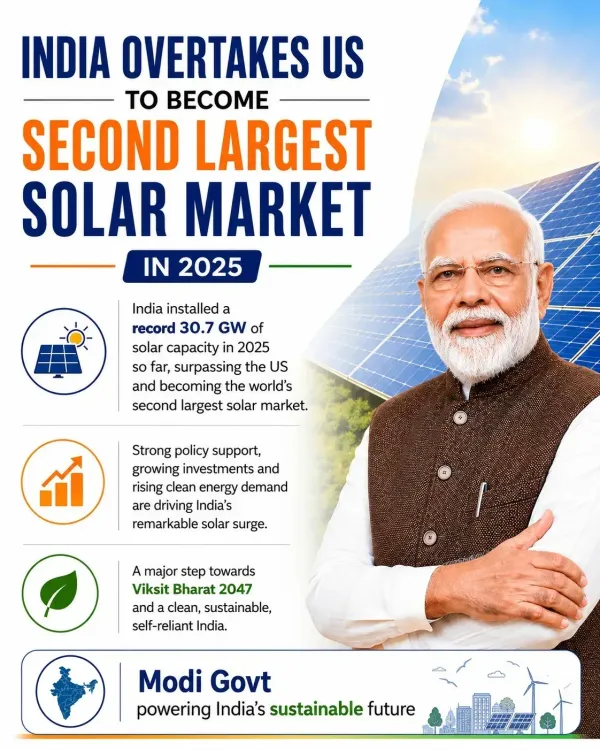
In his post on X, Kishan Reddy wrote that 'India's solar surge reaches a historic high, overtaking the US to become the world's second-largest solar market,' adding that 'this landmark achievement of 30.7 GW reflects the Modi Government's commitment to sustainable development and a cleaner planet.' The claim positions India ahead of the United States in cumulative or annual solar additions, a ranking that, if confirmed by official data from the Ministry of New and Renewable Energy (MNRE), would mark a significant shift in the global clean-energy order.
India's solar sector has expanded at a rapid clip since 2014, driven by falling tariffs, production-linked incentive schemes for domestic manufacturing, and the country's international commitments under the Paris Agreement. The Jawaharlal Nehru National Solar Mission, originally launched in 2010 with a target of 20 GW by 2022, was later revised to 100 GW — a signal of how quickly ambitions scaled alongside deployment.
Policy Backdrop
India updated its Nationally Determined Contributions (NDCs) in 2022, committing to sourcing 50 per cent of cumulative electric power capacity from non-fossil fuel sources by 2030. The broader target of 500 GW of non-fossil fuel capacity by 2030 places solar at the centre of the country's energy transition strategy. Achieving a global ranking of second in solar installations would serve as a visible marker of progress toward that goal.
Kishan Reddy, who also serves as BJP Telangana state president, has been a consistent voice on the government's energy transition record, frequently highlighting milestones in renewable capacity addition. His ministry oversees coal — still India's dominant power source — making his emphasis on solar growth a reflection of the government's stated intent to balance energy security with climate commitments.
Stakeholders and Impact
The claim, if validated by official MNRE data, carries significant implications for renewable energy developers, state electricity utilities, and international climate finance institutions that track India's clean-energy trajectory. A confirmed second-place global ranking would strengthen India's negotiating position ahead of COP31 and could attract fresh foreign investment into the sector.
For domestic consumers and state discoms, accelerated solar deployment has historically correlated with competitive tariff discovery — solar auction prices in India have repeatedly set global benchmarks. A surge in installed capacity also supports grid stability objectives, though integration challenges for utilities remain a structural concern.
What's Next
Analysts and policymakers will watch for the release of updated cumulative solar capacity figures from MNRE to independently verify the 30.7 GW figure and the precise ranking versus the United States. Any upward revision of India's 2030 non-fossil fuel targets — possible ahead of COP31 — would further cement the policy momentum that ministers like Kishan Reddy are now publicly highlighting. India's ability to sustain this pace of capacity addition while managing grid integration and domestic manufacturing scale-up will define whether the second-place ranking becomes a durable position or a momentary milestone.
Point of View
Ahead of what is likely to be a COP31 year in which India wants to project climate credibility. The choice of a coal minister to trumpet a solar record is itself notable: it speaks to the government's effort to present the energy transition as a unified policy rather than a contradiction. However, the 30.7 GW figure and the precise US-India ranking comparison await MNRE verification, and the gap between political proclamation and audited data has historically mattered in India's renewable energy discourse. If confirmed, the milestone would mark a genuine structural shift in global solar geography — one that would carry weight in both investment and diplomatic circles.
NationPress
17 Sept 2026
Frequently Asked Questions
Has India really become the world's second-largest solar market?
Union Minister G. Kishan Reddy claimed on 17 June 2026 that India has overtaken the United States to become the world's second-largest solar market, citing 30.7 GW; official confirmation from MNRE is awaited to verify the figure and ranking.
What is India's solar energy target for 2030?
India has committed to achieving 500 GW of non-fossil fuel capacity by 2030 , with solar power as the largest component, as part of its updated Nationally Determined Contributions submitted in 2022.
What is the Jawaharlal Nehru National Solar Mission?
The Jawaharlal Nehru National Solar Mission is India's flagship solar policy, launched in 2010 with an initial target of 20 GW by 2022, later revised to 100 GW — it laid the policy foundation for India's current solar scale-up.
Who is G. Kishan Reddy?
G. Kishan Reddy is India's Union Minister of Coal and Mines and the BJP's Telangana state president; he is a senior BJP leader who frequently communicates the Modi government's energy and development record.
Which country is currently the world's largest solar market?
China is widely recognised as the world's largest solar market by installed capacity; the post by Kishan Reddy claims India has now moved into second place, ahead of the United States.