Kishan Reddy hails India as world's No. 2 solar additions market

Synopsis
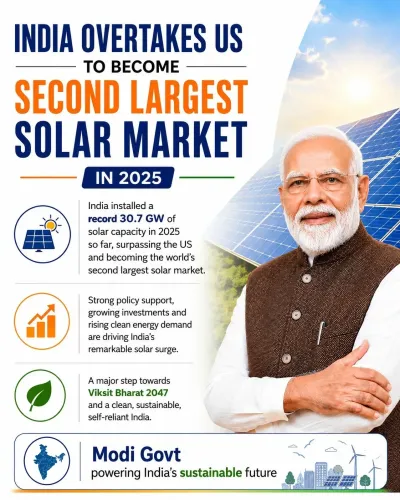
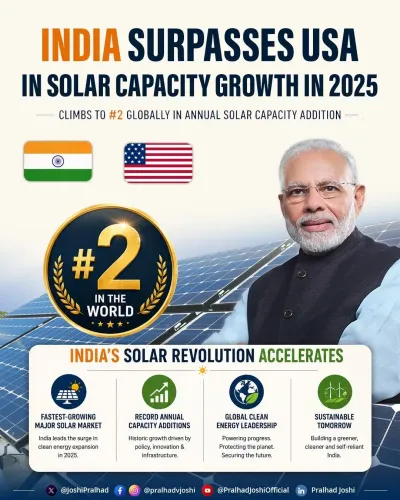
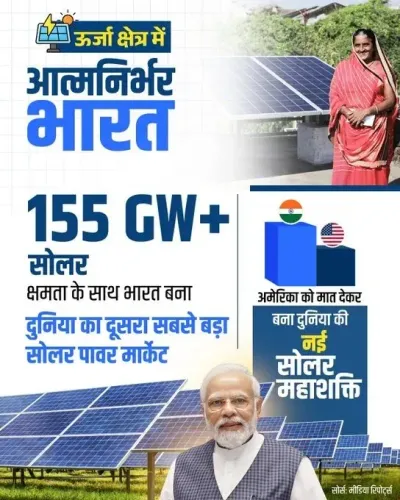
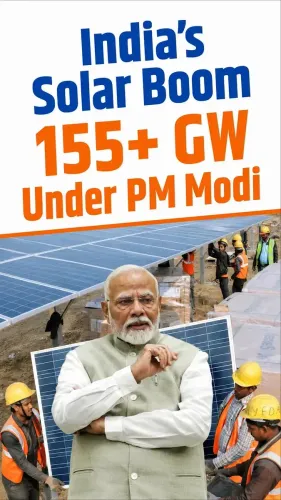
Union Coal and Mines Minister G. Kishan Reddy announced on X that India has crossed 150 GW of solar capacity and surpassed the United States as the world's second-largest market for annual solar additions in 2025, crediting Prime Minister Narendra Modi's leadership for the clean-energy push.
Key Takeaways
Kishan Reddy says India has crossed 150 GW of installed solar capacity.
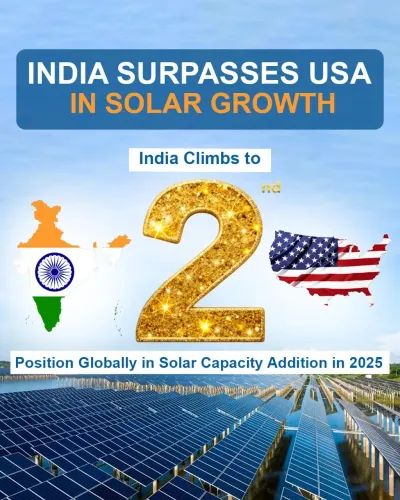
India has overtaken the United States as the world's second-largest market for annual solar additions in 2025 , per the minister.
The minister credited PM Narendra Modi's leadership and used the hashtag #IndiaRanks2InSolar .
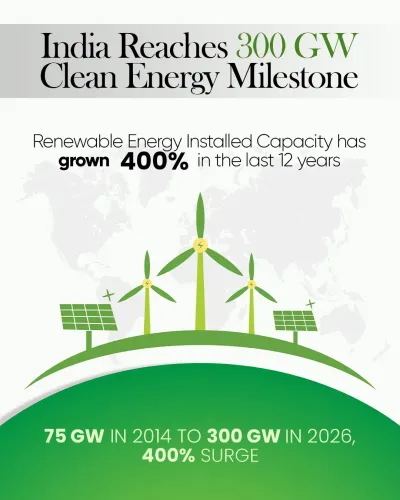
India is targeting 500 GW of non-fossil installed capacity by 2030 , announced at COP26 .
Solar growth is anchored in the National Solar Mission (2010) and the India-led International Solar Alliance (2015).
Union Coal and Mines Minister G. Kishan Reddy on Wednesday declared that India has crossed 150 GW of installed solar capacity and overtaken the United States to become the world's second-largest market for annual solar additions in 2025. In a post on X, the minister credited Prime Minister Narendra Modi's leadership for what he described as a national 'solar revolution' powering clean energy, energy security and sustainable growth.
'India's solar revolution is shining brighter than ever,' Kishan Reddy wrote, adding that Bharat (India) is 'setting new benchmarks in clean energy, energy security, and sustainable growth'. The post used the hashtag #IndiaRanks2InSolar and was accompanied by a short video highlighting the country's renewable energy trajectory.
Context
The minister's statement places solar firmly at the centre of the government's energy narrative, even as Kishan Reddy himself holds the Coal and Mines portfolio — sectors traditionally seen as counterweights to renewables. The framing positions the clean-energy push as complementary to, rather than in competition with, India's continued reliance on coal for baseload power.
Kishan Reddy, who also serves as BJP Telangana state president, has frequently linked the energy transition to broader development goals. His emphasis on India outpacing the United States in annual solar additions echoes a wider government messaging arc that casts the country as a global clean-energy leader.
Policy backdrop
India's solar journey formally began with the Jawaharlal Nehru National Solar Mission, launched in 2010, which was later scaled up to a 100 GW solar target by 2022 as part of a broader 175 GW renewable goal aligned with the 2015 Paris Agreement. At COP26, Prime Minister Modi announced a non-fossil fuel installed capacity target of 500 GW by 2030, of which solar is expected to be the single largest contributor.
Successive policy interventions — including solar parks, production-linked incentives for domestic module manufacturing, rooftop solar schemes and concessional financing — have underpinned the capacity build-out. India also anchored the International Solar Alliance, launched in 2015, to mobilise investment and technology across sunshine-rich countries.
Stakeholders and impact
Rapid solar additions affect a wide spectrum of stakeholders. Renewable developers benefit from a deeper project pipeline and clearer demand signals, while state distribution companies face the twin task of integrating variable solar power and managing legacy thermal contracts.
Coal-bearing regions, many of which fall within Kishan Reddy's ministerial remit, are watching the pace of transition closely. The government has consistently maintained that coal will remain part of the energy mix in the near term to ensure affordability and grid reliability, even as solar and wind capacity expands.
Domestic manufacturers of solar cells and modules, backed by production-linked incentives, are positioned to gain from scaling deployment, while consumers stand to benefit from declining tariffs over time as competitive bidding pushes solar prices lower.
What's next
Attention now turns to whether the government will unveil fresh measures on solar manufacturing, battery storage and grid integration in the upcoming parliamentary session. Storage in particular is emerging as the critical missing link to convert daytime solar surpluses into round-the-clock clean power.
Parliamentary questions on renewable capacity milestones and the trajectory toward the 500 GW non-fossil target by 2030 are also expected. With Kishan Reddy's post setting a triumphal tone, the political stakes around meeting — and publicising — each capacity milestone are likely to intensify in the run-up to global climate negotiations later this year.
Point of View
Signalling that the energy transition and conventional energy can coexist within the government's narrative. By benchmarking India against the United States, the framing taps into a broader 'Bharat as global leader' arc that has defined the Modi government's foreign-facing pitch. The real test, however, lies in firming up storage, grid and manufacturing capacity to sustain these additions toward the 500 GW non-fossil target by 2030. Expect each capacity milestone to be increasingly politicised as climate diplomacy intensifies.
NationPress
20 Oct 2026
Frequently Asked Questions
What did Kishan Reddy say about India's solar capacity?
Union Coal and Mines Minister G. Kishan Reddy said India has crossed 150 GW of solar capacity and surpassed the United States as the world's second-largest market for annual solar additions in 2025. He credited Prime Minister Narendra Modi's leadership for the achievement.
What is India's solar capacity target by 2030?
India is targeting 500 GW of non-fossil fuel installed capacity by 2030, announced by Prime Minister Narendra Modi at COP26. Solar is expected to be the single largest contributor to this goal.
When was India's National Solar Mission launched?
The Jawaharlal Nehru National Solar Mission was launched in 2010 to accelerate solar deployment across grid, off-grid and rooftop segments. It was later revised upward to a 100 GW solar target by 2022.
What is the International Solar Alliance?
The International Solar Alliance is an India-led multilateral platform launched in 2015 to mobilise solar investment and technology among sunshine-rich countries. It is co-anchored with France and headquartered in India.
Which portfolio does G. Kishan Reddy hold?
G. Kishan Reddy serves as the Union Minister of Coal and Mines. He is also the BJP Telangana state president.