Gujarat CM Bhupendra Patel Hails India's Solar Power Surge
Synopsis
Gujarat Chief Minister Bhupendra Patel has called India's emergence as the world's second-largest solar growth market and its lead over the United States in annual capacity additions a moment of national pride, crediting Prime Minister Narendra Modi's reforms, policies and infrastructure push for the country's clean energy transformation.
Key Takeaways
Gujarat CM Bhupendra Patel called India's rise as the world's 2nd largest solar growth market 'a matter of immense pride'.
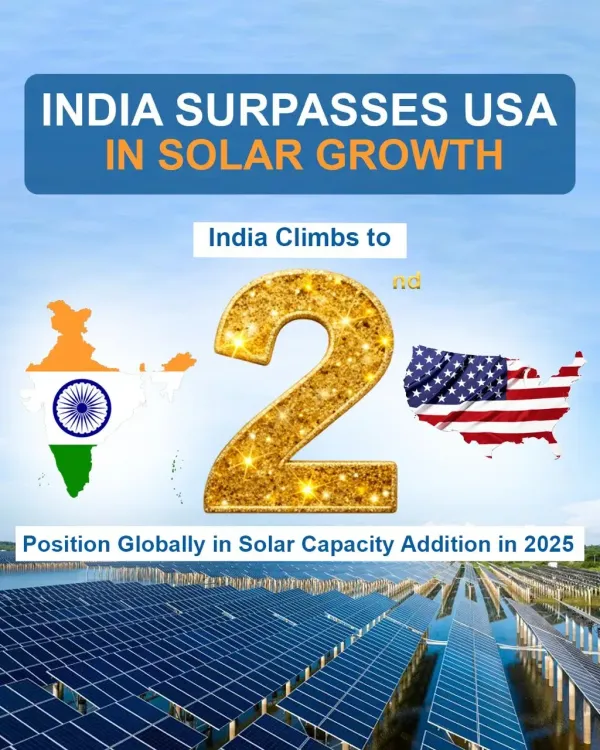
He said India has surpassed the USA in annual solar capacity additions.
Patel credited PM Narendra Modi's reforms, policies and infrastructure push for the clean energy transformation.
India's solar journey is anchored in the National Solar Mission (2010) and the International Solar Alliance (2015).
India is targeting 500 GW of non-fossil fuel capacity by 2030, announced at COP26.
Gujarat hosts some of India's earliest and largest solar parks.
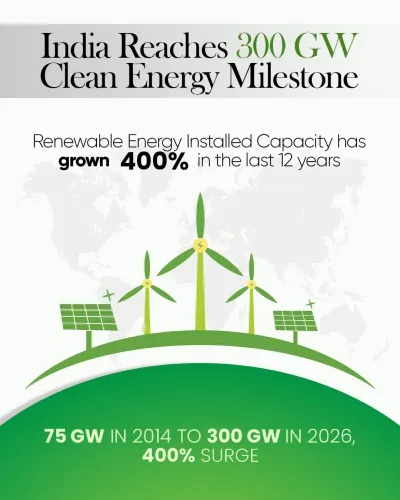
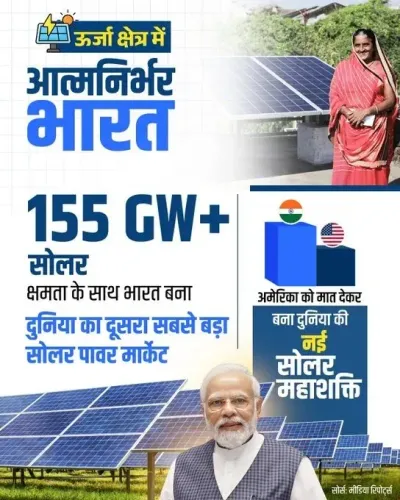
Gujarat Chief Minister Bhupendra Patel on Wednesday hailed India's emergence as the world's second-largest solar growth market, describing the country's reported lead over the United States in annual solar capacity additions as a moment of national pride. In a post on X, the BJP leader credited Prime Minister Narendra Modi's policy push for the transformation of India's clean energy landscape.
'India's rise as the world's 2nd largest solar growth market and its achievement in surpassing the USA in annual solar capacity additions is a matter of immense pride for every Indian,' the Chief Minister wrote. He added that the milestone 'strengthens India's energy security, advances sustainable growth and reinforces our position as a global leader in renewable energy,' tagging the post with #IndiaRanks2InSolar, #CleanEnergy and #RenewableEnergy.
Context
Patel's intervention frames the solar achievement as a direct outcome of what he called 'bold reforms, future-ready policies, technological innovation and world-class infrastructure' pursued under the Modi government. The Chief Minister, who heads a state that pioneered utility-scale solar parks in India, has consistently positioned Gujarat's renewable build-out as a template for the national clean-energy push.
The post comes amid sustained government messaging on India's energy transition, with senior BJP leaders highlighting renewable milestones as evidence of policy continuity from the centre down to the states.
Policy backdrop
India's solar trajectory traces back to the National Solar Mission, launched in 2010 under the National Action Plan on Climate Change, which initially set a target of 20 GW of solar capacity by 2022 before being revised sharply upward. At the COP21 summit in 2015, India pledged 100 GW of solar capacity by 2022 and co-launched the International Solar Alliance, a treaty-based grouping aimed at scaling solar deployment in sun-rich countries.
At COP26 in 2021, Prime Minister Modi raised the ambition further, committing India to 500 GW of non-fossil fuel capacity by 2030. Successive auction rounds, viability gap funding and grid infrastructure programmes administered by the Ministry of New and Renewable Energy have anchored the expansion.
Stakeholders and impact
The growth has implications for a wide spectrum of actors. Domestic solar developers stand to benefit from a deeper pipeline of projects, while power consumers — both industrial and household — gain from the long-term decline in renewable tariffs that competitive bidding has produced.
For Gujarat, which hosts some of India's earliest and largest solar parks, the national headline reinforces the state's pitch to manufacturers of solar modules, cells and balance-of-system equipment. The state's renewable policies have repeatedly been cited by the central government as a working model for other states.
At the geopolitical level, the comparison with the United States on annual capacity additions places India alongside China and the European Union as one of the principal markets driving the global energy transition, even as questions remain on financing, land acquisition and domestic manufacturing of upstream components.
What's next
Attention now turns to the next round of central solar and hybrid capacity auctions, as well as state-level policy refreshes — including in Gujarat — that will determine whether the pace of additions can be sustained. Progress reports ahead of COP31 are expected to provide an updated reading on India's path to the 500 GW non-fossil target.
For the BJP, leaders such as Patel are likely to keep amplifying renewable energy milestones as a core plank of the Modi government's development narrative, linking climate commitments to jobs, energy security and India's standing in global forums.
Point of View
The Gujarat CM extends a familiar template — pairing climate credentials with strategic positioning against the United States and China. The sharper test will be domestic: whether India can match capacity additions with upstream manufacturing, grid integration and land-acquisition reforms before the 500 GW deadline of 2030.
NationPress
20 Oct 2026
Frequently Asked Questions
What did Gujarat CM Bhupendra Patel say about India's solar ranking?
Patel said India's rise as the world's second-largest solar growth market and its lead over the USA in annual solar capacity additions is 'a matter of immense pride for every Indian'. He credited PM Modi's reforms and policies for the transformation.
Has India really surpassed the USA in solar capacity additions?
Patel's post claims India has surpassed the USA in annual solar capacity additions and now ranks as the second-largest solar growth market globally. The Chief Minister cited this as the basis for his statement on national energy progress.
What is India's solar energy target?
India has committed to 500 GW of non-fossil fuel capacity by 2030, a target announced by Prime Minister Narendra Modi at the COP26 summit in 2021. This built on an earlier 100 GW solar pledge made at COP21 in 2015.
What is the International Solar Alliance?
The International Solar Alliance is a treaty-based organisation launched by India in 2015 to promote solar energy deployment in sun-rich countries. It is one of the cornerstones of India's global climate diplomacy.
Why is Gujarat important to India's solar story?
Gujarat was among the first Indian states to develop utility-scale solar parks and dedicated solar policies, contributing significantly to early national capacity growth. The state continues to be a hub for solar generation and increasingly for module and cell manufacturing.