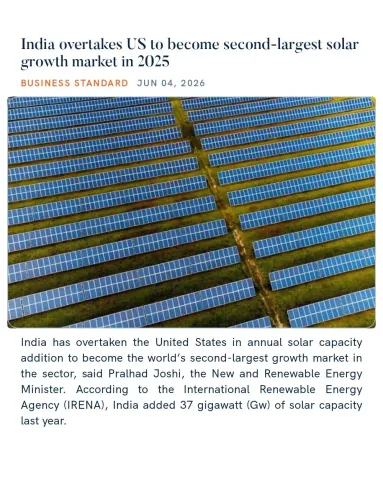
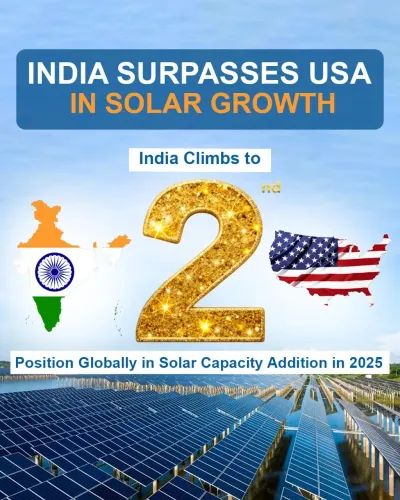
Bhupender Yadav: India is now world's 2nd-largest solar market

Synopsis
Union Environment Minister Bhupender Yadav announced that India has become the world's second-largest solar market, overtaking the United States in annual solar capacity additions in 2025. He linked the milestone to the country's broader clean-energy push, anchored in the Jawaharlal Nehru National Solar Mission and the 500 GW non-fossil target pledged at COP26.
Key Takeaways
Union Environment Minister Bhupender Yadav announced India is now the world's 2nd-largest solar market.
He said India overtook the United States in annual solar capacity additions in 2025.
The claim builds on India's 500 GW non-fossil capacity pledge for 2030, made at COP26 in 2021.
Policy lineage includes the Jawaharlal Nehru National Solar Mission (2010) and PM-KUSUM (2019).
The International Solar Alliance, headquartered in Gurugram, anchors India's solar diplomacy.
Next milestone: capacity data and manufacturing incentives expected around the 2026-27 Union Budget.
Union Environment Minister Bhupender Yadav on June 3, 2026 said India has emerged as the world's second-largest solar market, asserting that the country has overtaken the United States in annual solar capacity additions in 2025. The minister framed the milestone as evidence of India's accelerating clean-energy transition and the maturing of its solar infrastructure.
'India has emerged as the world's 2nd-largest solar market, overtaking the US in annual solar capacity additions in 2025,' Yadav wrote, adding that the achievement 'reflects the nation's rapid clean energy growth helping ensure efficient, reliable, and sustainable solar infrastructure.' He tagged the post with the hashtag #IndiaRanks2InSolar.
Context
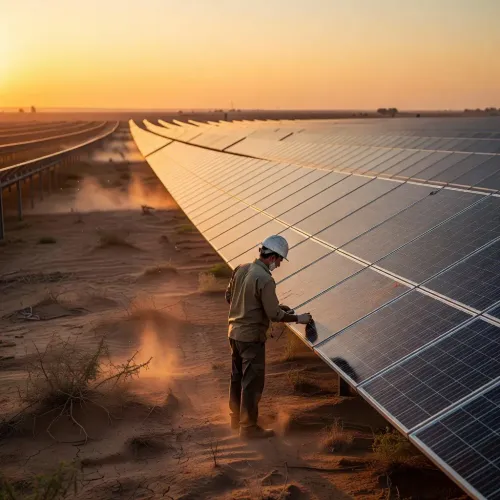
The minister's claim positions India behind only China in annual solar deployment, a ranking that — if borne out by year-end official data — would mark a significant shift in the global renewables league table. The United States has historically been among the top three solar markets, propelled by federal tax credits and utility-scale build-outs.
Yadav, a senior BJP leader who holds the portfolio for Environment, Forest and Climate Change, has repeatedly used the solar story to anchor the government's climate narrative both at home and at multilateral forums.
Policy backdrop
India's solar push traces back to the Jawaharlal Nehru National Solar Mission, launched in 2010 with an initial target of 20 GW that was later scaled up sharply. The mission has been supplemented by the PM-KUSUM scheme notified in 2019 for decentralised solar installations serving farmers, and by Production Linked Incentive support for domestic module and cell manufacturing.
At COP26 in Glasgow in 2021, Prime Minister Narendra Modi committed India to 500 GW of non-fossil-fuel electricity capacity by 2030 and net-zero emissions by 2070. The International Solar Alliance, co-founded by India and France in 2015 and headquartered in Gurugram, has served as the diplomatic vehicle for mobilising global solar finance and technology cooperation.
The nodal Ministry of New and Renewable Energy oversees capacity targets, tendering frameworks and subsidy disbursement, working in coordination with state electricity distribution companies that ultimately sign power-purchase agreements.
Stakeholders and impact
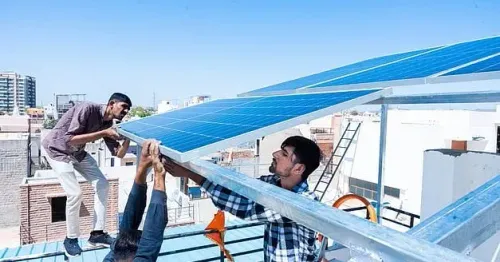
Rising capacity additions matter for a wide spectrum of actors. Solar developers benefit from larger project pipelines and reduced module costs, while state discoms gain access to competitively priced power that can offset volatile thermal tariffs. Farmers under PM-KUSUM and rooftop consumers stand to gain from distributed generation.
For the broader economy, sustained solar growth supports India's Paris Agreement commitments and reduces dependence on imported fossil fuels — a strategic concern given persistent crude-oil import bills. Domestic manufacturers of modules, cells and inverters are also positioned to scale under the PLI framework, although the sector continues to navigate concerns around import dependence on solar cells and polysilicon.
The growth trajectory mirrors comparable renewable scale-ups in China and the United States, but India's mix is distinctive for its combined emphasis on utility-scale parks, rooftop installations and agricultural feeders.
What's next
Watchers of the sector will look to renewable-capacity figures released around the 2026-27 Union Budget for an official tally of additions, as well as any fresh manufacturing incentives announced under the Production Linked Incentive scheme. The government's ability to sustain the pace required to reach the 500 GW non-fossil target by 2030 will depend on land acquisition, transmission build-out and discom financial health.
For Yadav, the post signals that the Centre intends to make solar leadership a recurring talking point in India's climate diplomacy through the remainder of the decade — including at upcoming COP negotiations where developing-country mitigation ambition remains a contested theme.
Point of View
Which depends on transmission readiness, discom solvency and continued module-manufacturing scale-up. Expect the solar story to feature prominently in the government's 2026-27 Budget communications.
NationPress
20 Oct 2026
Frequently Asked Questions
Is India now the world's second-largest solar market?
Union Environment Minister Bhupender Yadav has stated that India has become the world's second-largest solar market by overtaking the United States in annual solar capacity additions in 2025. Independent confirmation will come with full-year capacity tallies.
What is India's 2030 renewable energy target?
India has committed to 500 GW of non-fossil-fuel electricity capacity by 2030, a pledge made by Prime Minister Narendra Modi at the COP26 summit in Glasgow in 2021. The country has also targeted net-zero emissions by 2070.
What is the Jawaharlal Nehru National Solar Mission?
It is a central government programme launched in 2010 to scale up solar power in India, initially targeting 20 GW of solar capacity by 2022. The target was later revised upward as part of India's larger 100 GW renewable goal.
What does the PM-KUSUM scheme do?
PM-KUSUM, notified in 2019, supports decentralised solar installations for farmers, including solar pumps and grid-connected solar plants on agricultural land. It is part of the Ministry of New and Renewable Energy's distributed solar push.
Who is Bhupender Yadav?
Bhupender Yadav is the Union Minister of Environment, Forest and Climate Change and a senior BJP leader. He represents the Government of India at major global climate negotiations.