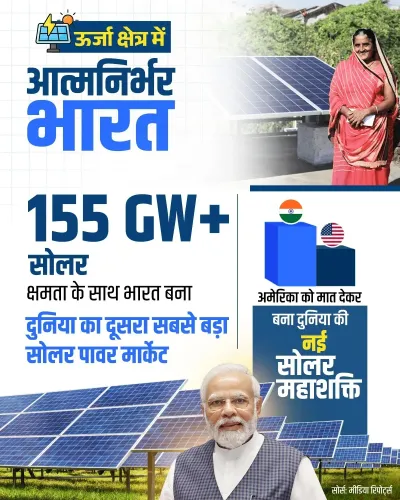
Shekhawat: India Overtakes US as No. 2 Solar Market in 2025

Synopsis
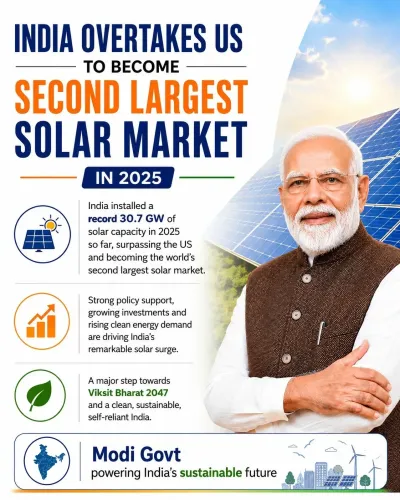
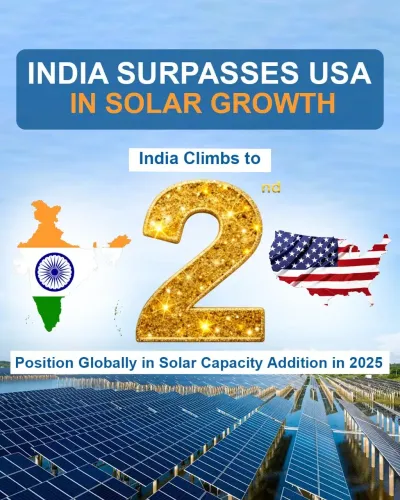
Union Culture and Tourism Minister Gajendra Singh Shekhawat said India has overtaken the United States to become the world's second-largest solar market in 2025, adding nearly 50 GW of new capacity in a single year, and credited Prime Minister Narendra Modi's leadership for the clean-energy push.
Key Takeaways
Shekhawat said India became the world's second-largest solar market in 2025, behind only China.
He pegged new solar capacity additions at nearly 50 GW in a single year.
The minister credited Prime Minister Narendra Modi's leadership for the renewables momentum.
India has committed to 500 GW non-fossil fuel capacity by 2030 and net-zero by 2070.
The National Solar Mission was launched in 2010; a PLI scheme for solar manufacturing was notified in 2021.
The post carried the hashtag #IndiaRanks2InSolar.
Union Culture and Tourism Minister Gajendra Singh Shekhawat on Wednesday said India has become the world's second-largest solar market in 2025, surpassing the United States in annual capacity additions. In a post on X, the senior BJP leader and Lok Sabha MP from Jodhpur said nearly 50 GW of new solar capacity was added in a single year, crediting Prime Minister Narendra Modi's leadership for the milestone.
'India is now a super solar power too,' Shekhawat wrote, asserting that the country had 'left the United States behind' in annual solar capacity growth in 2025. He added, in translation, that 'under Modi ji's leadership there is no place for negativity' and that preparations for 'sustainable renewable energy capacity and a self-reliant, clean and green future' were complete. He tagged the post #IndiaRanks2InSolar.
Context
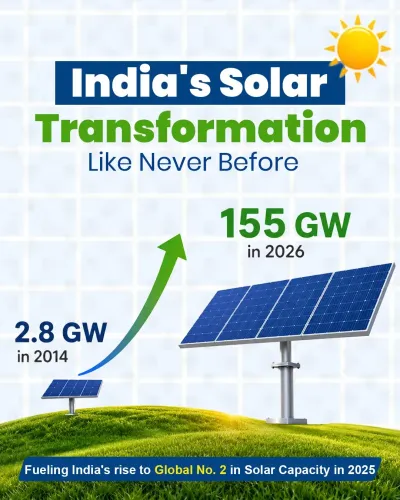
The minister's claim positions India behind only China in fresh annual solar deployments, a leap from the mid-2010s when the country was adding roughly 3-4 GW a year. The post was accompanied by a short video and carried no link to an external dataset, with Shekhawat framing the development as evidence of accelerating clean-energy momentum.
Shekhawat, who handles the Culture and Tourism portfolio at the Centre, frequently amplifies cross-sectoral government achievements on social media. His intervention on a renewables milestone underscores how the ruling party is folding energy-transition data points into its broader governance narrative ahead of state-level political cycles.
Policy backdrop
India's solar push traces back to the National Solar Mission, launched in 2010 under the National Action Plan on Climate Change, whose initial 20 GW target was later revised upward to 100 GW by 2022. At COP26 in 2021, Prime Minister Modi committed India to 500 GW of non-fossil fuel capacity by 2030 and net-zero emissions by 2070.
To reduce reliance on imported modules, the Centre notified a Production Linked Incentive scheme for solar manufacturing in 2021, encouraging integrated polysilicon-to-module units. Alongside, India and France co-founded the International Solar Alliance in 2015 to mobilise finance and technology among sun-rich member states.
Stakeholders and impact
Rapid capacity additions of the scale Shekhawat described would have direct implications for solar developers, state distribution companies and rural households connected through rooftop and agricultural feeder schemes. Falling tariffs at central auctions and rising renewable purchase obligations on state discoms have been the main demand levers in recent years.
Domestic manufacturers stand to benefit from sustained deployment if module sourcing rules continue to favour locally produced cells and panels. Conversely, grid operators face the task of integrating large volumes of variable generation, an issue that has pushed policy attention toward battery storage tenders and transmission build-out.
What's next
Attention will turn to the next quarterly capacity update from the Ministry of New and Renewable Energy, which typically breaks down utility-scale, rooftop and hybrid additions by state. Upcoming state budgets are also expected to revisit renewable purchase obligations and rooftop subsidy structures.
If the annual run-rate flagged by Shekhawat is sustained, India's trajectory toward the 500 GW non-fossil target by 2030 would shorten materially, sharpening the political contest over who claims credit for the energy transition and intensifying scrutiny of grid readiness, land acquisition and module-supply resilience.
Point of View
With a culture minister amplifying an energy-transition milestone to reinforce the ruling party's governance pitch. The framing fits a longer arc in which renewables data is increasingly used as political currency alongside infrastructure and welfare metrics. If the 50 GW figure holds up in official audits, it accelerates India's path to the 500 GW non-fossil goal and reshapes the credit-claiming contest among Centre and states. The watchpoint is whether grid, storage and manufacturing build-out keep pace with the headline capacity numbers.
NationPress
23 Sept 2026
Frequently Asked Questions
What did Gajendra Singh Shekhawat say about India's solar capacity?
Shekhawat said India became the world's second-largest solar market in 2025 by overtaking the United States in annual additions, with nearly 50 GW of new capacity added in a single year.
Is India now the second-largest solar market in the world?
According to Shekhawat's post, India ranked second globally in annual solar capacity additions in 2025, behind China and ahead of the United States.
What is India's renewable energy target for 2030?
India has committed to achieving 500 GW of installed non-fossil fuel electricity capacity by 2030, a pledge announced by Prime Minister Narendra Modi at COP26 in 2021.
What is the National Solar Mission?
The National Solar Mission is a central government programme launched in 2010 under the National Action Plan on Climate Change to scale up grid-connected solar power, with targets revised upward over time to 100 GW by 2022.
How is India boosting domestic solar manufacturing?
India notified a Production Linked Incentive scheme for solar manufacturing in 2021 to encourage integrated polysilicon-to-module units and cut dependence on imported cells and panels.