Goyal hails India's No. 2 global rank in 2025 solar additions
Synopsis
Union Commerce and Industry Minister Piyush Goyal announced that India ranked second globally in annual solar capacity additions in 2025, calling it a milestone in the country's clean energy journey. He credited PM Narendra Modi's leadership and linked the achievement to India's 500 GW non-fossil target by 2030 and broader energy-security goals.
Key Takeaways
Piyush Goyal said India ranked second globally in annual solar capacity additions in 2025.
The minister credited PM Narendra Modi's leadership and the government's sustained renewable energy push.
India has pledged 500 GW of non-fossil-fuel capacity by 2030, announced at COP26 in Glasgow.
The National Solar Mission, launched in 2010, anchors the country's solar policy framework.
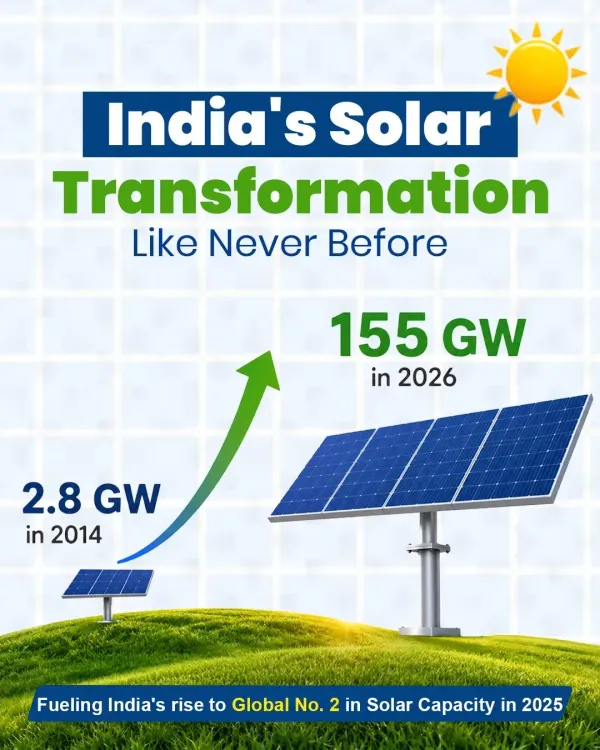
The post was shared with the hashtag #IndiaRanks2InSolar and three accompanying creatives.
Union Commerce and Industry Minister Piyush Goyal on Wednesday, 3 June 2026 said India ranked second globally in annual solar capacity additions in 2025, calling it 'another milestone in India's clean energy journey'. In a post on X, the senior BJP leader credited the achievement to the sustained policy push under Prime Minister Narendra Modi and linked it to the government's broader renewable energy and energy-security agenda.
'Under the leadership of PM Narendra Modi ji, India ranked second globally in annual solar capacity additions in 2025,' Goyal wrote, adding that the milestone 'reflects the Modi Government's sustained efforts to expand renewable energy capacity, strengthen energy security and advance India's commitment to meeting its clean energy goals'. The post, accompanied by three creatives and the hashtag #IndiaRanks2InSolar, was shared from his official handle.
Context
Goyal's claim positions India among the world's largest annual solar markets, a status the country has been steadily climbing toward over the past decade. The minister did not specify the absolute capacity added during the calendar year or the country that took the top slot, but framed the ranking as evidence of policy continuity.
Solar power has emerged as the fastest-growing segment of India's electricity mix, driven by falling module prices, competitive utility-scale auctions and a parallel push on domestic manufacturing through production-linked incentives.
Policy backdrop
India's solar journey is anchored in the National Solar Mission, launched in 2010 with an initial target of 20 GW of solar capacity by 2022. That target was revised sharply upward at COP21 in Paris in 2015, when India pledged 175 GW of renewable capacity by 2022, including 100 GW of solar.
At COP26 in Glasgow in 2021, Prime Minister Modi unveiled the Panchamrit (five nectar elements) climate pledges, committing India to 500 GW of non-fossil-fuel electricity capacity by 2030, sourcing 50 per cent of its electricity from renewables by the same year, and reaching net-zero emissions by 2070.
Successive budgets have reinforced this trajectory through viability gap funding for offshore and battery storage projects, the PM Surya Ghar rooftop scheme, and incentives for solar module and cell manufacturing.
Stakeholders and impact
The announcement is significant for solar developers, renewable energy financiers and equipment manufacturers, who have been scaling investments in line with the government's central targets. A higher global ranking strengthens India's pitch to international climate finance and to multilateral platforms such as the International Solar Alliance, co-founded by India and headquartered in Gurugram.
For consumers and state distribution utilities, accelerated solar additions have implications for tariff trajectories, grid balancing and the pace of coal-fired generation retirements. For the Ministry of New and Renewable Energy, sustaining the current pace is essential to staying on track for the 2030 milestone.
Politically, the post fits a familiar pattern of senior ministers using social media to spotlight quantifiable wins in flagship programmes, reinforcing the government's narrative on climate leadership ahead of the next round of United Nations climate negotiations.
What's next
Attention will turn to forthcoming quarterly capacity updates from the Ministry of New and Renewable Energy and to any revised interim trajectory the Centre may announce on the road to COP31. Project pipelines in Rajasthan, Gujarat and Karnataka — the leading solar states — will be closely watched, alongside progress on transmission corridors needed to evacuate large blocks of renewable power.
If the pace of 2025 is sustained, India's claim to global clean-energy leadership will increasingly rest on execution: integrating storage, expanding rooftop adoption and ensuring that domestic manufacturing keeps step with deployment.
Point of View
Designed to consolidate the Modi government's image as a credible climate actor at a moment when global capital is increasingly tied to clean-energy credentials. The framing — ranking, leadership, commitment — connects a single data point to a longer policy arc stretching from the National Solar Mission to the Panchamrit pledges. The political subtext is continuity: a reminder that India's energy transition is being delivered through central planning rather than market drift. The real test, however, lies in whether annual additions can be sustained at the scale required to hit 500 GW by 2030.
NationPress
17 Oct 2026
Frequently Asked Questions
What did Piyush Goyal say about India's solar ranking?
Piyush Goyal said India ranked second globally in annual solar capacity additions in 2025, calling it a milestone in the country's clean energy journey. He credited PM Narendra Modi's leadership and the government's sustained renewable energy push.
What is India's renewable energy target for 2030?
India has committed to 500 GW of non-fossil-fuel electricity capacity by 2030. The pledge was announced by PM Narendra Modi at the COP26 climate summit in Glasgow in 2021 as part of the Panchamrit commitments.
What is the National Solar Mission?
The National Solar Mission is a central government scheme launched in 2010 to promote grid-connected and off-grid solar power across India. Its capacity targets have been revised upward several times, most notably to 100 GW solar under the 2015 Paris commitments.
When did India announce its net-zero target?
India announced its net-zero by 2070 target at the COP26 summit in Glasgow in 2021. The commitment was part of PM Modi's five-point Panchamrit climate pledges, which also included 50% renewable electricity by 2030.
Which ministry tracks India's solar capacity additions?
The Ministry of New and Renewable Energy tracks India's solar capacity additions and publishes periodic updates on installed capacity. It oversees implementation of central schemes including the National Solar Mission and rooftop solar programmes.