Rijiju: India Adds 37 GW Solar in 2025, Overtakes US to Rank 2nd

Synopsis
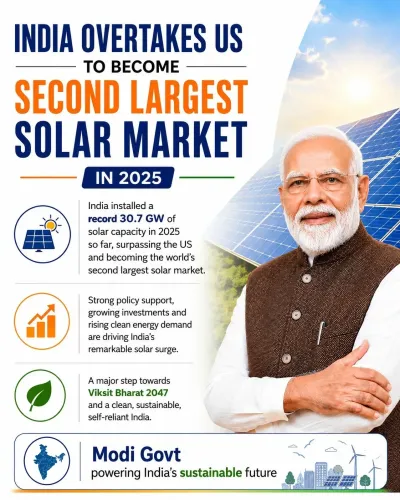
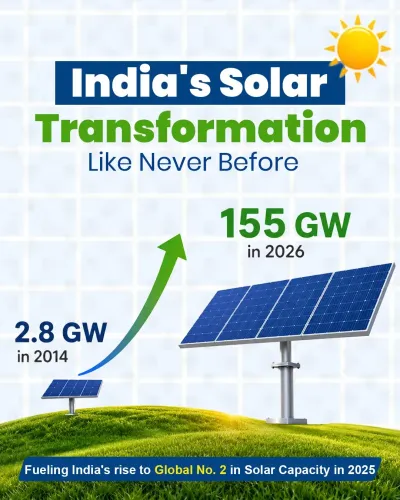
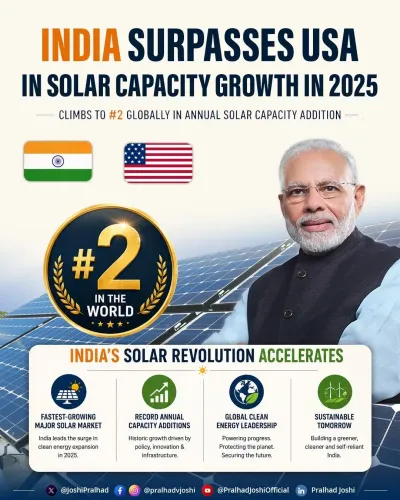
Union Parliamentary Affairs Minister Kiren Rijiju announced that India added over 37 GW of solar capacity in 2025, becoming the world's second-largest market for annual solar additions and overtaking the United States. He credited Prime Minister Narendra Modi's vision for the milestone, which strengthens India's push towards its 500 GW non-fossil capacity target by 2030.
Key Takeaways
India added over 37 GW of solar capacity in 2025 , according to Union Minister Kiren Rijiju.
The country became the world's second-largest market for annual solar additions, ahead of the United States .
China continues to lead globally on annual solar capacity additions.
The milestone is tied to India's 500 GW non-fossil fuel capacity target by 2030 .
Growth has been supported by solar parks, rooftop schemes and PLI manufacturing incentives.
Official confirmation is expected in the year-end report from the Ministry of New and Renewable Energy.
Union Parliamentary Affairs Minister Kiren Rijiju on 3 June 2026 announced that India had added over 37 GW of solar capacity in 2025, propelling the country to the position of the world's second-largest market for annual solar additions and moving it ahead of the United States. The statement, posted on X, credited the milestone to the vision of Prime Minister Narendra Modi and underscored what the minister described as fresh heights for the country's clean energy journey.
In his post, the minister wrote that 'India's clean energy journey continues to reach new heights' and that, guided by the Prime Minister's vision, the country had become the world's number two market for annual solar additions, surpassing the United States. He accompanied the message with the hashtag #IndiaRanks2InSolar.
Context
Kiren Rijiju, a senior BJP leader from Arunachal Pradesh, holds the portfolios of Parliamentary Affairs and Minority Affairs in the Union Council of Ministers. His remarks slot into a broader pattern of cabinet-level messaging that frames renewable energy expansion as a signature achievement of the Modi government.
The reference to overtaking the United States in annual solar additions positions India behind only China, which has long led the global league table on new solar capacity. Annual additions are distinct from cumulative installed capacity, where the US still retains a larger overall base than India.
Policy backdrop
India's solar push traces back to the Jawaharlal Nehru National Solar Mission, launched in 2010 and revised in 2014-15, which set an initial target of 100 GW of solar by 2022. That goal was later folded into a broader 175 GW renewable energy target for the same year.
The current overarching commitment is 500 GW of non-fossil fuel electricity capacity by 2030, a target the government has tied to its longer-term pledge of net-zero emissions by 2070 under the Paris Agreement framework. In 2015, India also co-launched the International Solar Alliance to promote solar deployment across member countries, particularly in the global south.
Domestic policy support has come through utility-scale solar parks, rooftop solar programmes, viability gap funding, and production-linked incentives for solar module and cell manufacturing under the Atmanirbhar Bharat framework.
Stakeholders and impact
The ranking, if confirmed by year-end data from the Ministry of New and Renewable Energy, has direct implications for solar developers, equipment manufacturers and renewable energy investors who have been ramping up capacity in states such as Rajasthan, Gujarat, Karnataka and Andhra Pradesh.
Faster annual additions also matter for electricity distribution companies that must integrate intermittent solar generation, and for industrial consumers seeking long-term green power contracts. A higher build rate strengthens India's negotiating position in international climate forums, where developing economies have pressed for both finance and recognition of mitigation progress.
For households, sustained solar growth is expected to influence rooftop adoption schemes and grid tariffs over the medium term, while creating jobs in installation, operations and manufacturing clusters.
What's next
Attention will turn to the official year-end 2025 capacity report from the Ministry of New and Renewable Energy, which is expected to formally confirm the addition figure and the country-wise ranking. Any revision of the 2030 solar target ahead of COP31 would further signal the government's near-term ambition.
If the second-place ranking holds, it will likely be cited extensively in India's climate diplomacy and in domestic political messaging as the government continues to position clean energy as a pillar of economic and strategic policy.
Point of View
Even as cumulative capacity gaps with both the US and China remain wide. The framing also sets the stage for India's pitch at COP31, where developing economies are pressing for climate finance commensurate with their mitigation pace. The political utility is real, but the harder test lies in grid integration, storage capacity and domestic manufacturing depth.
NationPress
19 Sept 2026
Frequently Asked Questions
How much solar capacity did India add in 2025?
India added over 37 GW of solar capacity in 2025, according to Union Minister Kiren Rijiju's announcement on X.
Is India now the second largest solar market in the world?
Yes, in terms of annual solar additions for 2025, India is now ranked second globally, ahead of the United States and behind China, as stated by Union Minister Kiren Rijiju.
What is India's solar energy target for 2030?
India aims to reach 500 GW of non-fossil fuel electricity capacity by 2030, with solar power forming the largest share of that goal.
Which country leads the world in annual solar additions?
China continues to lead the world in annual solar capacity additions by a significant margin, with India now in the second position.
What government schemes support India's solar growth?
India's solar expansion is backed by utility-scale solar parks, rooftop solar programmes, viability gap funding and production-linked incentives for module and cell manufacturing under the Atmanirbhar Bharat framework.