Rijiju Highlights India's Solar Power Leap Under Modi

Synopsis
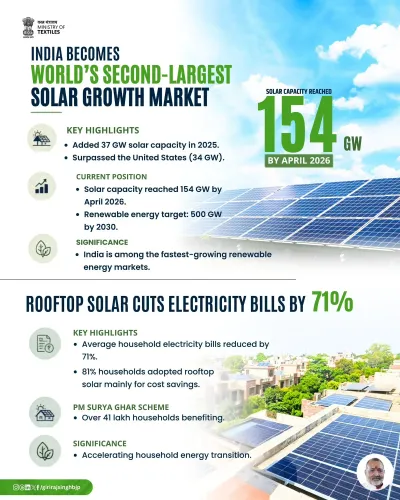
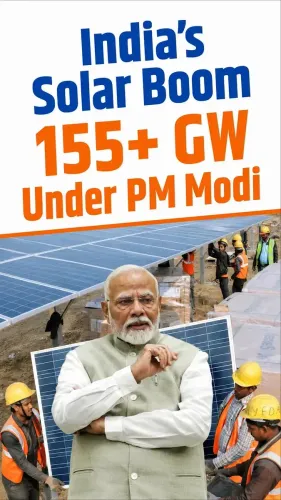
Union Parliamentary Affairs Minister Kiren Rijiju has highlighted India's solar energy milestone, citing a rise from 2.8 GW in 2014 to 155 GW in 2026 under PM Modi. Over 40 lakh homes are now solar-powered, and farmers are being positioned as energy producers through central schemes.
Key Takeaways
India's installed solar capacity has grown from 2.8 GW in 2014 to 155 GW in 2026 , according to Minister Rijiju's post.
Over 40 lakh households across India are now powered by solar energy.
The PM-KUSUM scheme (approved 2019) enables farmers to install solar plants and sell surplus power to the grid.
India co-founded the International Solar Alliance with France in 2015, headquartered in Gurugram.
At COP26 in 2021 , India pledged 500 GW of non-fossil fuel capacity by 2030 and net-zero by 2070.
Parliamentary debates on the next phase of renewable targets are expected in the forthcoming budget session.
Union Parliamentary Affairs Minister Kiren Rijiju on Saturday, June 6, 2026, highlighted India's solar energy transformation over the past 12 years, citing a rise in installed capacity from 2.8 GW in 2014 to 155 GW in 2026 under Prime Minister Narendra Modi's leadership.
Context
Rijiju posted in Hindi, stating: '12 साल: सौर ऊर्जा में भारत की उपलब्धि बेमिसाल!' ('12 years: India's achievement in solar energy is unparalleled!'). He credited Modi's 'visionary leadership' for what he described as unprecedented progress in the solar sector. The post also noted that over 40 lakh households across the country are now powered by solar energy.
Rijiju further highlighted a shift in the role of farmers, writing that the Indian farmer is becoming not just a provider of food (annadaata) but also a provider of energy (urjadaata) — a reference to schemes enabling farmers to generate and sell solar power.
Policy Backdrop
India's solar push has deep policy roots. The Jawaharlal Nehru National Solar Mission, launched in 2010 under the National Action Plan on Climate Change, set an initial target of 20 GW by 2022, later revised to 100 GW during the 2015 revision. The country has since far exceeded that benchmark.
The PM-KUSUM scheme, approved in 2019, has been central to empowering farmers with decentralised solar infrastructure — allowing them to install solar pumps and grid-connected plants and sell surplus electricity. At COP26 in 2021, India committed to 500 GW of non-fossil fuel energy capacity by 2030 and net-zero emissions by 2070.
India co-founded the International Solar Alliance with France in 2015, headquartered in Gurugram, to champion solar adoption globally — reinforcing its position as a leader in the clean energy transition.
Stakeholders and Impact
The most direct beneficiaries of this expansion are rural households and farmers. Rooftop solar schemes have brought electricity access to communities previously dependent on unreliable grid supply, while PM-KUSUM has given the agricultural sector a new income stream through energy generation.
India's aggressive scaling of solar capacity also serves its broader energy security goals, reducing dependence on fossil fuel imports and helping manage rising domestic electricity demand. The expansion aligns with India's Paris Agreement commitments and its stated climate targets.
What's Next
Attention will now turn to the forthcoming budget session of Parliament, where debates on the next phase of renewable energy targets and potential updates to rooftop solar subsidy schemes are expected. India's trajectory toward its 500 GW non-fossil fuel target by 2030 will require sustained policy momentum and capital deployment at scale.
Rijiju's post signals the ruling dispensation's intent to keep solar energy expansion as a flagship governance narrative heading into the second half of the decade.
Point of View
Tying rural welfare to clean energy in a way that speaks to both the farmer vote bank and India's international climate commitments. The milestone also reinforces India's positioning within the International Solar Alliance as a credible leader of the global south's energy transition. Whether the 155 GW figure and 40-lakh household claim withstand scrutiny from independent energy analysts will determine how much political capital the ruling party can extract from this narrative.
NationPress
19 Sept 2026
Frequently Asked Questions
What is India's current solar energy capacity in 2026?
According to Union Minister Kiren Rijiju's post on June 6, 2026, India's installed solar capacity has reached 155 GW, up from 2.8 GW in 2014. These figures are cited from the minister's official communication and should be verified against the latest Ministry of New and Renewable Energy reports.
What is the PM-KUSUM scheme and how does it help farmers?
PM-KUSUM (Pradhan Mantri Kisan Urja Suraksha evam Utthan Mahabhiyan) is a central government scheme approved in 2019 that allows farmers to install solar pumps and grid-connected solar plants on their land, enabling them to generate electricity and sell surplus power to the grid for additional income.
How many homes in India run on solar energy?
Minister Rijiju stated that over 40 lakh (4 million) households across India are now powered by solar energy, reflecting the expansion of rooftop solar and off-grid solar schemes over the past decade.
What is India's renewable energy target by 2030?
At the COP26 climate summit in 2021, India committed to achieving 500 GW of non-fossil fuel energy capacity by 2030 and reaching net-zero carbon emissions by 2070.
What is the International Solar Alliance and who founded it?
The International Solar Alliance is an intergovernmental organisation co-founded by India and France in 2015 to promote solar energy adoption globally. Its headquarters are located in Gurugram, India.