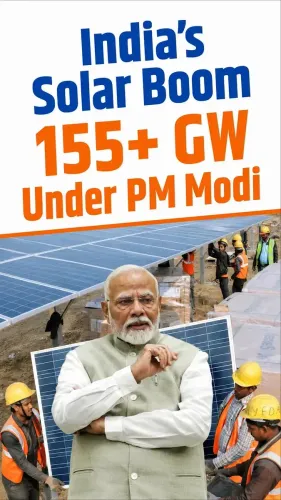
Shekhawat hails India's solar leap from 2.8 GW to 155 GW in 12 years

Synopsis
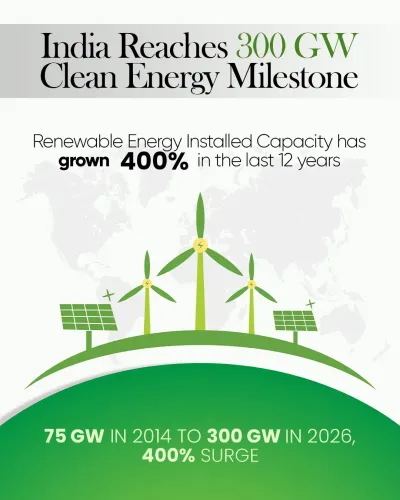
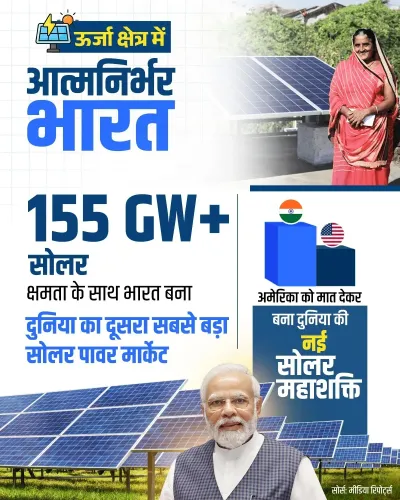
Union Minister Gajendra Singh Shekhawat has highlighted India's solar capacity surge from 2.8 GW to 155 GW between 2014 and 2026, citing over 40 lakh solarised homes and a doubling of agricultural solar capacity, as the country targets 500 GW of renewable energy by 2030.
Key Takeaways
India's installed solar capacity grew from 2.8 GW in 2014 to 155 GW in 2026 , a nearly 55-fold increase in 12 years.
More than 40 lakh (4 million) homes are now powered by solar energy, according to Shekhawat's post.
Agricultural solar capacity has doubled, with farmers increasingly generating and selling power under schemes like PM-KUSUM .
India has committed to 500 GW of non-fossil fuel electricity capacity by 2030 , announced at COP26 in 2021.
The Jawaharlal Nehru National Solar Mission (2010) and the International Solar Alliance (2015) form the foundational policy architecture behind India's solar push.
The minister framed the expansion as a jan-andolan (people's movement) driven by PM Modi's vision of solar on every rooftop and in every field.
Union Culture and Tourism Minister Gajendra Singh Shekhawat on Saturday, June 6, 2026, highlighted India's solar energy expansion under Prime Minister Narendra Modi, noting that the country's installed solar capacity has grown from 2.8 GW in 2014 to 155 GW in 2026 — a nearly 55-fold increase over twelve years.
Context
Shekhawat's post, written in Hindi, describes the transformation as 'ek jan-andolan' (a people's movement), crediting Modi's vision for converting what was once considered a distant possibility into a nationwide reality. He specifically noted that more than 40 lakh (4 million) homes are now powered by solar energy, and that the agricultural sector has seen its solar capacity double.
The minister invoked a new identity for India's farmers, calling them not just 'annadaata' (food providers) but now also 'urjadaata' (energy providers) — a reference to the growing adoption of solar installations on farmland and the PM-KUSUM scheme that enables farmers to sell surplus solar power to the grid.
Policy Backdrop
India's solar ambitions have deep policy roots. The Jawaharlal Nehru National Solar Mission, launched in 2010, set the country's first structured solar targets — initially 20 GW by 2022, later revised to 100 GW by 2022. Post-2014, the pace of capacity addition accelerated sharply, driven by central schemes, competitive tariff auctions, and a steep fall in global solar technology costs.
The PM-KUSUM scheme, introduced in 2019, specifically targeted the farm sector by subsidising solar pumps and enabling grid-connected solar plants on agricultural land. At COP26 in 2021, India announced an enhanced target of 500 GW non-fossil fuel electricity capacity by 2030, a commitment embedded in its Nationally Determined Contributions under the Paris Agreement. India is also a founding co-proposer of the International Solar Alliance, launched jointly with France in 2015, which now counts over 120 member nations.
Stakeholders and Impact
The expansion has direct implications for rural households and farming communities, who have historically faced unreliable grid power. Rooftop solar programmes and agricultural solar installations reduce electricity bills, provide income from surplus generation, and reduce dependence on diesel pumps.
For the broader economy, a larger domestic solar base supports India's energy security goals and reduces import dependence on fossil fuels. The sector has also become a significant employer and a destination for both domestic and foreign investment in manufacturing and project development.
What's Next
India's stated goal remains 500 GW of renewable energy capacity by 2030, of which solar is expected to form the largest share. Shekhawat's post underscores the political messaging around this target ahead of key parliamentary sessions where renewable energy progress and scheme allocations are likely to be debated.
The rollout pace of rooftop solar under the PM Surya Ghar: Muft Bijli Yojana and continued expansion of PM-KUSUM will be closely watched as indicators of whether the 500 GW milestone remains on track by the end of the decade.
Point of View
Timed to reinforce the BJP's narrative that the Modi administration has delivered transformational change in clean energy — a metric that resonates with both urban middle-class voters concerned about electricity costs and rural constituencies benefiting from farm-sector solar schemes. The framing of farmers as 'urjadaata' is a politically loaded extension of the 'annadaata' trope, designed to embed the energy transition into agrarian identity. More broadly, India's solar story has become a central pillar of its international climate diplomacy, and domestic milestones are routinely amplified by ministers to signal credibility ahead of multilateral forums. The 500 GW target for 2030 remains an ambitious benchmark, and the frequency of such posts suggests the government is keen to sustain public momentum as the deadline approaches.
NationPress
13 Sept 2026
Frequently Asked Questions
What is India's current solar energy capacity in 2026?
According to Union Minister Gajendra Singh Shekhawat's post, India's installed solar capacity has reached 155 GW in 2026, up from just 2.8 GW in 2014 .
How many homes in India are powered by solar energy?
Shekhawat's post states that more than 40 lakh (4 million) homes in India are currently powered by solar energy.
What is India's renewable energy target for 2030?
India has committed to achieving 500 GW of non-fossil fuel electricity capacity by 2030 , a target announced at the COP26 climate summit in 2021 and embedded in India's Paris Agreement commitments.
What is PM-KUSUM and how does it help farmers?
PM-KUSUM , launched in 2019 , is a central government scheme that subsidises solar pumps for farmers and enables them to set up grid-connected solar plants on agricultural land, allowing them to earn income by selling surplus power to the grid.
What is the International Solar Alliance?
The International Solar Alliance is a treaty-based international organisation co-founded by India and France in 2015 to promote solar energy adoption globally, with over 120 member nations.