Nadda marks World Stroke Day, urges FAST action
Synopsis
On World Stroke Day 2026, Union Health Minister J. P. Nadda urged Indians to recognise stroke warning signs — facial drooping, arm weakness, speech difficulty — and act FAST, linking the global campaign to India's NPCDCS non-communicable disease control programme.
Key Takeaways
Union Health Minister J.
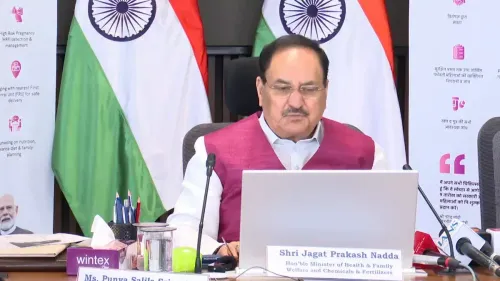
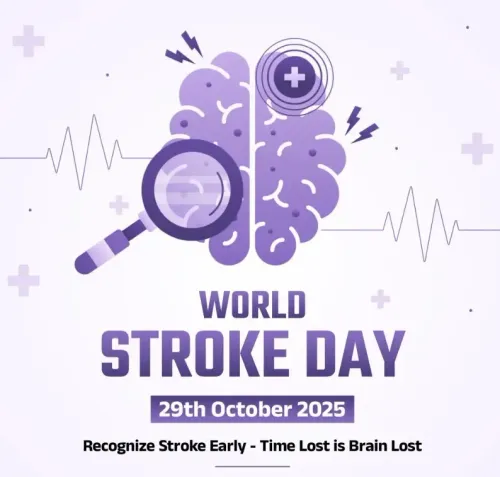
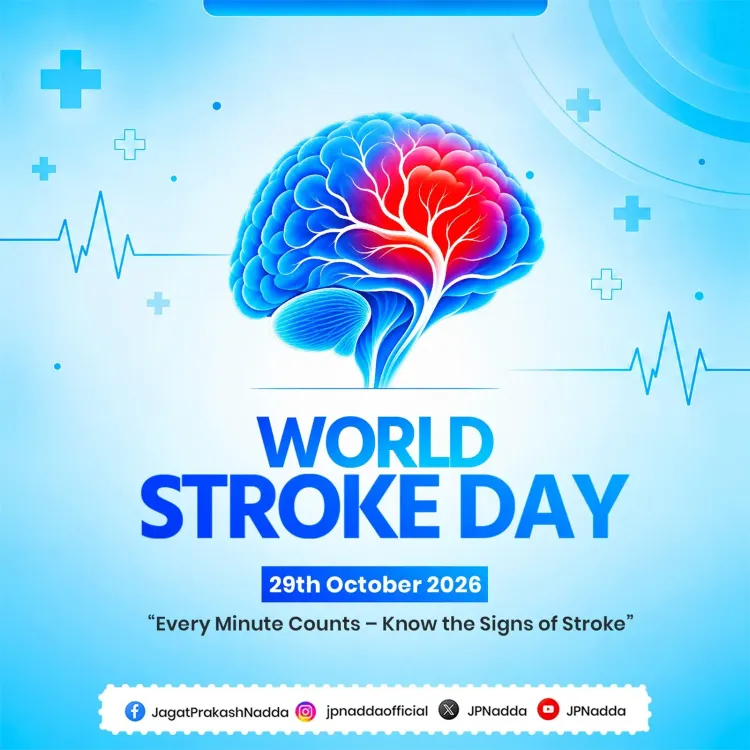
Nadda posted on World Stroke Day, 29 October 2026 , amplifying the global message 'Every Minute Counts – Know the Signs of Stroke.' Three key warning signs highlighted: sudden facial drooping , arm weakness , and difficulty speaking — together forming the FAST acronym.
Nadda stressed that immediate medical care is critical, as every minute of delay reduces chances of full recovery.
India's NPCDCS (2010) integrates stroke prevention into a national NCD control framework spanning screening, referral, and lifestyle counselling.
Bystander recognition of stroke symptoms remains one of the biggest gaps between onset and treatment in India.
Expansion of stroke care units and updated emergency-response guidelines are ongoing priorities for the health ministry.
Every minute a stroke goes unrecognised, nearly two million brain cells die — and on World Stroke Day, 29 October 2026, Union Health Minister J. P. Nadda used that urgency to push Indians to learn the warning signs before a crisis strikes.
Posting on the occasion, Nadda amplified this year's global campaign message — 'Every Minute Counts – Know the Signs of Stroke' — and listed the three red flags no one should brush aside: sudden facial drooping, weakness in one arm, and difficulty speaking. 'Seeking immediate medical care can make a crucial difference in recovery,' he wrote, closing with the call to 'act FAST.'
What FAST actually means — and why it saves lives
FAST is the internationally recognised stroke-response acronym: Face drooping, Arm weakness, Speech difficulty, Time to call emergency services. The logic is blunt — the brain's treatment window for a clot-busting drug is narrow, typically within hours of symptom onset. Every minute of delay between the first sign and hospital arrival narrows the odds of a full recovery and widens the risk of permanent disability.
Stroke is among the leading causes of death and long-term disability globally, and India carries a disproportionate share of that burden. Hypertension, diabetes, and tobacco use — all prevalent across Indian demographics — are primary risk drivers, making public-literacy campaigns particularly high-stakes here.
India's NPCDCS framework and stroke care goals
India has been building institutional scaffolding for stroke prevention since 2010, when the Ministry of Health launched the National Programme for Prevention and Control of Cancer, Diabetes, Cardiovascular Diseases and Stroke (NPCDCS). The programme integrates stroke into a wider non-communicable disease (NCD) control architecture — screening at community health centres, referral pathways, and lifestyle-change counselling — with an overarching goal of reducing premature NCD mortality.
Nadda's post plugs directly into that framework: a global awareness day becomes a domestic amplifier, driving the same message through social media that frontline health workers carry door to door. Expansion of dedicated stroke care units and updated emergency-response protocols remain active items on the health ministry's agenda.
The public-health ask: spread awareness, act without hesitation
The minister's appeal was deliberately simple: learn the signs, share them, and do not wait. That simplicity is intentional — research consistently shows that bystander recognition of stroke symptoms is one of the biggest bottlenecks between onset and treatment. A family member who knows FAST can cut the ambulance call delay from hours to minutes.
On a day when health ministries worldwide are making the same ask, India's message from the top is clear: a stroke is not something to sleep on, manage with home remedies, or drive slowly to a clinic. It is a medical emergency where hesitation has a measurable cost — measured in minutes, and in lives.
Point of View
Lending credibility and scale to messages that might otherwise feel bureaucratic. The FAST call-to-action is also low-risk, high-reach: it asks nothing of the state in the short term while placing moral responsibility on the informed citizen. The real policy test, however, lies not in the tweet but in whether stroke care units, trained paramedics, and fast-track emergency protocols exist in the Tier-2 and Tier-3 towns where most of India's stroke burden actually falls.
NationPress
29 Oct 2026
Frequently Asked Questions
What is World Stroke Day and when is it observed?
World Stroke Day is observed every year on 29 October to raise global awareness about stroke prevention, warning signs, and the importance of rapid emergency response.
What are the warning signs of a stroke I should know?
The FAST acronym covers the key signs: F acial drooping, A rm weakness, S peech difficulty. If you notice any of these, T stands for Time — call emergency services immediately.
What did J. P. Nadda say about stroke on World Stroke Day 2026?
Union Health Minister J. P. Nadda posted on 29 October 2026 urging people to learn stroke warning signs, spread awareness, and 'act FAST,' stressing that every minute of delay affects recovery.
What is India's national programme for stroke prevention?
India launched the National Programme for Prevention and Control of Cancer, Diabetes, Cardiovascular Diseases and Stroke (NPCDCS) in 2010 , which integrates stroke prevention into a broader NCD control framework.
Why is quick action so important when someone has a stroke?
Every minute a stroke is untreated, millions of brain cells are lost. Clot-busting treatments have a narrow time window after symptom onset, so immediate hospital care dramatically improves recovery outcomes.