Nadda Calls for Heart Health Awareness on World Heart Day
Synopsis
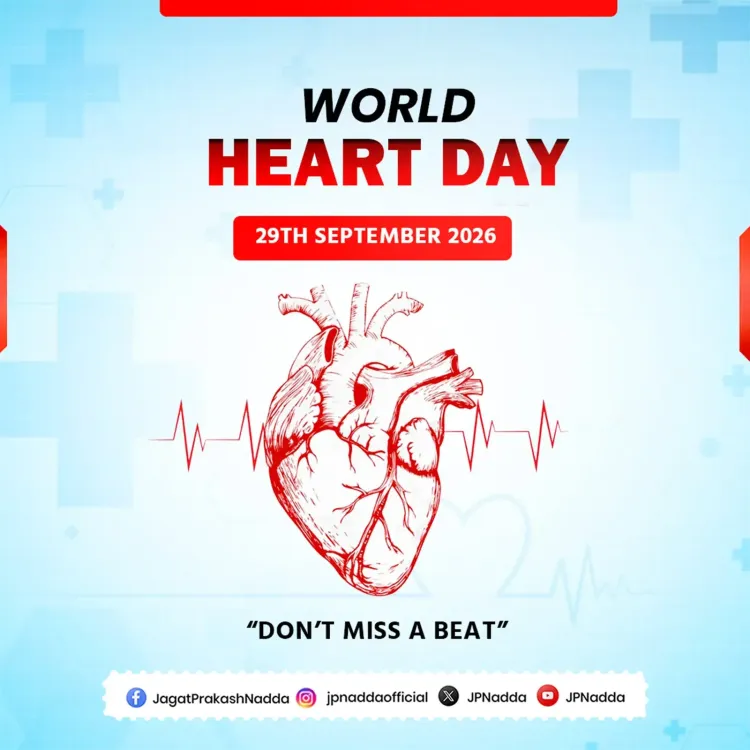
On World Heart Day 2026, Union Health Minister J. P. Nadda called on Indians to recognise cardiac warning signs, adopt healthy lifestyles, and seek timely care, citing the global theme 'Don't Miss a Beat' and reinforcing India's long-running national cardiovascular prevention agenda.
Key Takeaways
World Heart Day is observed annually on 29 September ; the 2026 global theme is 'Don't Miss a Beat'.
Union Health Minister J.
Nadda called on citizens to recognise warning signs, manage risk factors, and seek timely cardiac care.
Cardiovascular diseases are the largest driver of non-communicable disease deaths in India, affecting both urban and rural populations.
India's National Programme for Prevention and Control of Cancer, Diabetes, Cardiovascular Diseases and Stroke (NPCDCS) has been operational since 2010 .
The NPCDCS framework has been integrated into Ayushman Bharat Health and Wellness Centres for population-level NCD screening.
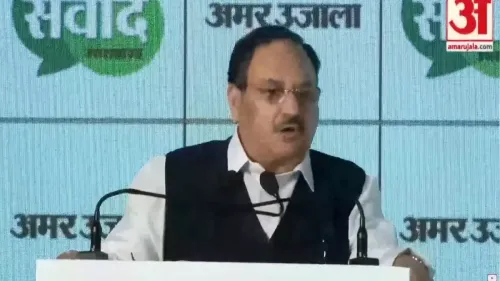
Every 29 September, the world pauses to reckon with the silent epidemic claiming more lives than almost any other cause — and on World Heart Day 2026, Union Health Minister J. P. Nadda used the occasion to call on Indians to recognise warning signs, embrace healthier habits, and seek timely care before a missed beat becomes a crisis.
Posting on Tuesday morning, Nadda anchored his message to this year's global theme, 'Don't Miss a Beat', urging citizens to 'recognise warning signs, adopt healthy lifestyle practices, manage risk factors and seek timely care.' The phrase is a deliberate double meaning — a rallying cry to stay alert both literally and figuratively to the health of one's heart.
Why Cardiovascular Disease Is India's Defining NCD Battle
Cardiovascular diseases represent the single largest driver of non-communicable disease deaths in India. Decades of rapid urbanisation, sedentary work patterns, processed diets, and rising rates of diabetes and hypertension have pushed heart disease from a condition associated with old age into one increasingly striking working-age adults. The burden is not evenly distributed — it falls hard on both urban professionals and rural populations who lack early-detection infrastructure.
The government's foundational policy response dates to 2010, when the National Programme for Prevention and Control of Cancer, Diabetes, Cardiovascular Diseases and Stroke (NPCDCS) was launched specifically to address this rising NCD burden. The programme established district-level NCD clinics, trained community health workers to screen for risk factors, and created referral pathways for early intervention — forming the backbone of India's population-level cardiovascular strategy.
Ayushman Bharat and the Push for NCD Screening at Scale
The NPCDCS framework was subsequently woven into the broader Ayushman Bharat architecture, which extended NCD screening to Health and Wellness Centres at the primary care level. The ambition: catch hypertension, diabetes, and early cardiac risk before patients ever reach a tertiary hospital. Nadda's ministerial portfolio places him at the centre of both the curative financing side of Ayushman Bharat and the preventive programming running through NPCDCS.
World Heart Day, observed globally since 2000 and anchored by the World Heart Federation, gives those programmes an annual public-communication moment — a chance to translate clinical targets into language ordinary citizens can act on.
The minister's call to 'renew our commitment' is not rhetorical window-dressing. With lifestyle disease numbers still climbing, the gap between policy architecture and individual behaviour change remains the hardest problem in Indian public health. A missed warning sign — chest tightness brushed off as acidity, breathlessness blamed on the weather — is still, for millions, the difference between a treatable condition and a fatal event.
Point of View
But it arrives at a moment when India's NCD burden is the defining long-term challenge for its public health system. By invoking the 'Don't Miss a Beat' theme, the Health Ministry subtly reinforces the behavioural-change pillar of its NCD strategy — the one area where institutional programmes consistently struggle to convert policy intent into individual action. The timing also keeps Ayushman Bharat's preventive-care architecture in the public conversation, signalling that the government's NCD agenda extends well beyond hospital coverage. Whether the message translates into measurable screening uptake will depend on ground-level implementation rather than social-media visibility.
NationPress
29 Sept 2026
Frequently Asked Questions
When is World Heart Day celebrated?
World Heart Day is observed globally every year on 29 September . It was established by the World Heart Federation and has been marked annually since 2000.
What is the theme of World Heart Day 2026?
The theme of World Heart Day 2026 is 'Don't Miss a Beat', calling on individuals to recognise cardiac warning signs, adopt preventive lifestyle habits, and seek timely medical care.
What did J. P. Nadda say on World Heart Day 2026?
Union Health Minister J. P. Nadda posted on X urging citizens to 'recognise warning signs, adopt healthy lifestyle practices, manage risk factors and seek timely care' in line with the global 'Don't Miss a Beat' theme.
What is India's national programme for cardiovascular disease prevention?
India's primary policy framework is the National Programme for Prevention and Control of Cancer, Diabetes, Cardiovascular Diseases and Stroke (NPCDCS) , launched in 2010 . It established NCD clinics, community screening, and referral pathways across districts.
How does Ayushman Bharat address heart disease?
The Ayushman Bharat Health and Wellness Centres have incorporated NCD screening — including cardiovascular risk assessment — at the primary care level, aiming to detect hypertension, diabetes, and early cardiac risk before patients require hospitalisation.