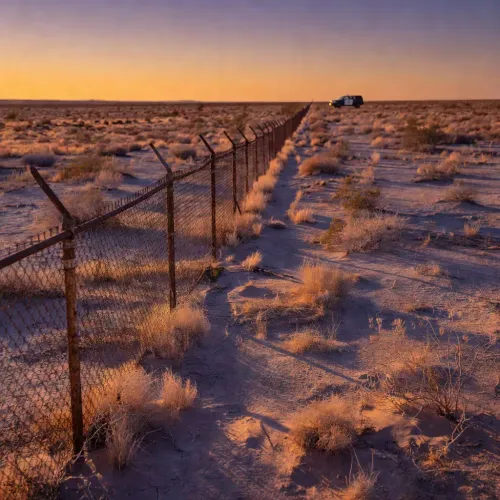
White House Claims 'Most Secure Border in History'

Synopsis
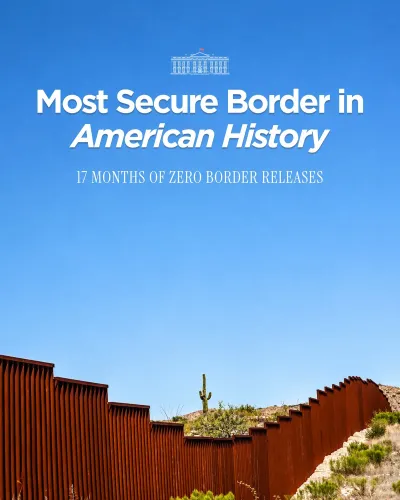
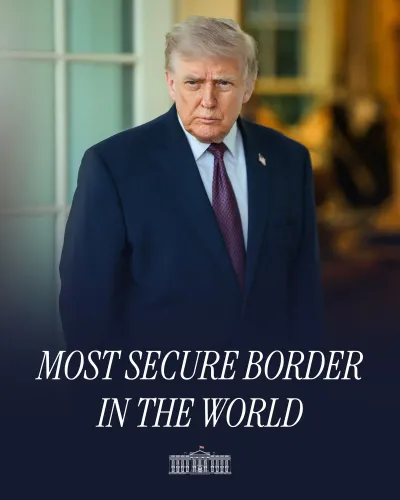
The White House declared on 13 November 2026 that the United States now has the 'most secure border in history', framing the claim as a defence of American sovereignty. No specific metrics accompanied the post, with official CBP data expected to follow.
Key Takeaways
The White House posted on 13 November 2026 declaring the US-Mexico border the most secure in American history.
The statement frames border control explicitly as a matter of national sovereignty , not merely immigration management.
No specific enforcement metrics or CBP encounter figures were attached to the declaration.
Border security was a flagship priority of the Trump administration from 2017 , involving physical barriers and enforcement surges.
Key data to watch: official CBP monthly encounter statistics and any follow-up executive actions on border resources.
The 'sovereignty' framing has broad international resonance, positioning the US alongside other nations that use territorial-control language in immigration policy.
A declaration — blunt, sweeping, and unmistakably political — landed from the White House on Thursday, 13 November 2026: the United States now holds what it calls the most secure border in its history. The post, shared on X by the official White House account, frames the achievement as a matter of national sovereignty, not just immigration policy.
A claim rooted in decades of border politics
The US-Mexico border has been the most contested stretch of American territorial policy for at least three decades. Administrations of both parties have poured resources — physical barriers, surveillance technology, enforcement surges, and legislative overhauls — into the question of how tightly that frontier should be held. The statement 'America's sovereignty will be defended' is a phrase with deep roots in that history, signalling that border control is being framed not as a humanitarian or logistical challenge but as a core test of national will.
Border security was a defining priority of the first Trump administration beginning in 2017, which accelerated wall construction and tightened enforcement protocols. The White House post's declaratory register — 'delivered', past tense, finished — suggests a milestone is being claimed rather than promised.
What 'most secure' actually means to border patrol and residents
For the Border Patrol agents who work the line daily and the border-state communities in Texas, Arizona, New Mexico, and California who live with the consequences of migration flows, 'most secure' is a metric that matters enormously — but one that is almost always contested. The standard yardstick is Customs and Border Protection (CBP) encounter data: monthly tallies of migrants apprehended or turned away. When those numbers fall sharply, administrations declare victory; when they spike, opponents declare crisis.
No specific figures accompany this White House post. The claim stands as a political assertion pending official CBP data that would either anchor or complicate it. What to watch next: any follow-up release of enforcement statistics, executive actions on staffing or resources, or congressional responses that challenge or validate the numbers behind the declaration.
The sovereignty frame and its global resonance
The choice of the word 'sovereignty' — not 'safety', not 'order', not 'law' — is deliberate and significant. It elevates a domestic enforcement story into a statement about a nation's right and capacity to control its own territory. That framing travels well internationally: governments from India to Hungary to Australia have deployed similar language to signal hard-line positions on border management. When the most powerful democracy on earth uses it, the rhetorical ripple is global.
For Indian observers tracking US domestic politics, this post signals that border security remains a central pillar of the current administration's governing identity — and that it intends to run that message hard.
The numbers, when they arrive, will tell us whether 'delivered' holds up. Until then, the declaration itself is the news.
Point of View
Past tense — marks a deliberate pivot from promise to claimed achievement, a rhetorical shift that typically precedes an election cycle or a major policy consolidation push. By anchoring the message in 'sovereignty' rather than humanitarian or logistical metrics, the administration signals it is playing to a base that views border control as an identity issue, not a technocratic one. The absence of accompanying data is itself a political choice: assertions move faster than spreadsheets, and the claim will dominate a news cycle before any counter-data can be assembled. For India, the post is a reminder that the world's largest democracy watches closely how the world's most powerful one defines the limits of its own territory.
NationPress
13 Nov 2026
Frequently Asked Questions
What did the White House say about the US border in November 2026?
The White House declared on 13 November 2026 that the United States now has the 'most secure border in history' and that 'America's sovereignty will be defended', framing the achievement as a matter of national sovereignty rather than simply immigration management.
What is CBP encounter data and why does it matter for border security claims?
CBP, or Customs and Border Protection, publishes monthly data on the number of migrants apprehended or turned away at the US-Mexico border. This data is the primary benchmark used to assess whether border enforcement is tightening or loosening, and no such figures accompanied the White House's November 2026 declaration.
How does the Trump administration's border policy compare to previous US administrations?
The Trump administration, beginning in 2017, made border security a defining priority through accelerated wall construction and tightened enforcement protocols. Subsequent administrations adjusted these measures, making the border a persistent flashpoint in American political debate.
Why does the White House use the word 'sovereignty' in border security messaging?
Using 'sovereignty' frames border control as a fundamental right of a nation to govern its own territory, moving the debate beyond immigration logistics into questions of national identity and power. This language resonates with voters who see border enforcement as a core expression of national strength.
What should observers watch for after the White House's border security declaration?
Key developments to monitor include the release of official CBP encounter statistics for recent months, any new executive actions on border staffing or resources, and Congressional responses that may challenge or validate the administration's claim of historic border security.