Shekhawat Hails India as World's 2nd Largest Solar Market
Synopsis
Union Minister Gajendra Singh Shekhawat on 29 May 2026 hailed India's crossing of 155 GW+ installed solar capacity, declaring the country the world's second-largest solar market and linking the feat to the PM Surya Ghar Muft Bijli Yojana rooftop scheme.
Key Takeaways
Union Minister Gajendra Singh Shekhawat posted on 29 May 2026 celebrating India's solar energy milestone.
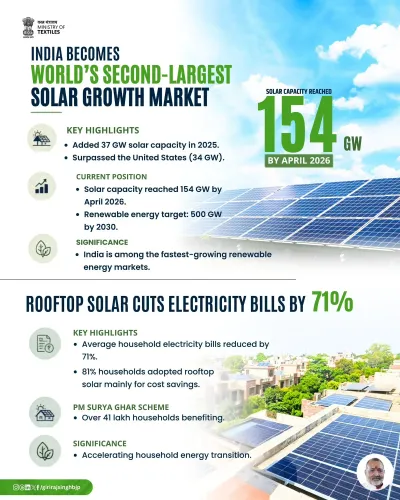
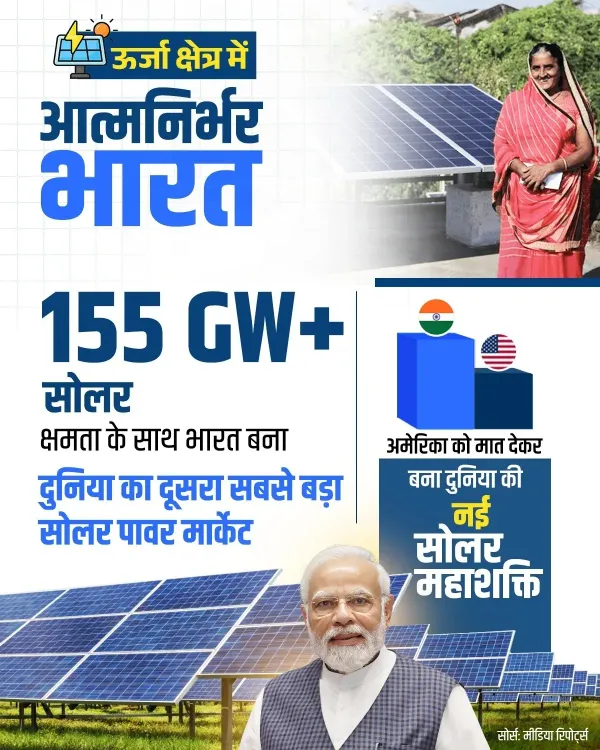
India has reportedly crossed 155 GW of installed solar capacity, claimed to make it the world's second-largest solar power market .
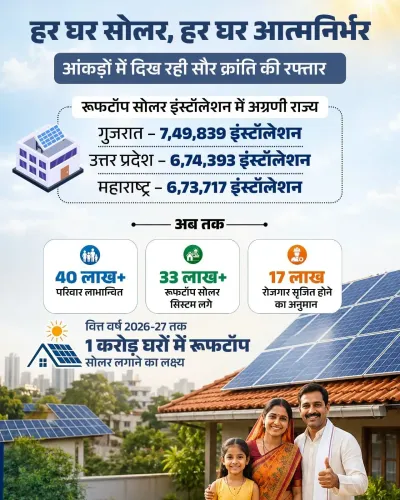
The post was tagged #40LakhsPMSuryaGhar , linking the achievement to the PM Surya Ghar Muft Bijli Yojana .
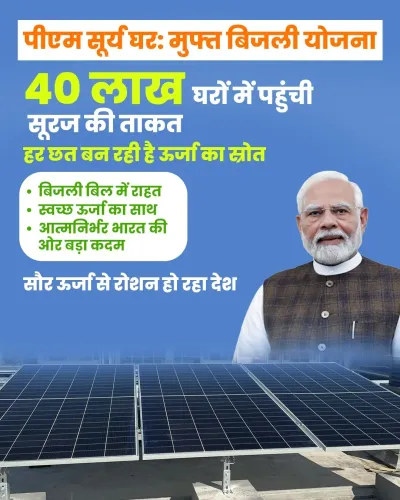
The PM Surya Ghar scheme, announced in the 2024 Union Budget , targets rooftop solar for one crore households with up to 300 units of free electricity monthly.
India's broader goal is 500 GW of non-fossil fuel capacity by 2030 , with solar as the primary driver.
Union Culture and Tourism Minister Gajendra Singh Shekhawat on Friday, 29 May 2026, took to X to celebrate what he called a historic milestone for India's energy sector, citing the country's achievement of over 155 GW of installed solar capacity and its emergence as the world's second-largest solar power market.
Posting in Hindi, the minister wrote: 'ऊर्जा क्षेत्र में भारत का ऐतिहासिक कीर्तिमान!' ('A historic milestone for India in the energy sector!'), adding that the landmark was 'a strong step towards a self-reliant and clean future.' He tagged the post with the hashtag #40LakhsPMSuryaGhar, linking the achievement to the government's flagship rooftop solar programme.
Context
India has pursued one of the world's most ambitious renewable energy expansion programmes over the past decade. The country set a target of 500 GW of non-fossil fuel capacity by 2030, with solar power at the centre of that push. Crossing the 155 GW solar threshold — if confirmed by official data — would represent a dramatic acceleration from the 100 GW target originally set under the revised Jawaharlal Nehru National Solar Mission for 2022.
The milestone has been framed by the government as validation of its twin goals of energy security and climate commitments made under successive National Action Plans on Climate Change.
Policy Backdrop
The hashtag in Shekhawat's post points directly to the PM Surya Ghar Muft Bijli Yojana, a central government scheme announced in the 2024 Union Budget under Prime Minister Narendra Modi. The scheme aims to install rooftop solar panels on one crore households, providing each with up to 300 units of free electricity every month.
The programme builds on the International Solar Alliance, launched in 2015 to mobilise global solar deployment, and positions India as both a domestic consumer and an international leader in the clean-energy transition. Falling solar module prices and a combination of central and state-level incentives have driven rapid capacity addition in recent years.
Stakeholders and Impact
The most direct beneficiaries of the PM Surya Ghar scheme are household consumers, particularly in states with high electricity tariffs, where free units translate into significant monthly savings. Solar developers and equipment manufacturers also stand to gain from the sustained pipeline of rooftop installations that the scheme generates.
Broader energy consumers benefit from reduced dependence on coal-fired generation, while India's international climate credibility is reinforced each time a capacity landmark is publicly confirmed. State-wise rollout figures and subsidy disbursement data will be key indicators of whether the scheme is reaching its one crore household target on schedule.
What's Next
Analysts and policymakers will watch for an official confirmation of the 155 GW+ figure and the global ranking from the Ministry of New and Renewable Energy, which maintains authoritative capacity data. Any upward revision of the 2030 renewable energy target in upcoming economic surveys or budget documents would be the logical next step if the current pace of addition is sustained.
The government's ability to maintain this trajectory will depend on continued subsidy disbursements under PM Surya Ghar, grid integration investments, and the pace of state-level policy alignment — all of which will come under scrutiny as India approaches the final stretch of its 2030 clean-energy deadline.
Point of View
Making the statistic politically legible to ordinary voters. The framing of 'Aatmanirbhar' (self-reliant) alongside 'clean future' also reflects the government's dual messaging on energy — nationalist self-sufficiency and global climate responsibility at once. Whether the 155 GW figure and the global ranking hold up to independent verification will determine how durable this narrative moment proves to be.
NationPress
13 Oct 2026
Frequently Asked Questions
Has India become the world's second-largest solar power market?
Union Minister Gajendra Singh Shekhawat claimed on 29 May 2026 that India has crossed 155 GW+ of installed solar capacity to become the world's second-largest solar market; official confirmation from the Ministry of New and Renewable Energy would be the authoritative source for this ranking.
What is the PM Surya Ghar Muft Bijli Yojana scheme?
PM Surya Ghar Muft Bijli Yojana is a central government rooftop solar scheme announced in the 2024 Union Budget that aims to provide up to 300 units of free electricity per month to one crore households through subsidised rooftop solar installations.
What is India's solar energy target for 2030?
India has set a target of 500 GW of total non-fossil fuel power capacity by 2030 , with solar power expected to contribute the largest share of that addition.
What is the International Solar Alliance?
The International Solar Alliance was launched in 2015 as an India-led initiative to mobilise global investment and deployment of solar energy, particularly in sun-rich developing nations.
Who is Gajendra Singh Shekhawat?
Gajendra Singh Shekhawat is a senior BJP leader, Lok Sabha MP from Jodhpur, Rajasthan , and currently serves as Union Minister of Culture and Tourism in the Narendra Modi government.