Shekhawat hails PM Surya Ghar as 40 lakh homes near zero power bills
Synopsis
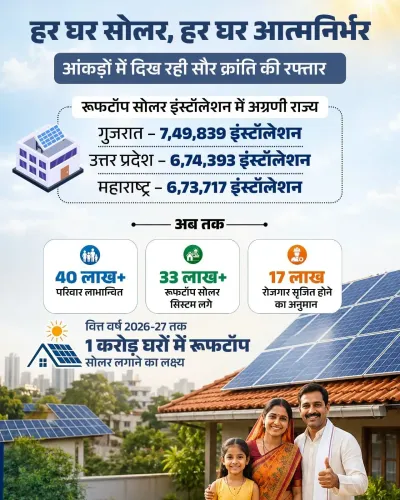
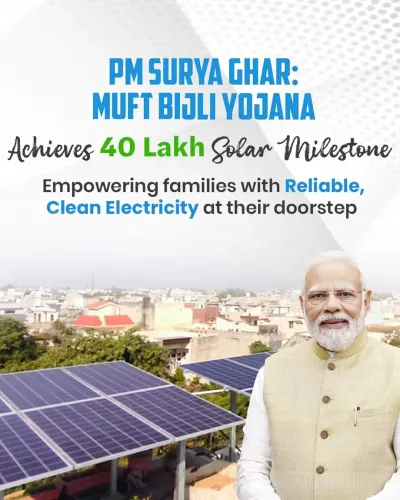
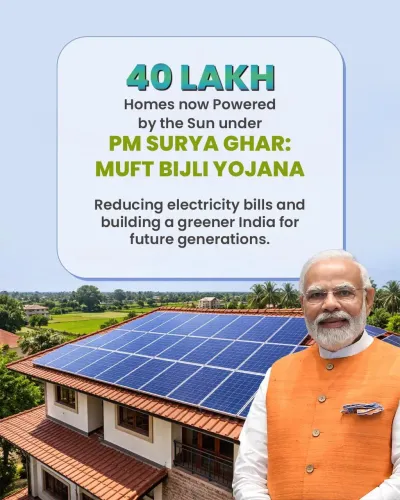
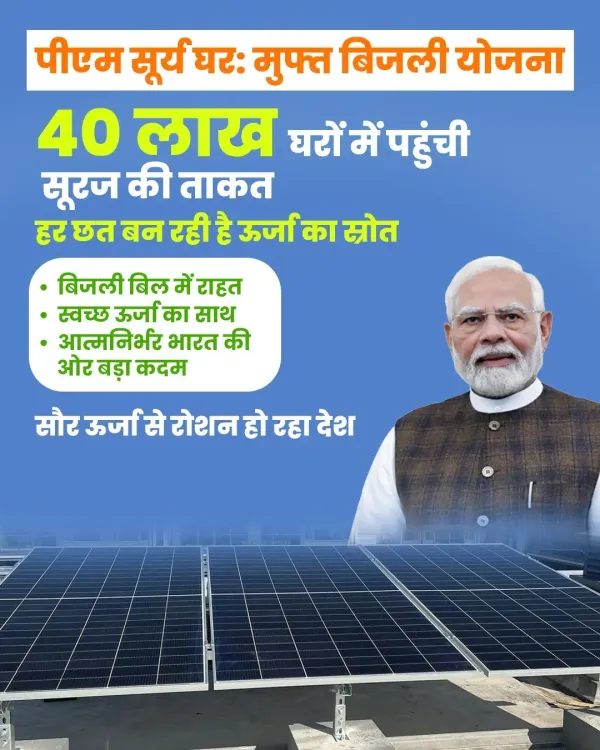
Union Minister Gajendra Singh Shekhawat on 29 May 2026 highlighted that 40 lakh families are advancing toward zero electricity bills under PM Surya Ghar: Muft Bijli Yojana, calling it a symbol of PM Modi's vision of an energy self-reliant India.
Key Takeaways
40 lakh families are now progressing toward zero electricity bills under PM Surya Ghar: Muft Bijli Yojana as of May 2026 .
The scheme, launched in 2024 , targets one crore households with rooftop solar systems of 1–3 kW capacity.
Eligible households can receive up to 300 units of free electricity per month through central financial assistance.
The Ministry of New and Renewable Energy is the nodal body overseeing implementation.
The scheme is part of India's broader target of 500 GW of non-fossil fuel energy capacity by 2030 .
At 40 lakh beneficiaries, the programme has reached roughly two-fifths of its one-crore installation goal.
Union Culture and Tourism Minister Gajendra Singh Shekhawat on Friday, 29 May 2026, highlighted a key milestone under the PM Surya Ghar: Muft Bijli Yojana, stating that 40 lakh families are now progressing toward zero electricity bills through the central government's flagship rooftop solar scheme.
Context
Posting in Hindi on X, Shekhawat wrote: 'हर छत पर सोलर, हर घर में बचत' ('Solar on every roof, savings in every home'), framing the scheme's reach as proof of Prime Minister Narendra Modi's vision of an energy self-reliant India — Urja Atmanirbhar Bharat. The post carried the hashtag #40LakhsPMSuryaGhar, amplifying the government's messaging around the scheme's expanding footprint.
The PM Surya Ghar: Muft Bijli Yojana was launched in 2024 with the stated goal of equipping one crore households across India with rooftop solar systems of 1–3 kW capacity, enabling beneficiary households to receive up to 300 units of free electricity every month through central financial assistance.
Policy Backdrop
The scheme sits within a decades-long arc of India's solar energy policy. The National Solar Mission, launched in 2010, set the foundational framework for scaling domestic solar capacity and reducing dependence on imported fossil fuels. The PM-KUSUM scheme, introduced in 2019, extended decentralised solar solutions to agricultural and rural consumers.
The Union Budget 2024-25 formalised central financial assistance specifically for one crore rooftop solar installations, with the Ministry of New and Renewable Energy designated as the nodal implementing body. The scheme also operates alongside state-level net-metering frameworks that allow surplus power generated by households to be fed back into the grid, further reducing electricity costs.
India's broader renewable energy ambition targets 500 GW of non-fossil fuel capacity by 2030, and rooftop solar is considered a critical distributed-generation lever in reaching that goal.
Stakeholders and Impact
The primary beneficiaries are residential electricity consumers — particularly middle-income and lower-middle-income households — for whom monthly power bills represent a significant recurring expense. A household receiving 300 units of free electricity monthly can effectively eliminate or drastically reduce its electricity bill depending on consumption patterns and local tariff structures.
Urban apartment complexes, peri-urban localities, and rural homeowners with suitable roof space are all eligible categories. State electricity distribution companies (DISCOMs) play a pivotal role in facilitating net-metering connections and processing subsidy disbursals, making their administrative capacity a key variable in the scheme's on-ground speed.
What's Next
The government's stated target remains one crore installations, meaning the current figure of 40 lakh families represents roughly two-fifths of the way to that benchmark. Quarterly progress reports on installation numbers and subsidy disbursal are expected to provide a clearer picture of the pace required to meet the one-crore goal within the scheme's original timeline.
Any mid-term review of central financial assistance in the next Union Budget could either accelerate or recalibrate the programme's rollout. As India's electricity demand continues to rise with urbanisation and industrial growth, the scheme's ability to convert rooftop potential into actual installed capacity will be watched closely by energy policymakers and state governments alike.
Point of View
A recurring rhetorical device the ruling party uses to frame economic and infrastructure policy as a civilisational project. Notably, the post comes from a minister whose own portfolio — Culture and Tourism — is unrelated to energy, signalling a coordinated party-wide amplification effort rather than a ministry-specific communication. The 40-lakh figure, while significant, also implicitly acknowledges that the one-crore target remains a work in progress, leaving the government's credibility tied to the pace of future installations.
NationPress
20 Sept 2026
Frequently Asked Questions
What is PM Surya Ghar Muft Bijli Yojana?
PM Surya Ghar: Muft Bijli Yojana is a central government scheme launched in 2024 that provides rooftop solar systems of 1–3 kW to households, enabling them to receive up to 300 units of free electricity per month through central financial assistance.
How many families have benefited from PM Surya Ghar scheme so far?
According to a post by Union Minister Gajendra Singh Shekhawat on 29 May 2026, 40 lakh families are now progressing toward zero electricity bills under the PM Surya Ghar: Muft Bijli Yojana.
What is the target of PM Surya Ghar scheme?
The scheme aims to install rooftop solar systems in one crore (10 million) households across India. As of May 2026, 40 lakh installations have been highlighted, representing roughly two-fifths of the total target.
Which ministry implements PM Surya Ghar Muft Bijli Yojana?
The Ministry of New and Renewable Energy is the nodal ministry responsible for implementing the PM Surya Ghar: Muft Bijli Yojana and overseeing rooftop solar targets under the scheme.
How does PM Surya Ghar scheme help reduce electricity bills?
The scheme installs 1–3 kW rooftop solar systems on beneficiary homes, generating up to 300 units of electricity monthly. Combined with state net-metering rules that allow surplus power to be fed back to the grid, households can effectively reduce or eliminate their monthly electricity bills.