Giriraj Singh: PM Surya Ghar Crosses 40 Lakh Homes
Synopsis
Union Textiles Minister Giriraj Singh announced that the PM Surya Ghar Muft Bijli Yojana has reached 40 lakh households and is targeting 75 lakh by end-2026, marking a key milestone in India's Rs 75,021 crore rooftop solar programme launched in February 2024.
Key Takeaways
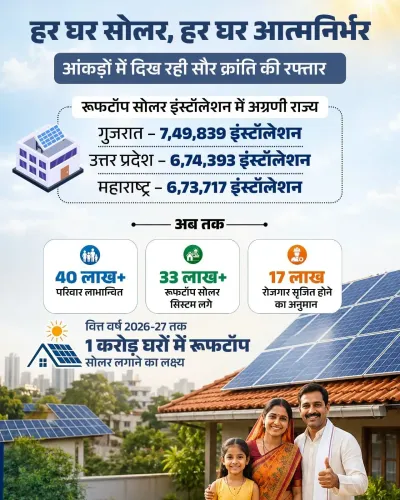
40 lakh households have been connected under the PM Surya Ghar Muft Bijli Yojana as of June 2026.
The scheme's revised near-term target is 75 lakh homes by end-2026 , requiring roughly 35 lakh additional connections.
The programme was launched by PM Narendra Modi on 13 February 2024 with an outlay of Rs 75,021 crore .
The scheme offers up to 300 units of free electricity per month to beneficiary households via rooftop solar.
The ultimate goal remains one crore households , aligning with India's 500 GW non-fossil fuel capacity target by 2030 .
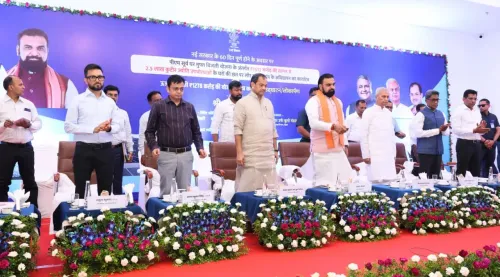
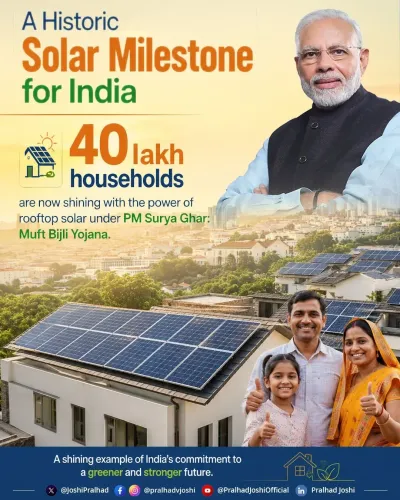
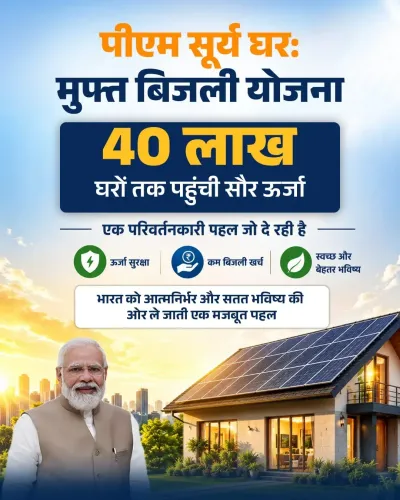
Union Textiles Minister Giriraj Singh on Friday, 5 June 2026 shared a milestone update on the PM Surya Ghar Muft Bijli Yojana, noting that the rooftop solar scheme has now connected 40 lakh households and is targeting 75 lakh homes by end-2026.
Context
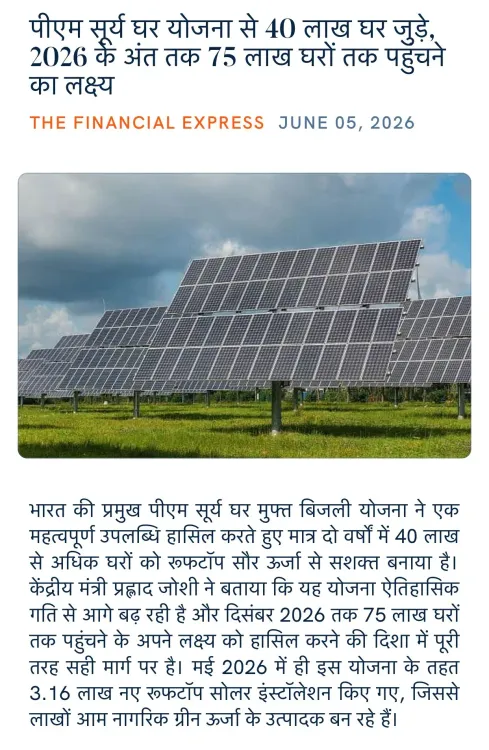
Singh's post, shared via the NaMo App, highlighted the scheme's progress in Hindi: 'पीएम सूर्य घर योजना से 40 लाख घर जुड़े, 2026 के अंत तक 75 लाख घरों तक पहुंचने का लक्ष्य' ('40 lakh homes connected under PM Surya Ghar scheme, target to reach 75 lakh homes by end of 2026'). The update signals that the programme has crossed a significant intermediate milestone on the road to its one-crore household ambition.
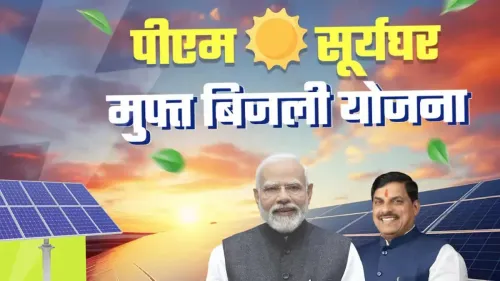
The PM Surya Ghar Muft Bijli Yojana was launched by Prime Minister Narendra Modi on 13 February 2024 with a total outlay of Rs 75,021 crore. The scheme promises up to 300 units of free electricity per month to beneficiary households through subsidised rooftop solar installations.
Policy Backdrop
The nodal Ministry of New and Renewable Energy (MNRE) administers the scheme, coordinating with state electricity distribution companies to onboard households, process subsidy disbursements, and oversee installation quality. The programme builds on earlier state-level rooftop solar subsidy frameworks that provided the implementation template for a national rollout.
The scheme is a key pillar of India's broader clean-energy push, which targets 500 GW of non-fossil fuel electricity capacity by 2030 and a net-zero emissions goal by 2070. Scaling rooftop solar directly reduces household electricity bills while adding distributed generation capacity to the national grid.
Stakeholders and Impact
The primary beneficiaries are low- and middle-income households who gain access to subsidised solar installations and reduced monthly power bills. Solar equipment manufacturers, certified installers, and local entrepreneurs engaged in the rooftop solar supply chain also stand to benefit from the accelerated rollout.
Electricity distribution companies (DISCOMs) face both an opportunity and a coordination challenge: integrating a large volume of rooftop generators into the grid requires upgrades to metering infrastructure and net-metering frameworks. The pace at which DISCOMs in different states adapt will influence whether the 75 lakh target by end-2026 is met on schedule.
What's Next
With 40 lakh homes connected and a revised near-term target of 75 lakh by December 2026, the scheme must add roughly 35 lakh more households in the remaining months of the year — an acceleration from the pace seen so far. Quarterly progress reports from MNRE and state-level coordination meetings between the ministry and DISCOMs will be closely watched for signs of whether the pipeline can sustain this momentum.
The ultimate benchmark remains the original one-crore household target. How the government bridges the gap between the 75 lakh interim milestone and that final goal will define the scheme's legacy as a model for mass-scale residential solar adoption in India.
Point of View
Where residential rooftop solar is a visible, quantifiable deliverable. Whether the 75 lakh figure is met on schedule will be an early indicator of the government's capacity to operationalise its one-crore household promise.
NationPress
20 Oct 2026
Frequently Asked Questions
What is the PM Surya Ghar Muft Bijli Yojana?
The PM Surya Ghar Muft Bijli Yojana is a central government scheme launched on 13 February 2024 by Prime Minister Narendra Modi to provide subsidised rooftop solar installations to one crore households, offering up to 300 units of free electricity per month, with a total outlay of Rs 75,021 crore.
How many homes have been connected under PM Surya Ghar so far?
As of June 2026, 40 lakh households have been connected under the PM Surya Ghar scheme, according to an update shared by Union Textiles Minister Giriraj Singh.
What is the PM Surya Ghar target for 2026?
The scheme is targeting 75 lakh household connections by the end of 2026, up from 40 lakh already connected, as part of its broader one-crore household goal.
Which ministry implements the PM Surya Ghar scheme?
The Ministry of New and Renewable Energy (MNRE) is the nodal ministry responsible for implementing the PM Surya Ghar Muft Bijli Yojana, in coordination with state electricity distribution companies.
How does PM Surya Ghar relate to India's climate targets?
The scheme supports India's national target of 500 GW non-fossil fuel energy capacity by 2030 and contributes to the country's net-zero emissions commitment by 2070 by scaling distributed rooftop solar generation.