Puri flags 40 lakh homes under PM Surya Ghar solar scheme
Synopsis
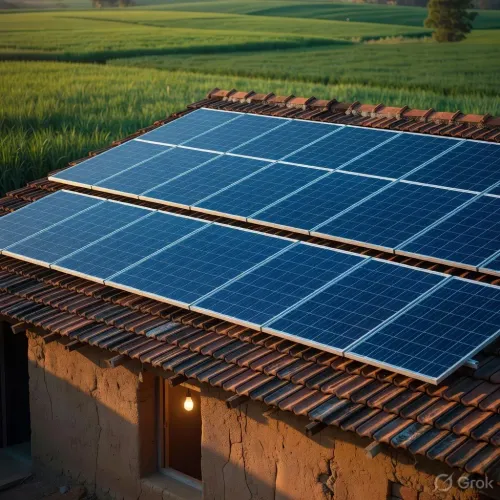
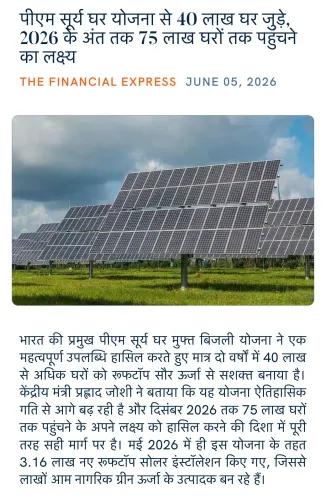
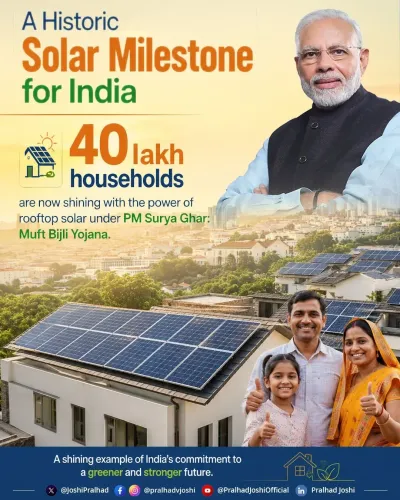
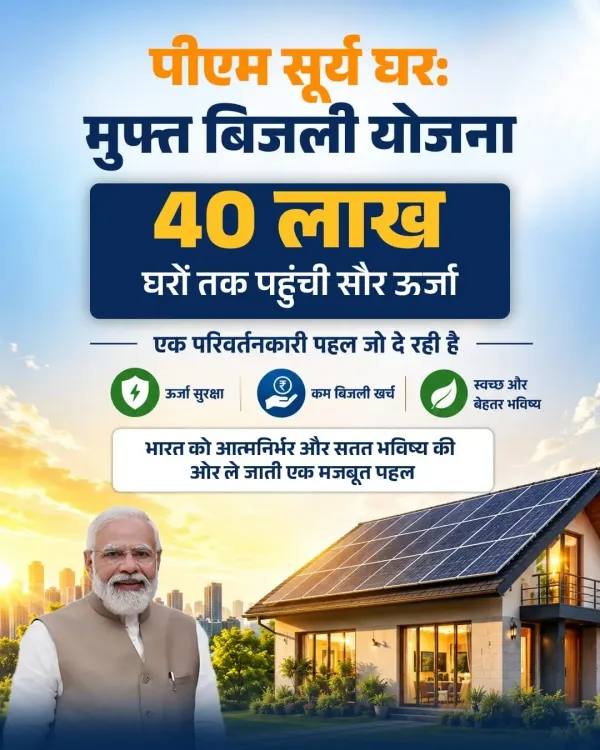
Union Petroleum Minister Hardeep Singh Puri announced on 29 May 2026 that 40 lakh households have been enrolled under the PM Surya Ghar: Muft Bijli Yojana rooftop solar scheme, marking 40 per cent of the one-crore-household target set under the Rs 75,021 crore central programme.
Key Takeaways
40 lakh households have been connected under PM Surya Ghar: Muft Bijli Yojana as of 29 May 2026 , according to Union Minister Hardeep Singh Puri .
The scheme targets one crore households in total, meaning roughly 40 per cent of the goal has been reported as achieved.
The Union Cabinet approved the scheme in 2024 with an outlay of Rs 75,021 crore , offering up to 300 units of free electricity per month per beneficiary.
The programme aligns with India's Panchamrit COP26 pledge of 500 GW non-fossil fuel capacity by 2030 and net-zero by 2070 .
Puri framed the milestone under the Atmanirbhar Bharat objective, linking rooftop solar to energy self-reliance and reduced household electricity costs.
State-level DISCOM grid integration and subsidy disbursement remain key variables for reaching the remaining 60 lakh households .
Union Petroleum Minister Hardeep Singh Puri on Friday, 29 May 2026, highlighted a landmark in India's rooftop solar push, stating that 40 lakh households have been connected under the 'PM Surya Ghar: Muft Bijli Yojana', describing the milestone as a major step toward making India a clean-energy superpower.
Context
Puri's post, written in Hindi, declared 'सौर शक्ति का सुपरपावर बनता भारत' ('India becoming a superpower of solar energy') and called the 40-lakh-household figure 'एक ऐतिहासिक पड़ाव' — 'a historic milestone'. He credited the achievement to the guidance of Prime Minister Narendra Modi, framing the scheme as both an economic relief measure and an environmental intervention. The minister noted the initiative was freeing ordinary citizens from electricity bills while simultaneously advancing the country's green goals.
The PM Surya Ghar: Muft Bijli Yojana was approved by the Union Cabinet in 2024 with a total outlay of Rs 75,021 crore. Its stated target is to install rooftop solar systems on one crore households, providing beneficiaries with up to 300 units of free electricity per month. The scheme is classified as a central sector programme, meaning funding flows directly from the central government to beneficiaries without state intermediaries.
Policy Backdrop
The rooftop scheme sits within a broader policy architecture that dates to India's Panchamrit climate commitments announced at COP26 in 2021, which include a target of 500 GW of non-fossil fuel capacity by 2030 and net-zero emissions by 2070. An earlier Rooftop Solar Programme Phase-II, launched in 2019, had already introduced central financial assistance for residential installations, laying the administrative groundwork that PM Surya Ghar later scaled up significantly.
Distributed rooftop solar is seen as a complement to utility-scale solar farms, spreading generation capacity to the household level and reducing strain on transmission infrastructure. The Atmanirbhar Bharat ('self-reliant India') framing used by Puri connects the scheme to the government's wider industrial and energy-security narrative, positioning domestic solar adoption as a hedge against fossil-fuel import dependence.
Stakeholders and Impact
The primary beneficiaries are residential households — particularly those in states with high solar irradiance — who receive subsidised or fully funded rooftop installations and subsequently lower or zero electricity bills. The domestic solar manufacturing and installation industry also stands to gain, as the scheme's scale creates sustained demand for panels, inverters, and grid-connection equipment.
State electricity distribution companies (DISCOMs) are a key stakeholder in the scheme's execution, as rooftop solar requires net-metering arrangements and grid-integration approvals at the state level. Smooth subsidy disbursement and timely grid approvals by state regulators have been cited as variables that can accelerate or slow household-level adoption across different regions.
What's Next
With 40 lakh households reported connected against a target of one crore, the programme has covered roughly 40 per cent of its stated goal. Attention will now turn to the pace of the remaining installations, the adequacy of subsidy disbursal pipelines, and whether state-level grid-integration rules are being harmonised to prevent bottlenecks. Any revision to the scheme's financial outlay or an extension of the beneficiary target would mark the next significant policy development to watch.
As India inches toward its 2030 renewable capacity targets, the rooftop solar programme's consumer-level penetration will be a closely watched indicator of whether the country's clean-energy transition is reaching beyond large power plants into individual homes.
Point of View
The BJP is weaving a consumer-welfare narrative into its climate record — a dual-purpose frame that appeals both to cost-conscious households and to international audiences tracking India's green commitments. The choice of a Petroleum Minister to amplify a solar scheme also signals the government's intent to project an energy-transition identity across portfolios traditionally associated with fossil fuels. With 60 lakh households still to be covered, the frequency and tone of such milestone posts will likely intensify as the one-crore target comes within reach.
NationPress
13 Oct 2026
Frequently Asked Questions
What is PM Surya Ghar Muft Bijli Yojana?
PM Surya Ghar: Muft Bijli Yojana is a central government scheme approved in 2024 with an outlay of Rs 75,021 crore to install rooftop solar systems on one crore households, providing up to 300 units of free electricity per month to each beneficiary.
How many households have benefited from PM Surya Ghar scheme so far?
Union Minister Hardeep Singh Puri stated on 29 May 2026 that 40 lakh households have been connected under the scheme, representing approximately 40 per cent of the one-crore target.
Who is eligible for PM Surya Ghar free electricity scheme?
The scheme targets residential households across India, with central financial assistance provided directly to beneficiaries. State electricity distribution companies facilitate net-metering and grid connection at the local level.
What is India's solar energy target for 2030?
India has pledged 500 GW of non-fossil fuel electricity capacity by 2030 as part of its Panchamrit commitments announced at COP26 in 2021, with rooftop solar forming a key distributed-generation component of that goal.
What is the budget of PM Surya Ghar Muft Bijli Yojana?
The Union Cabinet approved the PM Surya Ghar: Muft Bijli Yojana with a total outlay of Rs 75,021 crore, making it one of the largest central sector schemes in the residential renewable energy space.