Pralhad Joshi: PM Surya Ghar Scheme Aids 40 Lakh Homes
Synopsis
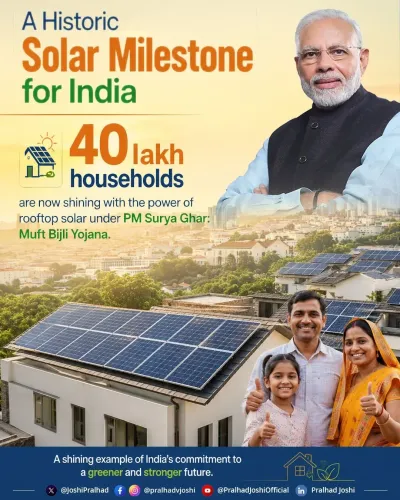
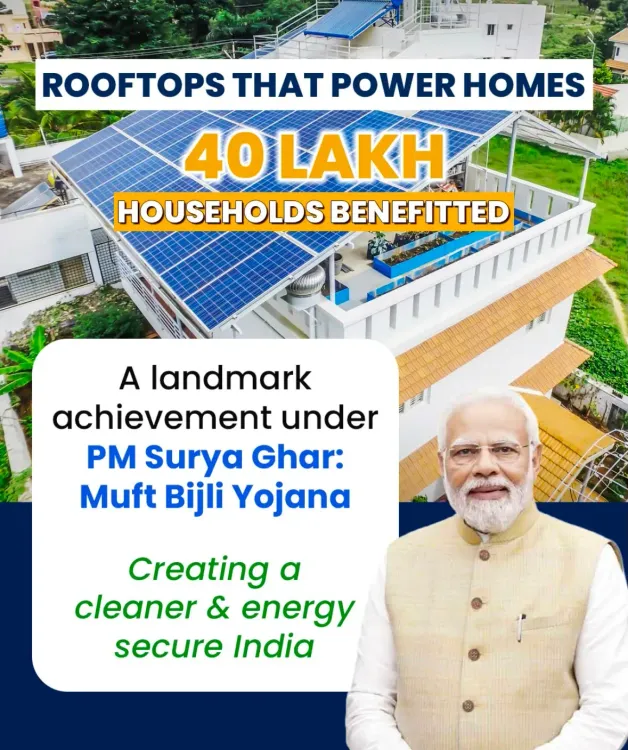
Union Minister Pralhad Joshi has highlighted that the PM Surya Ghar Muft Bijli Yojana has reached over 40 lakh households across India, providing rooftop solar installations and up to 300 units of free monthly electricity, as the government marks 12 years of its Garib Kalyan welfare drive.
Key Takeaways
Union Minister Pralhad Joshi stated on June 8, 2026 that more than 40 lakh households have benefited from the PM Surya Ghar Muft Bijli Yojana.
The scheme, launched in February 2024 , targets one crore households and provides central financial assistance for rooftop solar installations.
Eligible households receive up to 300 units of free electricity per month under the scheme.
The announcement was made under the #12YearsofGaribKalyan campaign, linking the scheme to the government's broader welfare record.
India aims to achieve 500 GW of non-fossil fuel energy capacity by 2030 , with rooftop solar a key component.
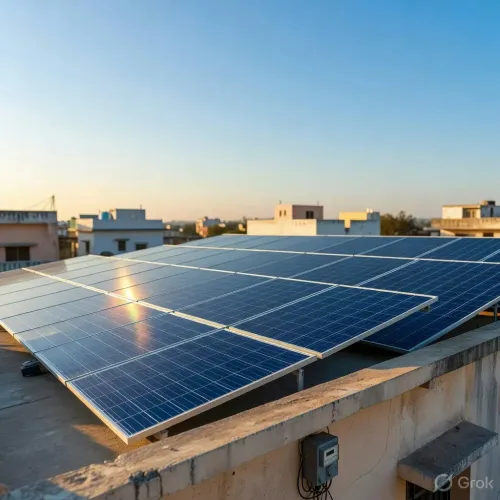
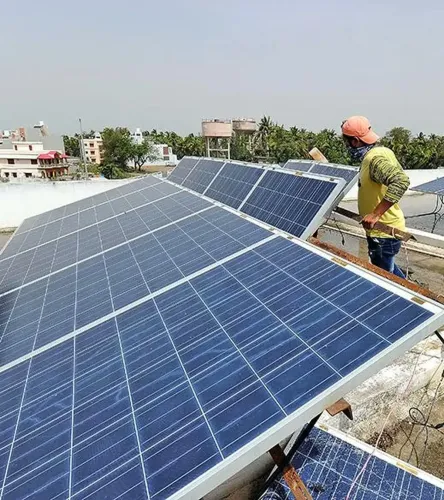
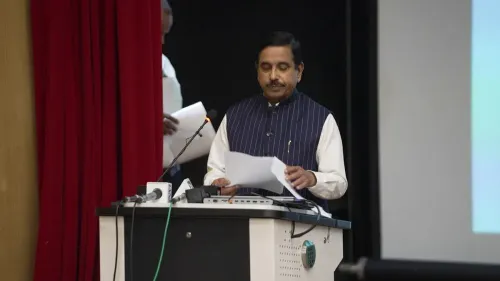
Union Consumer Affairs Minister Pralhad Joshi on Monday, June 8, 2026, highlighted the reach of the PM Surya Ghar Muft Bijli Yojana, stating that more than 40 lakh households across India have benefited from the scheme, which provides rooftop solar installations and up to 300 units of free electricity per month to eligible families.
Context
Joshi's post, shared under the hashtag #12YearsofGaribKalyan, frames the solar scheme as part of a decade-long arc of welfare delivery under the BJP-led central government. The minister noted that the scheme has helped families 'reduce electricity expenses and move towards a sustainable future,' directly linking clean energy access to household economic relief.
The PM Surya Ghar Muft Bijli Yojana was launched in February 2024 by the government of Prime Minister Narendra Modi with an ambitious target of reaching one crore households. The scheme provides central financial assistance for rooftop solar panel installations, with the dual goal of expanding distributed solar generation and lowering power bills for lower- and middle-income families.
Policy Backdrop
India's push for rooftop solar has deep policy roots. The Jawaharlal Nehru National Solar Mission, launched in 2010, first set the framework for scaling grid-connected and off-grid solar capacity nationwide. Since 2014, successive policy interventions have accelerated renewable capacity addition, with rooftop solar emerging as a key instrument for meeting the country's target of 500 GW of non-fossil fuel energy capacity by 2030.
The PM Surya Ghar Muft Bijli Yojana extends this lineage by tying clean energy directly to welfare outcomes — positioning solar not merely as an infrastructure goal but as a tool for reducing the financial burden on ordinary households. As Minister of New and Renewable Energy, Joshi oversees the scheme's implementation alongside his consumer affairs portfolio.
Stakeholders and Impact
The primary beneficiaries are Indian households, particularly those in the lower- and middle-income brackets who face high electricity costs. By installing rooftop solar panels with central subsidy support, enrolled families can offset their monthly power bills, with the scheme promising up to 300 units of free electricity each month.
The figure of more than 40 lakh households cited by the minister represents a significant share of the one-crore target set at launch. State governments, distribution companies, and local implementation agencies are key stakeholders in ensuring subsidy disbursement and installation quality reach intended beneficiaries on the ground.
What's Next
Analysts and policymakers will watch state-wise installation dashboards and subsidy disbursement data closely to assess whether the scheme remains on track toward its one-crore household target. Any mid-term review or revised allocation in the 2026-27 Union Budget could signal the government's assessment of progress and remaining gaps.
With India accelerating its clean energy commitments ahead of the 2030 non-fossil fuel target, the performance of demand-side schemes like PM Surya Ghar will increasingly serve as a benchmark for how effectively the country's renewable ambitions translate into tangible relief for ordinary citizens.
Point of View
Using a concrete beneficiary figure to reinforce the BJP government's welfare narrative ahead of what is likely a politically significant anniversary milestone. By anchoring a clean energy scheme within a welfare frame, the government is attempting to broaden the appeal of its renewable energy push beyond environmental policy into kitchen-table economics. The 40-lakh figure, if independently verified, would represent a meaningful step toward the one-crore target, though the gap between the two numbers also signals the scale of work remaining. As minister holding both the consumer affairs and renewable energy portfolios, Joshi is well-placed to articulate this dual welfare-and-energy argument.
NationPress
24 Oct 2026
Frequently Asked Questions
What is PM Surya Ghar Muft Bijli Yojana?
PM Surya Ghar Muft Bijli Yojana is a central government scheme launched in February 2024 that provides financial assistance for rooftop solar panel installations and delivers up to 300 units of free electricity per month to enrolled households.
How many households have benefited from PM Surya Ghar scheme?
Union Minister Pralhad Joshi stated on June 8, 2026 that more than 40 lakh households across India have benefited from the PM Surya Ghar Muft Bijli Yojana.
What is the target of PM Surya Ghar Muft Bijli Yojana?
The scheme was launched with a target of reaching one crore households across India, providing them with rooftop solar installations and subsidised clean electricity.
Who is the minister in charge of PM Surya Ghar scheme?
Pralhad Joshi, Union Minister of New and Renewable Energy as well as Consumer Affairs, Food and Public Distribution, oversees the implementation of the PM Surya Ghar Muft Bijli Yojana.
What is the 12 Years of Garib Kalyan campaign?
The 12 Years of Garib Kalyan campaign is a BJP government initiative marking over a decade of welfare programmes since 2014, under which schemes like PM Surya Ghar are highlighted as examples of welfare delivery for ordinary Indian households.