Minister Pralhad Joshi Remembers R. K. Laxman on Birth Anniversary
Synopsis
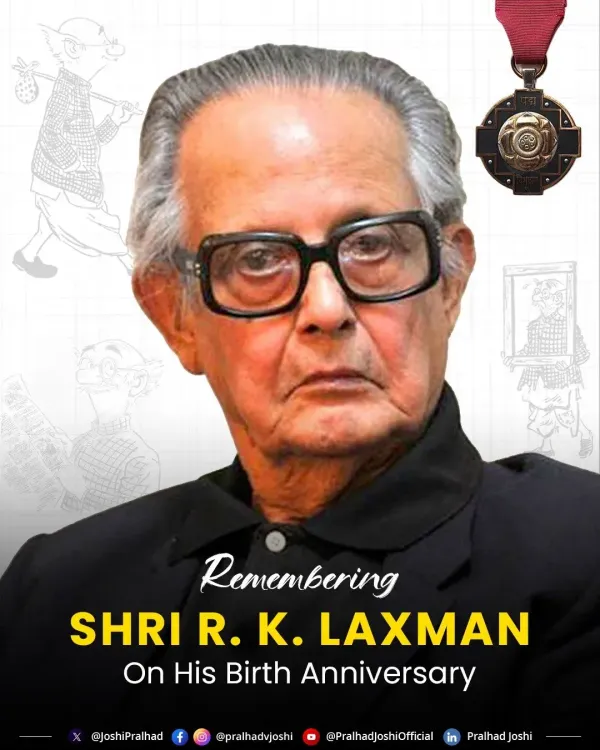
Union Minister Pralhad Joshi marked the birth anniversary of Padma Vibhushan R. K. Laxman, celebrating the legendary cartoonist's 'Common Man' as an enduring symbol of ordinary Indian life and a cornerstone of India's cultural legacy.
Key Takeaways
Union Minister Pralhad Joshi posted a bilingual tribute — in English and Kannada — to cartoonist R.
Laxman on his birth anniversary on 24 October 2026 .
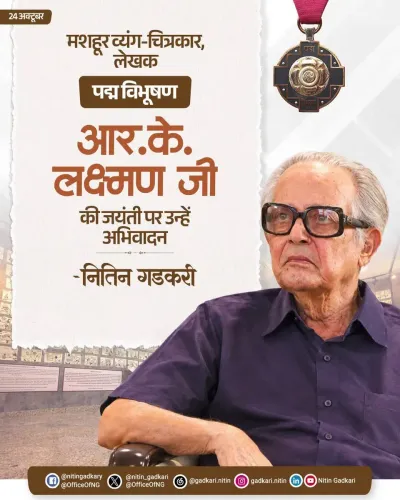
Laxman was awarded the Padma Vibhushan , India's second-highest civilian honour, for his contribution to Indian cartooning.
Laxman's iconic 'Common Man' character became a national symbol representing the ordinary Indian citizen's experience of governance and public life.
Joshi, a senior BJP leader from Karnataka , highlighted the shared Kannadiga heritage in his tribute, calling Laxman's art immortal — 'ಅಜರಾಮರ' .
Laxman's 'You Said It' strip, featuring the 'Common Man', ran for decades and shaped how generations of Indians engaged with political satire.
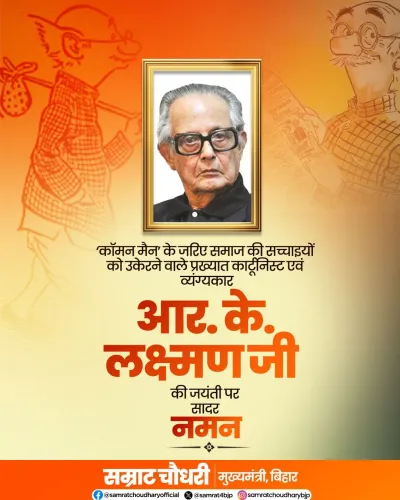
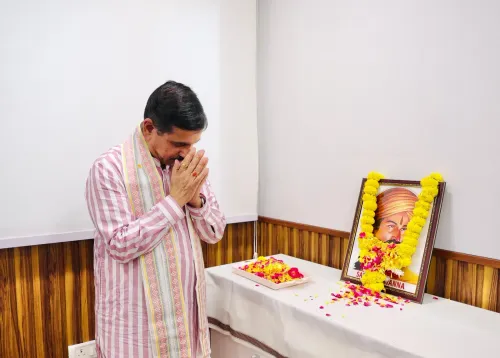
Long before Twitter gave every citizen a soapbox, one man with a pen and a chequered coat did the same job — and did it better. On his birth anniversary, Union Consumer Affairs Minister Pralhad Joshi paid tribute to Padma Vibhushan R. K. Laxman, saluting the legendary cartoonist who spent decades holding a mirror to the absurdities of Indian public life through his immortal 'Common Man'.
Posting on Saturday, 24 October 2026, Joshi wrote: 'Through his timeless cartoons and the beloved Common Man, he gave voice to the concerns of ordinary Indians, capturing the ironies of public life with wit and insight.' In Kannada, he added his respects to a fellow Kannadiga, calling Laxman's art immortal in the field of Indian cartooning — 'ಅಜರಾಮರ' (ajara-mara, literally 'deathless').
Who Was R. K. Laxman — and Why Does the 'Common Man' Still Matter?
Rasipuram Krishnaswami Laxman, born in Mysore, Karnataka, became the most widely recognised cartoonist in Indian history. His 'You Said It' strip, which ran for decades in one of India's most-read English dailies, made the 'Common Man' — a wide-eyed, dhoti-clad, silent bystander — a national institution. The character never spoke; he only watched. That silence was the point.
Through wars, elections, scams, and policy U-turns, the 'Common Man' stood on the sidelines — perpetually bewildered, permanently ignored, stubbornly present. Laxman's genius was in making that bystander the true protagonist of Indian democracy: a shorthand for every citizen squeezed between grand political promises and grinding daily reality. The Padma Vibhushan, India's second-highest civilian honour, recognised a career that shaped how an entire generation processed its government.
A Kannadiga Voice Honouring a Kannadiga Legacy
Joshi's tribute carries an additional layer — both he and Laxman share roots in Karnataka, and the minister posted a bilingual tribute in English and Kannada, underscoring Laxman's place in the regional cultural consciousness as much as the national one. The Kannada portion praises his 'subtle humour, satire, and social-political thought communicated simply through images.'
Such annual commemorations by Indian political figures serve a quiet but consistent function: they anchor living cultural memory inside the official public sphere, reminding a younger, scroll-happy audience that India's tradition of holding power to account with art stretches far deeper than any news cycle.
The 'Common Man' never retired. He just moved from newsprint to the national imagination — and tributes like this one are how he stays there.
Point of View
Using social media to stake a claim on shared national heritage. For a senior BJP leader from Karnataka, honouring Laxman — a Kannadiga who became a pan-Indian institution — reinforces a regional cultural pride that feeds into broader political identity. More substantively, the 'Common Man' remains a potent symbol: any invocation of him is implicitly an acknowledgement that the gap between citizen and state is real, persistent, and worth satirising. That the tribute comes from a sitting minister adds an unspoken irony Laxman himself would have appreciated.
NationPress
24 Oct 2026
Frequently Asked Questions
When was R. K. Laxman's birth anniversary?
R. K. Laxman was born on 24 October 1921 in Mysore, Karnataka, and his birth anniversary falls each year on 24 October.
Who was R. K. Laxman?
R. K. Laxman was India's most celebrated political cartoonist, best known for creating the 'Common Man' character and running the 'You Said It' strip for decades. He was awarded the Padma Vibhushan , India's second-highest civilian honour.
What is the 'Common Man' by R. K. Laxman?
The 'Common Man' is a fictional cartoon character — a silent, wide-eyed, dhoti-clad bystander — created by R. K. Laxman to represent the everyday Indian citizen caught between grand political promises and daily hardship. He became a national cultural icon.
Why did Minister Pralhad Joshi pay tribute to R. K. Laxman?
Union Minister Pralhad Joshi posted a tribute on 24 October 2026 to mark Laxman's birth anniversary, calling him a cultural legend whose contribution to Indian cartooning is an enduring part of the nation's heritage.
What award did R. K. Laxman receive?
R. K. Laxman was conferred the Padma Vibhushan , India's second-highest civilian honour, in recognition of his extraordinary contribution to Indian art and cartooning.