Jal Shakti Minister Paatil hails community water harvesting drive

Synopsis
Union Jal Shakti Minister C. R. Paatil on 14 July 2026 applauded civil society's role in PM Modi's 'Jal Sanchay – Jan Bhagidari' drive, citing the Girganga Parivar Trust's rainwater harvesting structures as proof that the campaign is taking root as a genuine mass movement.
Key Takeaways
Union Jal Shakti Minister C.
Paatil publicly praised the Girganga Parivar Trust for constructing rainwater harvesting structures under PM Modi's water conservation campaign.
The post frames Jal Sanchay – Jan Bhagidari as a call to convert government policy into a people-led mass movement.
The campaign builds on earlier schemes including the Jal Shakti Abhiyan (2019) and the Atal Bhujal Yojana (2018-19) .
Civil society groups, trusts, and local bodies are being positioned as co-implementers alongside the central government.
The ministry's next steps — formal guidelines and budget allocations for community-led works — will determine the campaign's scalability.
The initiative has direct implications for farmers and rural communities facing groundwater depletion and erratic rainfall.
Union Jal Shakti Minister C. R. Paatil on Tuesday, 14 July 2026 praised the active participation of civil society in Prime Minister Narendra Modi's 'Jal Sanchay – Jan Bhagidari' (Water Conservation – People's Participation) campaign, calling it an inspiring step toward turning the initiative into a mass movement. He specifically highlighted the rainwater harvesting structures built by the Girganga Parivar Trust as a heartening example of the government's conservation pledge becoming reality.
Context
Posting on X, Minister Paatil wrote that 'the active participation of society in giving the form of a mass movement to Prime Minister Modi's call of Jal Sanchay – Jan Bhagidari is extremely inspiring.' He singled out rainwater collection in water structures built by the Girganga Parivar Trust as a 'pleasant example of seeing this resolve come to fruition.' The post, tagged with #JalSanchayJanBhagidari and #ViksitBharat, was accompanied by a video, suggesting a ground-level documentation of the trust's work.
Policy Backdrop
The Jal Sanchay Jan Bhagidari campaign is part of a broader policy architecture that the central government has built around water security over the past decade. It draws on the lineage of the Jal Shakti Abhiyan, launched in 2019 as a time-bound drive for water conservation and rainwater harvesting across water-stressed districts, and the Atal Bhujal Yojana, approved in 2018-19 to strengthen community-based groundwater management across seven states.
The Jal Jeevan Mission, another flagship scheme under the Jal Shakti Ministry, has embedded community involvement in water management as a structural requirement, linking household tap-water access to local stewardship. Together, these programmes reflect a central government philosophy that treats water conservation as both an infrastructure challenge and a behavioural change imperative, with civil society groups, trusts, and local bodies positioned as co-implementers alongside the state.
Stakeholders and Impact
The Jan Bhagidari model targets rural communities, farmers, and civil society organisations as the primary agents of change. By publicly recognising the Girganga Parivar Trust's work, Minister Paatil signals that voluntary and faith-based organisations are being actively encouraged to build and maintain rainwater harvesting infrastructure — a model that can reduce pressure on groundwater in regions facing erratic monsoons and depletion of aquifers.
The emphasis on community-built water structures is particularly significant for agriculture-dependent districts, where groundwater depletion directly affects crop cycles and rural livelihoods. Mobilising non-governmental actors to augment storage and recharge structures has the potential to scale impact beyond what state budgets alone can achieve.
What's Next
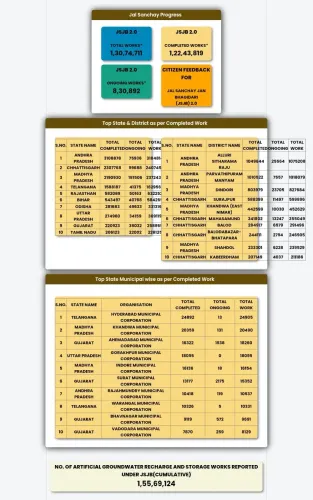
Attention will now turn to whether the Jal Shakti Ministry translates this public recognition into formal guidelines or additional funding for community-led water conservation works under the Jal Sanchay Jan Bhagidari framework. Progress reports on the number and capacity of rainwater harvesting structures created under the campaign, as well as any new budget allocations announced in the coming months, will be key indicators of how far the 'mass movement' framing converts into measurable outcomes on the ground.
Point of View
The ministry reinforces a 'Jan Bhagidari' governance model that has become a recurring motif across multiple central schemes, from Swachh Bharat to Jal Jeevan Mission. The move also serves a political purpose: it ties community action to PM Modi's personal brand on environment and development, ahead of what is likely to be a period of heightened scrutiny on water security given erratic monsoon patterns. Whether the ministry backs this rhetoric with concrete financial and institutional support for community-built infrastructure will be the real test of the campaign's ambitions.
NationPress
12 Oct 2026
Frequently Asked Questions
What is Jal Sanchay Jan Bhagidari?
Jal Sanchay Jan Bhagidari is a campaign launched by the central government calling on citizens, communities, and civil society organisations to actively participate in water conservation and rainwater harvesting, with the goal of turning water stewardship into a nationwide mass movement.
What did C. R. Paatil say about the Girganga Parivar Trust?
Minister C. R. Paatil described the rainwater harvesting structures built by the Girganga Parivar Trust as a 'pleasant example' of PM Modi's Jal Sanchay – Jan Bhagidari resolve becoming reality on the ground.
What is the Jal Shakti Abhiyan?
The Jal Shakti Abhiyan is a time-bound water conservation campaign launched in 2019 focused on rainwater harvesting and water recharge across water-stressed districts in India.
How does Jan Bhagidari work in water conservation?
Under the Jan Bhagidari model, the government encourages rural communities, farmers, NGOs, trusts, and local bodies to build and maintain water storage and recharge structures, supplementing central and state government investments in water infrastructure.
What is the Atal Bhujal Yojana?
The Atal Bhujal Yojana, approved in 2018-19, is a centrally sponsored scheme aimed at strengthening community-based groundwater management in seven Indian states facing acute groundwater depletion.