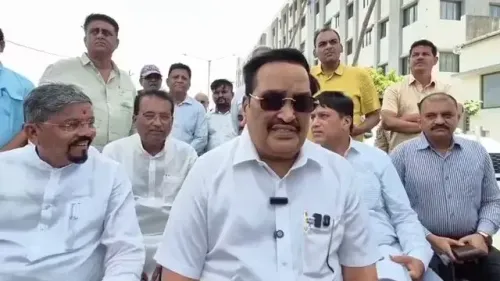
Jal Shakti Minister Paatil: 1.55 Cr Rain Harvesting Structures Built
Synopsis
Union Jal Shakti Minister C. R. Paatil announced on 1 June 2026 that over 1.55 crore rainwater harvesting structures have been completed under the Jal Sanchay Jan Bhagidari campaign — surpassing both JSJB 1.0 and JSJB 2.0 targets — marking a major milestone in India's community-driven water conservation drive.
Key Takeaways
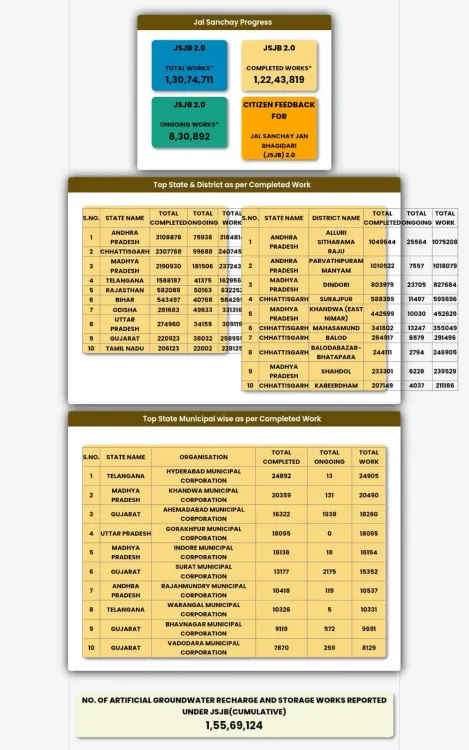
More than 1.55 crore rainwater harvesting structures have been built nationwide under the Jal Sanchay Jan Bhagidari campaign as of 31 May 2026 .
The campaign was launched by Prime Minister Narendra Modi from Surat, Gujarat on 6 September 2024 .
JSJB 1.0 targeted 10 lakh structures and JSJB 2.0 targeted 1 crore structures — both targets have been surpassed.
The Ministry of Jal Shakti positioned the achievement as evidence of growing public participation in water conservation.
The campaign is part of a broader policy framework — including the Jal Shakti Abhiyan, Jal Jeevan Mission, and Amrit Sarovar Mission — aimed at long-term water security under the Viksit Bharat agenda.
Farmers and rural communities are the primary beneficiaries, with structures designed to recharge aquifers and reduce irrigation vulnerability.
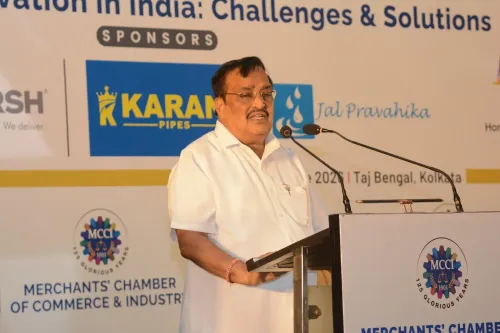
Union Jal Shakti Minister C. R. Paatil announced on Monday, 1 June 2026 that more than 1.55 crore rainwater harvesting structures have been completed across India under the Jal Sanchay Jan Bhagidari (JSJB) campaign, which was launched from Surat on 6 September 2024 at the call of Prime Minister Narendra Modi.
Sharing what he called 'pleasant news' with the nation, Paatil wrote on X: 'आज मुझे देशवासियों के साथ यह सुखद समाचार साझा करते हुए अत्यंत प्रसन्नता हो रही है' — 'Today I am extremely pleased to share this pleasant news with the countrymen.' He stated that the milestone of 1.55 crore-plus structures was crossed by 31 May 2026, ahead of the campaign's rolling targets.
Context
The Jal Sanchay Jan Bhagidari initiative was inaugurated by Prime Minister Modi in Surat, Gujarat in September 2024 as a mass-participation drive to build decentralised rainwater harvesting infrastructure. The campaign ran in two phases: JSJB 1.0, which set a target of 10 lakh structures, and JSJB 2.0, which raised the bar to a cumulative target of 1 crore structures. According to Paatil's post, both targets have been surpassed, with the final tally exceeding 1.55 crore.
The minister described the achievement as proof of 'public participation and growing awareness towards water conservation' — 'देशवासियों की सहभागिता और जल संरक्षण के प्रति बढ़ती जागरूकता का प्रमाण'. The structures span rural and urban areas nationwide, built through community-led effort coordinated by the Ministry of Jal Shakti.
Policy Backdrop
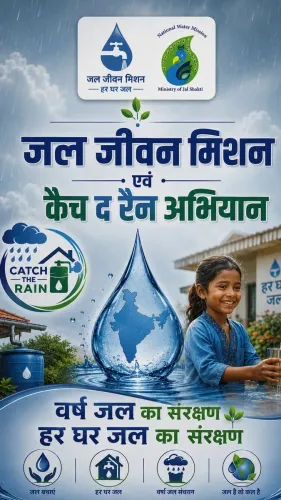
The JSJB campaign sits within a broader architecture of centrally-sponsored water programmes that India has pursued since 2019. The Jal Shakti Abhiyan, launched that year, focused on water conservation and groundwater recharge through district-level action plans. The Jal Jeevan Mission, also announced in 2019, aimed to provide functional household tap connections while embedding source-sustainability components. The Amrit Sarovar Mission, begun in 2022, targeted the construction or rejuvenation of ponds and water bodies across districts.
JSJB represents the latest and most explicitly community-driven layer of this policy stack, placing the onus of construction on local participation rather than purely on government contractors. The Ministry of Jal Shakti has positioned the campaign as a vehicle for the Viksit Bharat (Developed India) framework's long-term water-security objectives.
Stakeholders and Impact
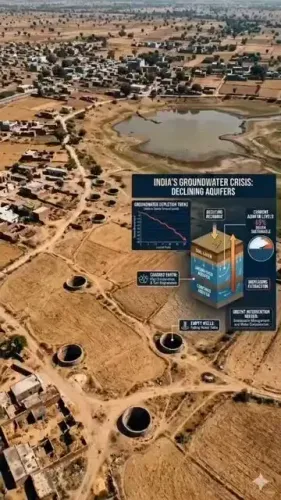
Farmers and rural communities are the primary intended beneficiaries. Rainwater harvesting structures — ranging from farm ponds and check dams to rooftop collection units — are designed to recharge local aquifers, reduce dependence on monsoon variability, and lower irrigation costs. India's Central Ground Water Board has for years flagged declining water tables in large parts of the country, making decentralised recharge a policy priority.
Paatil stated that the campaign 'will not only help improve the groundwater level in the country, but will also prove to be an important step towards ensuring water security for Viksit Bharat.' The scale — 1.55 crore structures across a single campaign cycle — would, if sustained, represent one of the largest community-driven water infrastructure drives in the country's recent history.
What's Next
The government's next measurable test will be whether the completed structures translate into verifiable improvements in groundwater levels, a metric tracked through periodic assessments by the Central Ground Water Board. Parliamentary oversight committees and independent researchers are expected to scrutinise the quality, geographic distribution, and functional status of the reported structures.
With the monsoon season approaching, the efficacy of the newly built harvesting infrastructure will face its first large-scale operational test. Any formal announcement of a JSJB 3.0 or an expanded national target would signal the government's confidence in the programme's delivery model and its intent to deepen community participation in water governance.
Point of View
Framing a quantitative milestone in community water infrastructure as validation of the 'Jan Bhagidari' (people's participation) governance model championed by Prime Minister Modi. By citing both JSJB 1.0 and 2.0 targets as surpassed, the Ministry of Jal Shakti is signalling iterative ambition — a pattern consistent with how flagship schemes are scaled and communicated ahead of budget cycles or electoral calendars. The real policy test, however, lies downstream: whether the volume of structures correlates with measurable groundwater recovery, a question that independent monitoring bodies and parliamentary committees will be expected to pursue. The framing within the Viksit Bharat narrative also ties water security explicitly to the government's long-horizon development agenda, elevating JSJB from a sectoral scheme to a civilisational project in official discourse.
NationPress
15 Oct 2026
Frequently Asked Questions
What is the Jal Sanchay Jan Bhagidari campaign?
Jal Sanchay Jan Bhagidari is a public-participation campaign launched by Prime Minister Narendra Modi on 6 September 2024 in Surat, Gujarat, to build decentralised rainwater harvesting structures across India. It ran in two phases — JSJB 1.0 targeting 10 lakh structures and JSJB 2.0 targeting 1 crore structures — and is coordinated by the Ministry of Jal Shakti.
How many structures have been built under JSJB by 2026?
According to Union Jal Shakti Minister C. R. Paatil, more than 1.55 crore rainwater harvesting structures had been completed across India by 31 May 2026, surpassing both phase-wise targets set under the campaign.
Who launched the Jal Sanchay Jan Bhagidari campaign and where?
Prime Minister Narendra Modi launched the campaign on 6 September 2024 in Surat, Gujarat. The initiative was designed as a community-driven drive to build rainwater harvesting infrastructure at the grassroots level.
What is the difference between JSJB 1.0 and JSJB 2.0?
JSJB 1.0 set an initial target of 10 lakh rainwater harvesting structures, while JSJB 2.0 expanded the cumulative target to 1 crore structures. The Ministry of Jal Shakti has announced that both targets have been exceeded as of May 2026.
How does Jal Sanchay Jan Bhagidari relate to other water schemes in India?
It is the latest in a series of centrally-sponsored water conservation programmes that includes the Jal Shakti Abhiyan (2019), Jal Jeevan Mission (2019), and Amrit Sarovar Mission (2022). Together, these schemes aim to improve groundwater levels and ensure long-term water security under the government's Viksit Bharat framework.