Rajnath Singh hails 40-lakh PM Surya Ghar milestone
Synopsis
Union Defence Minister Rajnath Singh on 29 May 2026 hailed the 40-lakh household milestone under the PM Surya Ghar Muft Bijli Yojana, describing it as a defining symbol of India's clean energy transformation and the NDA government's commitment to sustainable, affordable energy for families.
Key Takeaways
Rajnath Singh posted on 29 May 2026 celebrating 40 lakh households enrolled under the PM Surya Ghar Muft Bijli Yojana .
The scheme was announced in the 2024 Union Budget with a target of one crore household rooftop solar installations.
Eligible households receive up to 300 units of free electricity per month through subsidised grid-connected solar panels.
India has committed to 500 GW of non-fossil fuel capacity by 2030 and net-zero by 2070 , with rooftop solar a key instrument.
The minister framed the milestone as reflecting the NDA Government 's commitment to sustainable growth and reduced electricity burden for families.
Reaching the one-crore target will require continued momentum on registrations, grid connectivity, and vendor capacity across smaller towns and rural areas.
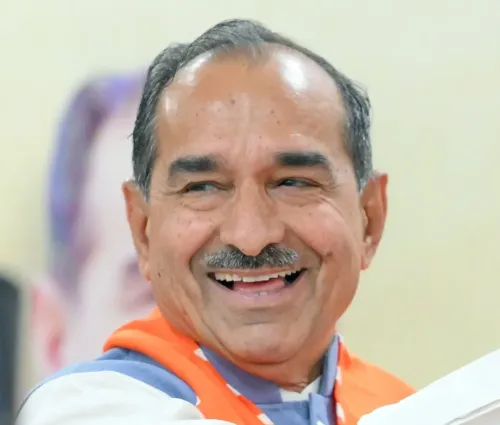
Union Defence Minister Rajnath Singh on Friday, 29 May 2026, celebrated the 40-lakh household milestone under the Pradhan Mantri Surya Ghar Muft Bijli Yojana, calling it a 'defining symbol of India's clean energy transformation' under Prime Minister Narendra Modi's leadership.
Context
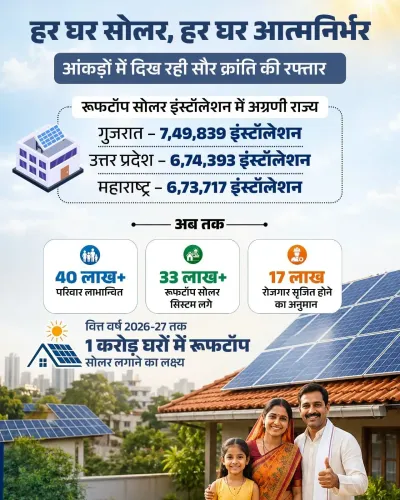
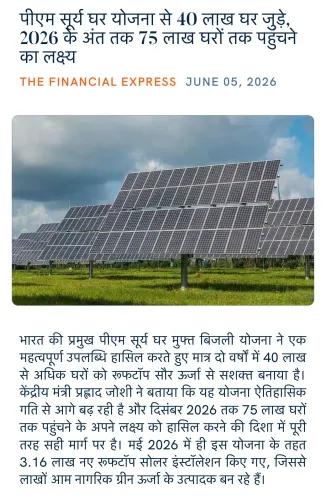
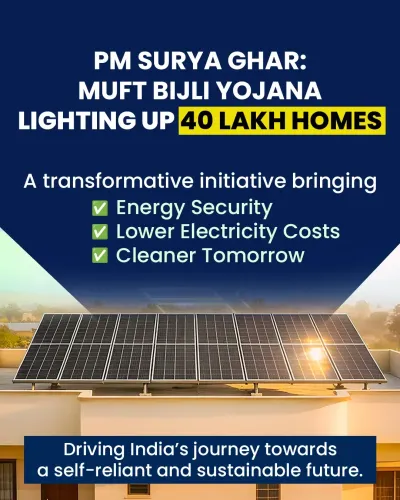
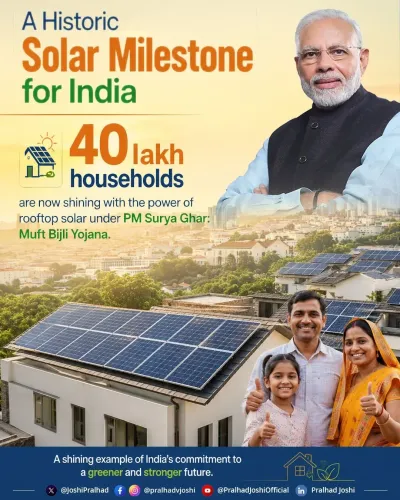
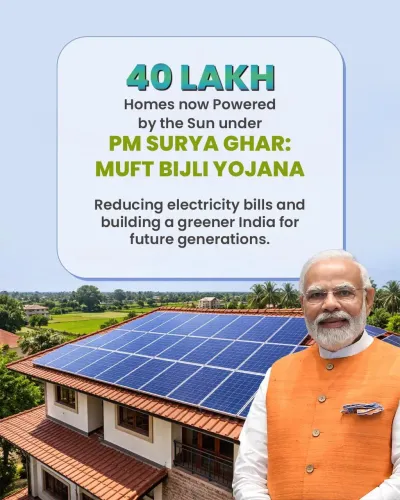
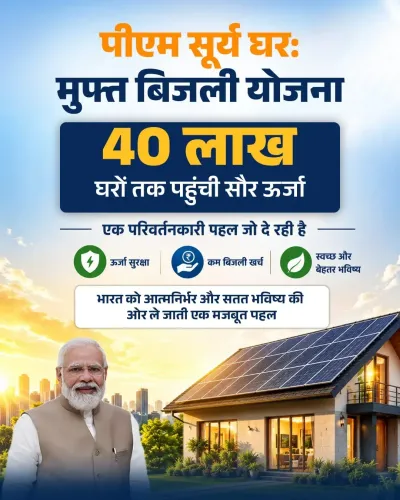
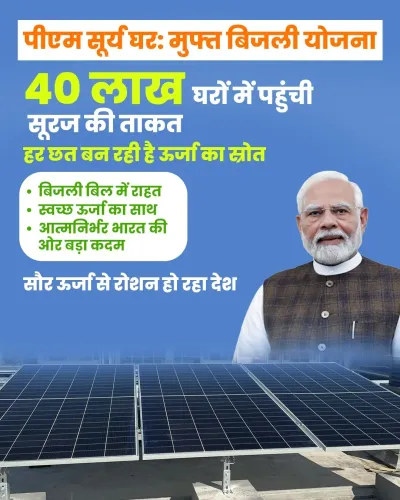
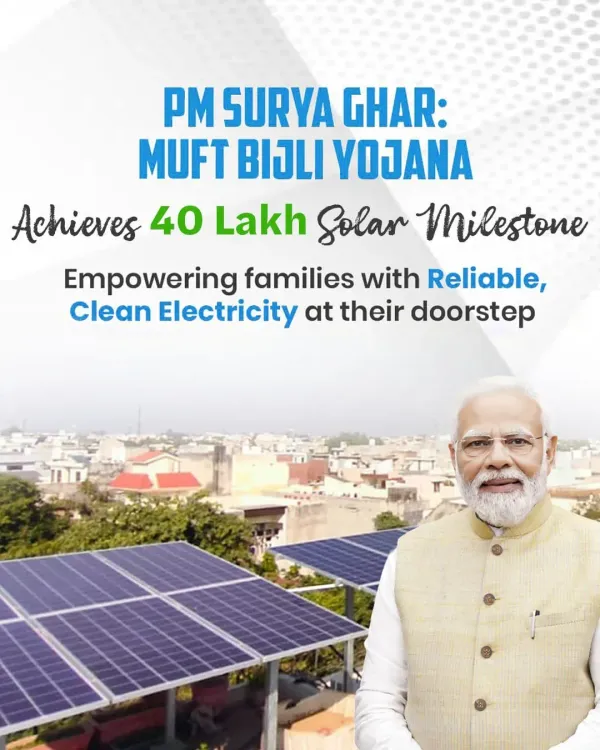
Singh posted on X with four images marking the occasion, stating that the scheme has moved 'from illuminating homes to empowering aspirations.' He credited the NDA Government with delivering on commitments around sustainable growth and reducing the electricity burden on ordinary families.
The post uses the hashtag #40LakhsPMSuryaGhar, signalling a coordinated government communication push around the numerical milestone. The minister described the achievement as 'historic' and framed it as a legacy investment for 'coming generations.'
Policy Backdrop
The Pradhan Mantri Surya Ghar Muft Bijli Yojana was announced in the 2024 Union Budget with a target of installing subsidised rooftop solar systems on one crore households. The scheme offers eligible families up to 300 units of free electricity per month through grid-connected solar panels.
The programme sits within India's broader renewable energy architecture. At COP26 in 2021, India committed to achieving 500 GW of non-fossil fuel energy capacity by 2030 and net-zero emissions by 2070. Rooftop solar has been identified as a key instrument for distributing the energy transition directly to households rather than concentrating it in utility-scale projects alone.
Multiple central subsidy windows and state-level co-financing arrangements have been deployed since the scheme's launch to accelerate registrations and installations across urban and semi-urban areas.
Stakeholders and Impact
The primary beneficiaries are Indian households, particularly those in the lower and middle-income segments for whom electricity costs represent a significant share of monthly expenditure. Free or heavily subsidised units translate directly into household savings.
The renewable energy sector — including solar panel manufacturers, engineering procurement and construction contractors, and distribution companies — stands to gain from sustained demand generated by the scheme. The 40-lakh figure, if sustained toward the one-crore target, represents a substantial pipeline for domestic solar manufacturing, a sector the government has separately incentivised through production-linked incentive programmes.
For the BJP and the NDA coalition, the milestone also carries political salience ahead of state assembly cycles, as tangible household-level benefits are a core plank of the party's welfare-delivery narrative.
What's Next
The government is expected to issue further official updates on cumulative installation numbers, subsidy disbursements, and any scheme expansions or enhanced budget allocations in the next fiscal cycle. Reaching the one-crore target — the scheme's original benchmark — will require sustaining the current pace of registrations and resolving on-ground bottlenecks around grid connectivity and vendor capacity in smaller towns and rural areas.
With 40 lakh households now on record as beneficiaries, the PM Surya Ghar scheme is increasingly central to India's pitch that its energy transition is equitable and household-level, not merely a macro-grid story — a framing that carries weight in both domestic politics and international climate diplomacy.
Point of View
Positioned against a one-crore target, allows the government to claim momentum while keeping the larger goal in view as a continuing mandate. For a minister whose primary portfolio is defence, the intervention underscores how clean energy has become a whole-of-government political asset for the BJP, not just a domain of the power or environment ministries. The framing around 'coming generations' and climate consciousness also reflects an effort to align domestic scheme delivery with India's international climate commitments.
NationPress
13 Oct 2026
Frequently Asked Questions
What is the PM Surya Ghar Muft Bijli Yojana?
The Pradhan Mantri Surya Ghar Muft Bijli Yojana is a central government scheme that provides subsidised rooftop solar installations to households, offering eligible families up to 300 units of free electricity per month through grid-connected solar panels. It was announced in the 2024 Union Budget with a target of one crore households.
How many households have benefited from PM Surya Ghar so far?
As of the milestone cited by Defence Minister Rajnath Singh on 29 May 2026, 40 lakh households have been covered under the PM Surya Ghar scheme. The scheme's original target is one crore households.
Why did Rajnath Singh comment on a solar energy scheme?
As a senior NDA cabinet minister and BJP leader, Rajnath Singh regularly amplifies government welfare milestones across portfolios. His post reflects the NDA government's practice of collective ministerial communication around major scheme achievements.
What is India's renewable energy target by 2030?
India committed at COP26 in 2021 to achieving 500 GW of non-fossil fuel energy capacity by 2030 and reaching net-zero emissions by 2070. Rooftop solar schemes like PM Surya Ghar are a key part of the strategy to meet these targets.
What free electricity does PM Surya Ghar provide?
Under the PM Surya Ghar Muft Bijli Yojana, eligible households can receive up to 300 units of free electricity per month through their subsidised rooftop solar installation connected to the grid.