Sonowal Hails 40 Lakh Homes Under PM Surya Ghar Yojana
Synopsis
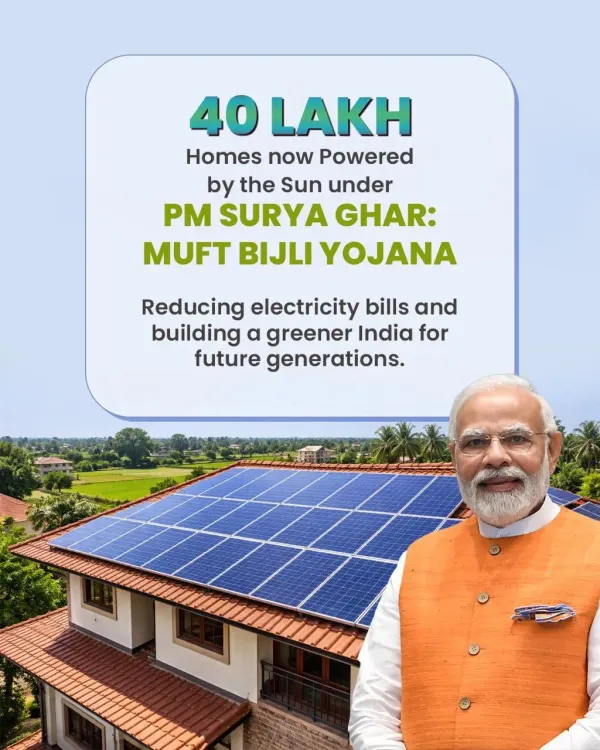
Union Minister Sarbananda Sonowal on 29 May 2026 announced that PM Surya Ghar Muft Bijli Yojana has reached 40 lakh households with rooftop solar, marking a significant step toward the scheme's one-crore target by 2027 under PM Modi's clean-energy push.
Key Takeaways
40 lakh households have received rooftop solar installations under PM Surya Ghar Muft Bijli Yojana as of May 2026.
The scheme targets one crore households to be solarised by 2027 , offering up to 300 units of free electricity per month.
Union Minister Sarbananda Sonowal amplified the milestone on X, reflecting cross-ministry coordination on the scheme's messaging.
The programme is part of India's goal to achieve 500 GW of non-fossil fuel capacity by 2030 .
The scheme was announced in 2024 and builds on India's solar mission lineage dating to 2010 .
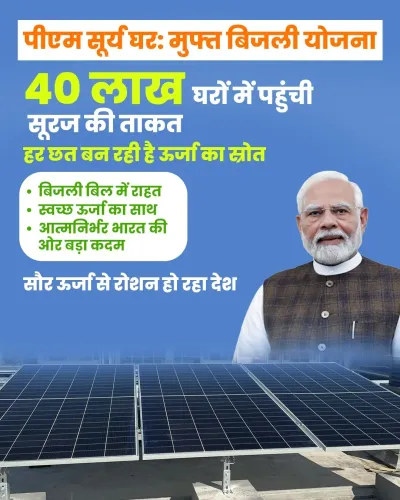
Union Minister of Ports, Shipping and Waterways Sarbananda Sonowal on Friday, 29 May 2026 highlighted a key milestone under the PM Surya Ghar Muft Bijli Yojana, stating that 40 lakh households across India have been empowered with rooftop solar installations under the scheme championed by Prime Minister Narendra Modi.
Context
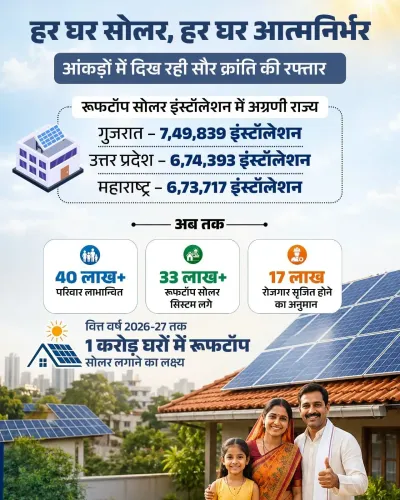
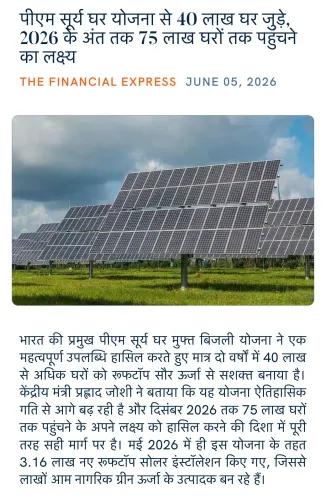
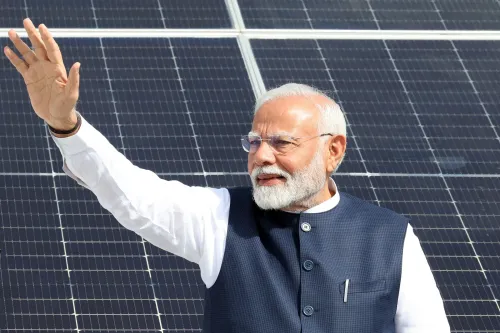
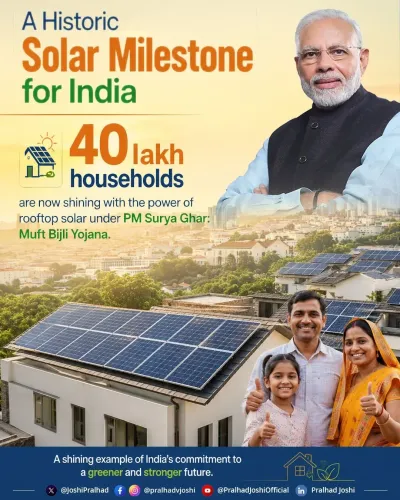
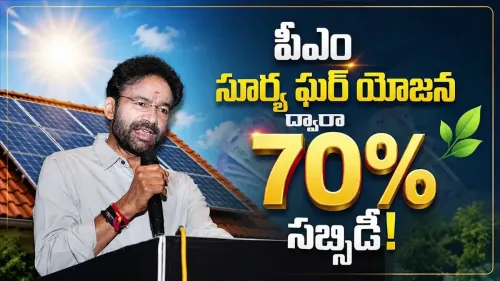
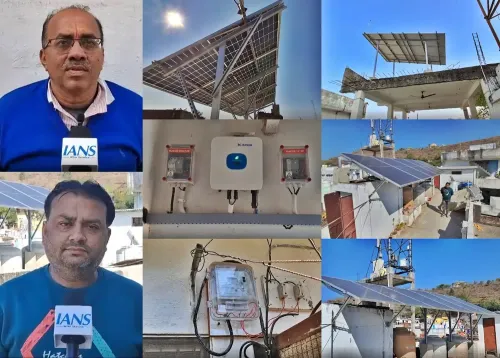
In his post on X, Sonowal wrote: 'India's solar revolution is shining brighter than ever. Under the leadership of Hon'ble PM Shri Narendra Modi Ji, PM Surya Ghar Muft Bijli Yojana has empowered 40 lakh homes with rooftop solar, accelerating India's Clean Energy future.' The post was accompanied by four images and carried the hashtag #40LakhsPMSuryaGhar, signalling a coordinated government communication push around the scheme's progress.
The minister's remarks place the 40 lakh figure as a visible waypoint on the road to the scheme's stated target of solarising one crore households by 2027. Cross-ministry amplification of the milestone underscores the scheme's centrality to the ruling dispensation's clean-energy narrative.
Policy Backdrop
PM Surya Ghar Muft Bijli Yojana was announced in 2024 with the promise of providing eligible households up to 300 units of free electricity per month through subsidised rooftop solar systems. The scheme draws its lineage from the Jawaharlal Nehru National Solar Mission of 2010, which first set grid-connected solar capacity targets for the country.
The programme sits within India's broader ambition to build 500 GW of non-fossil fuel power capacity by 2030, a commitment made at successive international climate forums. Rooftop solar is seen as a demand-side complement to the large utility-scale solar parks being developed across Rajasthan, Gujarat, and other sun-rich states.
Stakeholders and Impact
The primary beneficiaries are residential electricity consumers, particularly households in states where daytime grid supply is unreliable or tariffs are rising. By generating power at the point of consumption, rooftop installations reduce dependence on distribution companies and can translate into direct savings on monthly bills.
State electricity boards and distribution companies are also key stakeholders, as net-metering arrangements under the scheme require grid integration and administrative coordination at the state level. Smooth implementation depends on alignment between central subsidy disbursement and state-level regulatory frameworks.
What's Next
With 40 lakh households now reported as covered, the government faces the larger challenge of scaling installations to reach the one-crore target within the remaining window before 2027. Parliamentary sessions are expected to see updates on state-wise installation data and subsidy utilisation figures as scrutiny of the scheme's pace intensifies.
Sonowal's post is part of a pattern of senior ministers publicly endorsing the scheme's progress, suggesting the PM Surya Ghar Muft Bijli Yojana will remain a flagship communications vehicle for the government in the run-up to state and national electoral cycles.
Point of View
A pattern that reveals how the scheme has been elevated into a whole-of-government communications asset rather than a portfolio-specific announcement. Reaching 40 lakh households is a credible progress marker, but the gap to the one-crore target means the government will need to sustain both subsidy flows and state-level administrative capacity at scale. The timing — well ahead of the 2027 deadline — allows the BJP to bank an early win narrative while managing expectations on the steeper climb ahead. For a minister whose primary portfolio is ports and waterways, the post also signals the broader expectation that senior leaders actively amplify the Prime Minister's flagship schemes regardless of departmental remit.
NationPress
13 Oct 2026
Frequently Asked Questions
What is PM Surya Ghar Muft Bijli Yojana?
PM Surya Ghar Muft Bijli Yojana is a central government scheme launched in 2024 to install subsidised rooftop solar systems on residential homes, providing eligible households up to 300 units of free electricity per month. Its target is to solarise one crore households by 2027.
How many homes have been covered under PM Surya Ghar Muft Bijli Yojana?
According to Union Minister Sarbananda Sonowal's post on 29 May 2026, 40 lakh homes have been empowered with rooftop solar under the scheme.
Who is Sarbananda Sonowal?
Sarbananda Sonowal is the Union Minister of Ports, Shipping and Waterways in the Government of India, a senior BJP leader, and a former Chief Minister of Assam.
What is India's solar energy target for 2030?
India has committed to achieving 500 GW of non-fossil fuel power capacity by 2030, with rooftop solar programmes like PM Surya Ghar Muft Bijli Yojana forming a key part of that strategy.
What free electricity does PM Surya Ghar scheme offer?
The PM Surya Ghar Muft Bijli Yojana offers eligible households up to 300 units of free electricity per month through rooftop solar installations subsidised by the central government.