Akhilesh Yadav urges Sonam Wangchuk to end hunger strike
Synopsis
Samajwadi Party president Akhilesh Yadav has publicly urged activist Sonam Wangchuk to end his hunger strike, arguing the BJP government is too 'principleless and corrupt' to respond to moral pressure. He called Wangchuk a beacon for democracy and environmental causes across India.
Key Takeaways
Akhilesh Yadav made a public appeal on 14 July 2026 urging Sonam Wangchuk to end his hunger strike, calling his life 'priceless for the entire world.' Yadav described the BJP as a 'principleless, corrupt system' and said hoping for its moral transformation was 'futile,' arguing Wangchuk's sacrifice was being wasted on an unresponsive government.
Sonam Wangchuk , founder of SECMOL and a renowned Ladakhi innovator, has led protests since 2023 demanding statehood and Sixth Schedule protections for Ladakh .
Ladakh was made a Union Territory without a legislature in 2019 after the abrogation of Article 370 , sparking sustained local and national campaigns for constitutional safeguards.
Yadav called Wangchuk a 'lighthouse' ( prakash stambh ) for citizens, youth, democracy, and the environment, and urged him to remain a source of inspiration against 'negative forces.' Any response from the Ministry of Home Affairs or a parliamentary debate during the monsoon session could be the next critical development in the Ladakh statehood standoff.
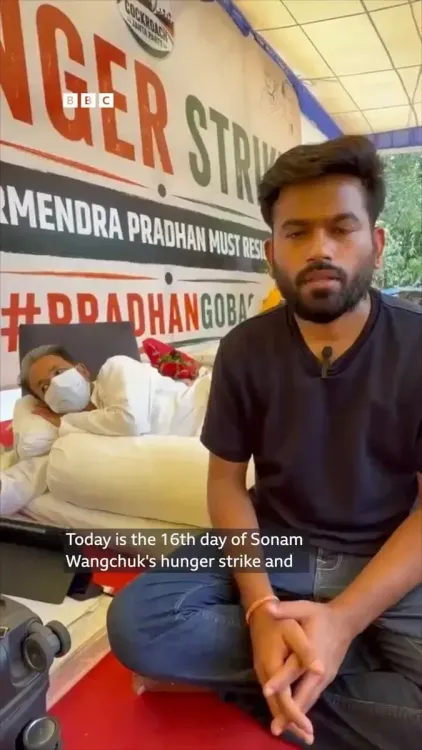
Samajwadi Party president Akhilesh Yadav on Tuesday, 14 July 2026, made a public appeal to Ladakhi activist Sonam Wangchuk urging him to break his hunger strike, while launching a sharp attack on the Bharatiya Janata Party for what he called its indifference to civil-society protests.
Context
In his post on X, Yadav addressed Wangchuk directly, writing — translated from Hindi — 'Sri Sonam Wangchuk ji se hamara ati vinamra aagraha aur savinay appeal hai ki wo apna anshan tod den' ('We humbly and respectfully appeal to Shri Sonam Wangchuk to break his fast'). He said Wangchuk's life was 'priceless for the entire world' because it embodied commitment to humanity, the environment, and democracy in equal measure.
Yadav argued that continuing the fast-unto-death against the BJP government was futile, describing the ruling dispensation as a 'principleless, corrupt system' ('siddhantaheen, bhrasht tantra') incapable of moral change. He said those consumed by arrogance — 'jinmein ahankaar hota hai unmen parishkaar nahin hota' ('those who harbour ego cannot be refined') — could not be moved by sacrifice.
Policy Backdrop
Ladakh was carved out of Jammu and Kashmir and granted Union Territory status in 2019 following the abrogation of Article 370. Since then, residents have mounted sustained campaigns demanding full statehood, inclusion under the Sixth Schedule of the Constitution, and stronger protections for the region's fragile ecology against commercial mining and infrastructure projects.
Sonam Wangchuk, founder of the Students' Educational and Cultural Movement of Ladakh (SECMOL) and a Magsaysay Award-winning innovator, has led multiple public fasts and protest marches since 2023 to press these demands. His campaigns have drawn national and international attention to glacial melt, land-rights concerns, and the absence of an elected legislature in Ladakh.
Yadav invoked the concept of 'satyagraha' (truth-force) against what he called 'sattagraha' (lust for power), accusing BJP leaders of looting even temples in their hunger for authority — a rhetorical contrast aimed at delegitimising the government's moral standing in the face of non-violent protest.
Stakeholders and Impact
Wangchuk's protest has drawn solidarity from environmental groups, youth organisations, and opposition parties across the country. Yadav's statement extends that cross-regional alliance, positioning the Samajwadi Party alongside civil-society movements in border and hill regions — a pattern seen among non-BJP parties seeking to highlight federal asymmetry and environmental governance failures.
For Ladakhi residents, the stakes include both constitutional rights and ecological survival. Glacial retreat and unregulated mining threaten livelihoods that have depended on traditional water and land use for centuries. Yadav called Wangchuk a 'lighthouse' (prakash stambh) for all those fighting negative forces on behalf of citizens, youth, democracy, and the environment.
The SP chief also took aim at what he called the BJP's 'underground, unregistered associates' — a reference to affiliated organisations — framing the broader opposition task as defeating this 'mahapapi-adharmi' (greatly sinful, unrighteous) combine permanently.
What's Next
All eyes are now on whether Wangchuk heeds appeals from opposition leaders and civil-society voices to suspend his fast while political pressure is maintained through other channels. Any statement from the Ministry of Home Affairs on Ladakh's administrative status, or a possible parliamentary discussion during the ongoing monsoon session, could shift the political calculus significantly.
Yadav's intervention signals that Ladakh's demands for statehood and Sixth Schedule protections will remain a live issue in national opposition politics, with the SP likely to raise it in Parliament and on the campaign trail ahead of future state elections.
Point of View
He simultaneously expresses solidarity and frames the ruling party as the sole obstacle to Ladakh's legitimate demands. The intervention fits a broader opposition strategy of building cross-regional alliances around civil-society movements to highlight federal and environmental governance failures ahead of electoral cycles. Invoking 'satyagraha' versus 'sattagraha' is a calculated rhetorical move designed to occupy moral high ground without committing to a specific legislative remedy. Whether such statements translate into concrete parliamentary action on Ladakh's statehood or Sixth Schedule demands will be the real test of their political weight.
NationPress
14 Jul 2026
Frequently Asked Questions
Why is Sonam Wangchuk on a hunger strike?
Sonam Wangchuk has been protesting to demand full statehood for Ladakh, inclusion under the Sixth Schedule of the Constitution, and stronger environmental protections — rights that Ladakhi residents say were promised but not delivered after the region was made a Union Territory in 2019.
What did Akhilesh Yadav say about Sonam Wangchuk's fast?
Akhilesh Yadav urged Wangchuk to break his fast, calling his life 'priceless for the entire world.' He argued that continuing the hunger strike against the BJP was futile because, in his words, the ruling party is a 'principleless, corrupt system' incapable of moral change.
What is the Sixth Schedule and why does Ladakh want it?
The Sixth Schedule of the Indian Constitution provides autonomous governance councils to tribal-majority areas, protecting land rights, cultural practices, and local laws. Ladakhi activists argue its protections are essential to safeguard the region's ecology and indigenous communities from outside commercial interests.
What happened to Ladakh's status in 2019?
In August 2019, the Indian government abrogated Article 370 and bifurcated Jammu and Kashmir, making Ladakh a separate Union Territory without a legislature. Residents have since demanded statehood and constitutional safeguards to restore a degree of self-governance.
Is the Samajwadi Party involved in Ladakh politics?
The Samajwadi Party has no direct electoral presence in Ladakh, but its president Akhilesh Yadav has expressed solidarity with the Ladakh statehood and environmental movement as part of a broader national opposition effort to highlight federal asymmetry and governance failures under the BJP-led central government.