Akhilesh Yadav targets Yogi govt in sharp verse on X

Synopsis
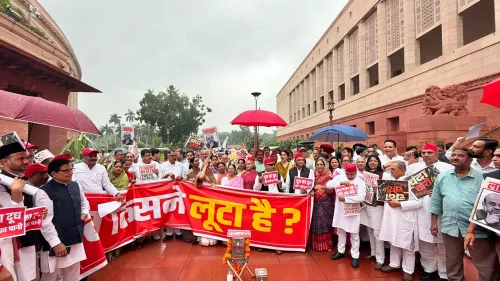
Samajwadi Party president Akhilesh Yadav posted a pointed Hindi poem on X on 30 May 2026, accusing the Uttar Pradesh BJP government of bulldozer demolitions, fake encounters, communal bias, and welfare failures — closing with a declaration that the ruling side is 'leaving and not returning.'
Key Takeaways
Akhilesh Yadav posted a multi-stanza Hindi verse on X on 30 May 2026 targeting the Uttar Pradesh BJP government .
The poem accuses the administration of using bulldozers to demolish homes and shops, filing fabricated cases, and running fake encounters .
It references specific pressure points: Shiksha Mitra pay cuts, ASHA and Anganwadi worker grievances, and the demolition of structures at Manikarnika Ghat, Varanasi .
The verse attacks alleged dilution of reservation policy and oppression of the Samajwadi Party's PDA (Pichhda-Dalit-Alpsankhyak) social coalition.
The closing line declares the ruling dispensation is 'leaving and never returning,' signalling the SP's confidence ahead of 2027 Uttar Pradesh assembly elections .
The post names no individuals directly, using the rhetorical device of the '-wale' suffix to describe actions rather than actors.
Samajwadi Party president Akhilesh Yadav on Saturday, 30 May 2026, launched a pointed political broadside against the Uttar Pradesh BJP government through a lengthy poem posted on X, cataloguing what he described as governance failures, communal bias, and abuse of state power under the current administration.
Context
The post, written entirely in Hindi verse, lists a series of accusations against those in power — without naming any individual directly. Each couplet ends with the refrain 'wale' (those who do), and the poem closes with the line: 'ab hain jaanewale lautkar na aanewale' — 'now they are leaving, never to return.' The rhetorical device is a staple of Hindi political oratory, allowing Yadav to catalogue grievances while maintaining the cadence of a public address.
Among the charges levelled in verse: dropping genuine criminal cases while filing fabricated ones, using bulldozers to demolish homes and shops, harassing citizens over electricity and water supply, using abusive language against journalists, and taking foreign trips under the guise of botanical research. The poem also accuses the ruling dispensation of bestowing patronage on co-caste loyalists and spreading communal poison.
Policy Backdrop
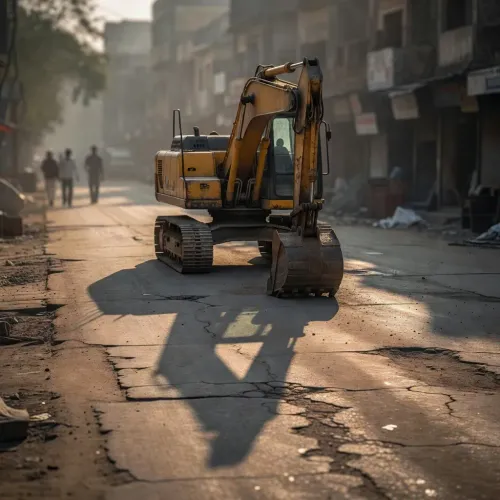
Several lines in the poem map directly onto documented policy disputes in Uttar Pradesh. The BJP government's bulldozer-led anti-encroachment drives, which began in 2017, have been a recurring flashpoint, with opposition parties arguing they disproportionately target minorities and political opponents. The verse line 'bulldozer se ghar-dukaan dhaanewale' ('those who demolish homes and shops with bulldozers') directly invokes that controversy.
The poem's reference to Shiksha Mitras — para-teachers employed in state government schools — echoes a long-running dispute over their honorarium and service conditions that has periodically erupted since 2017. Similarly, the mention of ASHA and Anganwadi workers being 'misled' reflects grievances over wages and welfare that these frontline health and nutrition workers have raised repeatedly. The line targeting lawyers — 'advocates pe laathi chalwanewale' ('those who wield batons on advocates') — alludes to reported clashes between police and the legal community in the state.
The reference to Manikarnika Ghat in Varanasi — one of Hinduism's most sacred cremation grounds — points to infrastructure and development works there that generated public controversy between 2019 and 2021. Yadav's verse accuses the government of having the ghat's structure broken.
On reservation, the poem accuses the ruling side of 'running scissors over reservation' — a metaphor for diluting constitutionally mandated quotas — and of inflicting 'gross oppression' on the PDA coalition, the Samajwadi Party's own social alliance of Pichhda (OBC), Dalit, and Alpsankhyak (minority) communities, which has been central to the party's electoral strategy since the 2022 Uttar Pradesh assembly elections.
Stakeholders and Impact
The poem names or implies a wide range of constituencies: journalists, lawyers, teachers, ASHA workers, Anganwadi workers, Shiksha Mitras, religious minorities, OBC communities, Dalits, and saints. By aggregating these groups into a single verse, Yadav appears to be reinforcing the PDA coalition's breadth ahead of the 2027 Uttar Pradesh assembly elections.
The line 'satta sajatiya pe kripa barsaanewale' — 'those who shower favour on their own caste in power' — is a direct attack on what the Samajwadi Party characterises as caste-based patronage by the current dispensation. This framing is aimed squarely at consolidating non-dominant caste voters behind the SP's platform.
What's Next
With Uttar Pradesh assembly elections due in 2027, political messaging of this intensity is expected to escalate. Yadav's use of verse — a format that travels easily via social media and resonates in Hindi-speaking audiences — signals that the Samajwadi Party intends to fight the next election on a broad welfare-and-rights platform rather than a single issue. State budget sessions, any new government orders on reservation policy, and the resolution of Shiksha Mitra and ASHA worker pay disputes will serve as near-term tests of whether the grievances listed in this poem translate into organised electoral pressure.
Point of View
Class, and professional lines in a single shareable poem, he is attempting to weld together the SP's PDA coalition into a unified anti-incumbency bloc well before the 2027 Uttar Pradesh polls. The choice of Hindi verse rather than a press statement is tactically significant — it is designed for oral circulation, WhatsApp forwarding, and regional resonance in a way that a policy document cannot match. The closing couplet, declaring that the ruling side will 'leave and not return,' is less a prediction than a mobilisation call. Whether this messaging penetrates beyond the party's existing base will depend on how concrete welfare disputes — teacher pay, ASHA wages, reservation policy — develop in the months ahead.
NationPress
23 Sept 2026
Frequently Asked Questions
What did Akhilesh Yadav post on X on 30 May 2026?
Akhilesh Yadav posted a multi-stanza Hindi poem on X on 30 May 2026 accusing the Uttar Pradesh BJP government of a range of governance failures, including bulldozer demolitions, fake criminal cases, fake encounters, communal bias, cuts to reservation, and neglect of ASHA, Anganwadi, and Shiksha Mitra workers.
Who is the target of Akhilesh Yadav's poem?
The poem does not name any individual, but its references to bulldozer drives, Manikarnika Ghat, Shiksha Mitra pay, and PDA oppression point clearly at the Uttar Pradesh BJP government led by Chief Minister Yogi Adityanath.
What is the PDA coalition that Akhilesh Yadav mentions?
PDA stands for Pichhda (Other Backward Classes), Dalit, and Alpsankhyak (minorities) — a social alliance formula promoted by the Samajwadi Party as its core electoral coalition, deployed prominently during the 2022 Uttar Pradesh assembly elections.
What is the Shiksha Mitra dispute in Uttar Pradesh?
Shiksha Mitras are para-teachers employed in Uttar Pradesh government schools. Since 2017, disputes over their honorarium levels and service conditions have recurred, and Akhilesh Yadav's poem accuses the current government of reducing their pay.
Why is Manikarnika Ghat mentioned in Akhilesh Yadav's post?
Manikarnika Ghat is a historic cremation ground in Varanasi. Infrastructure and development works there generated public controversy between 2019 and 2021, and Yadav's poem accuses the ruling government of having the ghat's structure demolished.