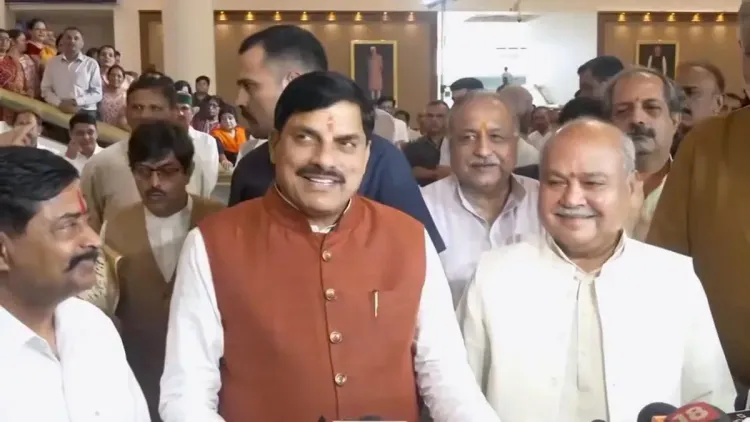
CM Mohan Yadav: UCC Report Received, to Be Tabled in MP Assembly
Synopsis
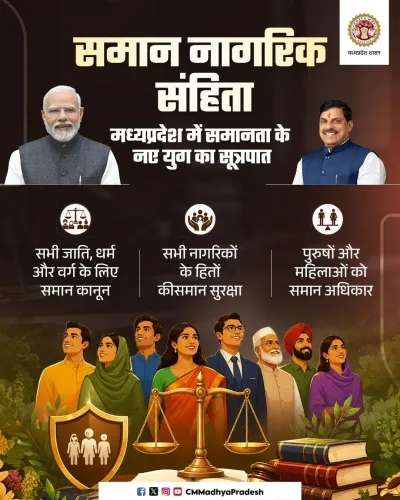
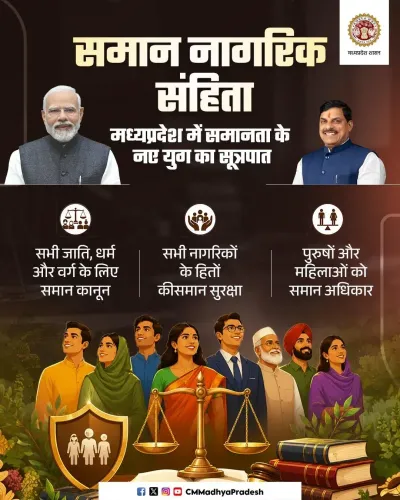
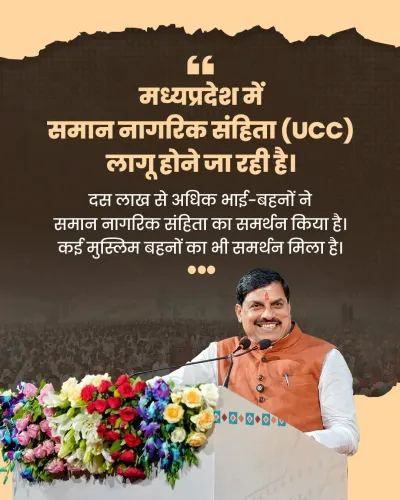
Madhya Pradesh CM Dr. Mohan Yadav announced on 14 July 2026 that the state's UCC expert committee has submitted its report, which will be tabled in the Legislative Assembly. He accused Congress of a 'double standard' for failing to clarify its position on the Uniform Civil Code.
Key Takeaways
The Madhya Pradesh UCC expert committee has formally submitted its report to the state government.
Mohan Yadav confirmed the report will be presented in the Madhya Pradesh Legislative Assembly .
He accused the Indian National Congress of a 'double standard' for not clarifying its stand on the UCC.
Uttarakhand passed India's first state-level UCC law in February 2024 , setting the precedent Madhya Pradesh is following.
The UCC, rooted in Article 44 of the Constitution, has been a core BJP manifesto commitment since 2014 .
The tabling of the report will trigger legislative debate and could make MP the second state to enact a UCC.
Madhya Pradesh Chief Minister Dr. Mohan Yadav announced on Tuesday, 14 July 2026 that the committee report on the Uniform Civil Code (UCC) has been received and will be presented before the Madhya Pradesh Legislative Assembly. He also accused the Indian National Congress of adopting a 'double standard' by refusing to clarify its position on the UCC.
Context
Posting on X, Dr. Mohan Yadav stated — 'UCC की रिपोर्ट समिति द्वारा प्राप्त हुई है। इसे हम विधानसभा में प्रस्तुत करेंगे।' ('The UCC report has been received from the committee. We will present it in the Legislative Assembly.') He added that Congress 'did not consider it appropriate to even clarify its stand on UCC,' calling it their 'double standard' (दोहरा रवैया).
The announcement marks a significant procedural step: the expert committee constituted by the Madhya Pradesh government to examine the Uniform Civil Code has formally submitted its findings, bringing the state closer to a legislative debate on the subject.
Policy Backdrop
Article 44 of the Indian Constitution (1950) places a Uniform Civil Code — a common set of personal laws governing marriage, divorce, inheritance, and adoption for all citizens regardless of religion — among the Directive Principles of State Policy. The BJP included UCC implementation in its national election manifestos in 2014 and 2019.
Uttarakhand became the first Indian state to pass a UCC law in February 2024 under a BJP government, setting a legislative precedent that BJP-ruled states have since sought to follow. Madhya Pradesh, also governed by the BJP, constituted its own expert committee as part of this broader state-level push.
The Congress party has historically backed religion-specific personal laws under its interpretation of secularism, a position that has drawn repeated criticism from the BJP, which frames uniform personal laws as essential to gender justice and national integration.
Stakeholders and Impact
The UCC directly affects religious communities across Madhya Pradesh — including Hindus, Muslims, Christians, and tribal groups — whose personal-law matters such as marriage and inheritance are currently governed by separate community-specific statutes. Women's rights advocates have long argued that a uniform code could strengthen protections against practices such as unilateral divorce and unequal inheritance.
Opposition groups, including the Congress, contend that imposing a single code without broad community consensus risks overriding minority religious rights. The CM's remarks directly target this position, framing Congress's silence as political ambiguity rather than principled opposition.
What's Next
The immediate next step is the tabling of the UCC committee report in the Madhya Pradesh Legislative Assembly during an upcoming session. Floor debates and potential resolutions will test the ruling BJP's legislative majority and the opposition's ability to mount a coherent counter-argument.
If Madhya Pradesh advances toward passing a UCC Bill, it would become the second BJP-governed state after Uttarakhand to legislate on the subject — adding momentum to the party's national-level UCC agenda ahead of future electoral cycles.
Point of View
He frames the assembly tabling as a moment of reckoning for the opposition. The move fits a clear BJP pattern: use state legislatures to normalise UCC ahead of any central law, building a multi-state record. Congress's historically ambiguous stance on uniform personal laws leaves it vulnerable to exactly this kind of targeted criticism, particularly among urban and women voters who see the code as a gender-justice measure. How the opposition responds in the assembly session will reveal whether it has developed a coherent alternative narrative since Uttarakhand enacted its UCC in 2024.
NationPress
12 Oct 2026
Frequently Asked Questions
What is the UCC report that Madhya Pradesh CM Mohan Yadav mentioned?
It is the report submitted by an expert committee constituted by the Madhya Pradesh government to examine the feasibility and framework of a Uniform Civil Code for the state. CM Dr. Mohan Yadav announced on 14 July 2026 that the report has been received and will be tabled in the Legislative Assembly.
What is the Uniform Civil Code (UCC) and why does it matter in India?
The Uniform Civil Code is a proposed set of common personal laws — covering marriage, divorce, inheritance, and adoption — that would apply to all Indian citizens regardless of religion. It is mentioned in Article 44 of the Constitution as a directive principle, and has been a long-standing BJP policy commitment.
Has any Indian state already passed a UCC law?
Yes. Uttarakhand became the first Indian state to pass a Uniform Civil Code law in February 2024 under a BJP government. Madhya Pradesh is now working toward a similar legislative step.
Why did CM Mohan Yadav criticise Congress over UCC?
CM Dr. Mohan Yadav accused the Indian National Congress of a 'double standard' because the party has not clearly stated its position on the Uniform Civil Code. Congress has historically supported community-specific personal laws, but has avoided a direct public stand on state-level UCC moves.
What happens after the UCC report is tabled in the Madhya Pradesh assembly?
Once tabled, the report will be open for legislative debate. The ruling BJP could then move toward drafting and passing a UCC Bill in Madhya Pradesh, potentially making it the second state after Uttarakhand to enact such a law.