MP CM Mohan Yadav Invites Public Input on UCC Drive
Synopsis
The Chief Minister's Office of Madhya Pradesh has announced a high-level committee inviting public suggestions on implementing the Uniform Civil Code in the state, urging citizens to submit views at uccmp.gov.in — a significant step in MP's formal UCC examination process.
Key Takeaways
The Chief Minister's Office of Madhya Pradesh announced on June 1, 2026 that a high-level committee has been formed to study and examine Uniform Civil Code (UCC) implementation in the state.
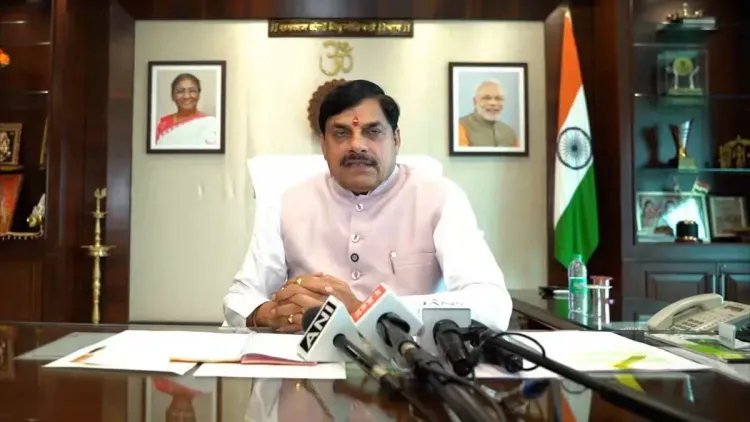
Mohan Yadav has personally appealed to all citizens to register their suggestions at uccmp.gov.in .
The initiative is framed as being guided by Prime Minister Narendra Modi's vision of public welfare and good governance.
Uttarakhand enacted India's first state-level UCC in February 2024 , providing a legislative precedent for other BJP-ruled states.
The UCC is rooted in Article 44 of the Indian Constitution as a directive principle of state policy.
The committee's report and any subsequent bill in the Madhya Pradesh Legislative Assembly are the key developments to watch.
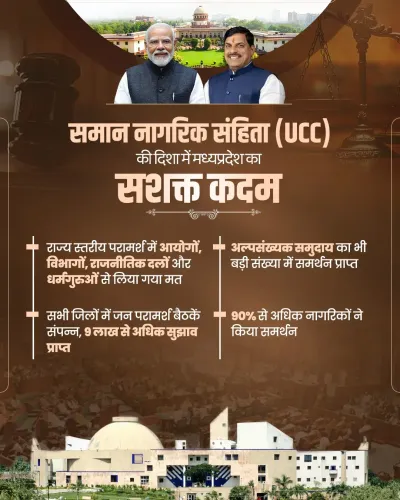
The Chief Minister's Office of Madhya Pradesh announced on Monday, June 1, 2026, that the state government has launched a significant initiative toward implementing the Uniform Civil Code (UCC) in Madhya Pradesh, with a high-level committee now inviting public suggestions through a dedicated portal.
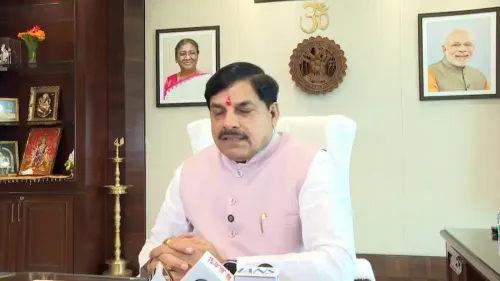
Posting on behalf of Chief Minister Dr. Mohan Yadav, the official CMO account stated — in the words of the CM — that the Madhya Pradesh government is 'निरंतर कार्य कर रही है' (continuously working) toward public welfare and good governance under the guidance of Prime Minister Narendra Modi. Citizens have been urged to submit their suggestions at uccmp.gov.in to participate in this initiative.
Context
The push for a Uniform Civil Code in Madhya Pradesh follows the broader national conversation anchored in Article 44 of the Indian Constitution, which directs the State to endeavour to secure a common civil code for all citizens irrespective of religion. The article has remained a directive principle since the Constitution came into force in 1950, without being enacted into law at the national level. Uttarakhand became the first Indian state to enact a state-level UCC law in February 2024, setting a legislative precedent that several other states have since cited as a model. Madhya Pradesh's current initiative is part of this wider pattern of BJP-governed states formally examining UCC measures.Policy Backdrop
The Madhya Pradesh government has constituted a high-level committee to study and examine the UCC and to solicit public input before any legislative action. The committee's outreach through the uccmp.gov.in portal marks a participatory step, allowing ordinary citizens, community organisations, and legal experts to register their views. The UCC proposes to replace religion-based personal laws — governing matters such as marriage, divorce, inheritance, and adoption — with a single set of civil laws applicable uniformly to all citizens. Proponents argue it strengthens constitutional equality; critics from various religious communities have historically raised concerns about cultural and religious autonomy.Stakeholders and Impact
The consultation process directly concerns citizens of Madhya Pradesh across all religious communities, given that UCC would affect personal law matters that currently differ for Hindus, Muslims, Christians, and other communities under separate statutory frameworks. Legal experts and civil society organisations are among the stakeholders expected to engage with the committee's public consultation. The outcome of this process could influence the shape of any eventual legislation introduced in the Madhya Pradesh Legislative Assembly.What's Next
The immediate next step is the close of the public consultation period, after which the high-level committee is expected to compile submissions and present its findings. Any subsequent bill introduction in the state assembly would mark a significant legislative milestone for Madhya Pradesh and would be closely watched as a model — or a contrast — to Uttarakhand's 2024 legislation. With the BJP's long-standing national commitment to a Uniform Civil Code, the Madhya Pradesh process will serve as a key indicator of how state-level implementation frameworks are being designed ahead of any potential central legislation.Point of View
Process-driven approach that distinguishes it from Uttarakhand's more direct legislative route — suggesting the BJP is road-testing different implementation models across states. By anchoring the initiative to PM Modi's guidance, the CMO is also signalling that this is not a standalone state experiment but part of a coordinated national policy arc. The use of a public portal introduces a participatory legitimacy argument that could pre-empt criticism of the process being top-down. Whether the consultation translates into a bill, and how quickly, will reveal the state government's actual legislative timeline ahead of any central UCC move.
NationPress
17 Oct 2026
Frequently Asked Questions
What is the Uniform Civil Code and why is Madhya Pradesh working on it?
The Uniform Civil Code (UCC) proposes a single set of civil laws for all citizens regardless of religion, covering matters like marriage, divorce, and inheritance. Madhya Pradesh is working on it following Article 44 of the Constitution, which directs states to endeavour to secure a UCC, and in the context of Uttarakhand becoming the first state to enact one in February 2024.
How can citizens submit suggestions for UCC in Madhya Pradesh?
Citizens can submit their suggestions through the official portal at uccmp.gov.in, as urged by Chief Minister Dr. Mohan Yadav in the June 1, 2026 announcement.
Which state first implemented the Uniform Civil Code in India?
Uttarakhand became the first Indian state to enact a state-level Uniform Civil Code in February 2024.
What is the high-level committee formed by Madhya Pradesh for UCC?
The Madhya Pradesh government has constituted a high-level committee to study and examine the feasibility and framework of implementing the UCC in the state, and it is currently inviting public suggestions as part of this process.
What happens after the public consultation on UCC in Madhya Pradesh?
After the consultation closes, the high-level committee is expected to compile submissions and present its report. The next major step would be any bill introduction in the Madhya Pradesh Legislative Assembly.