CM Shivakumar Announces India's First Govt AI University in Bengaluru
Synopsis
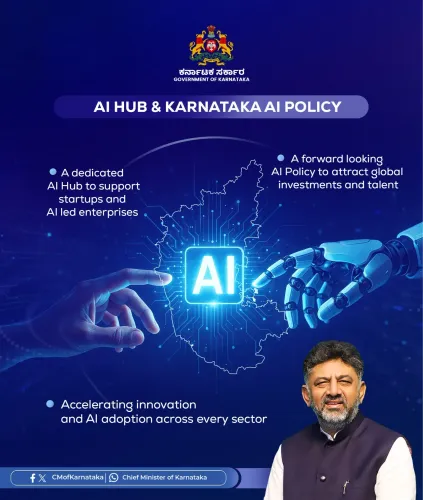
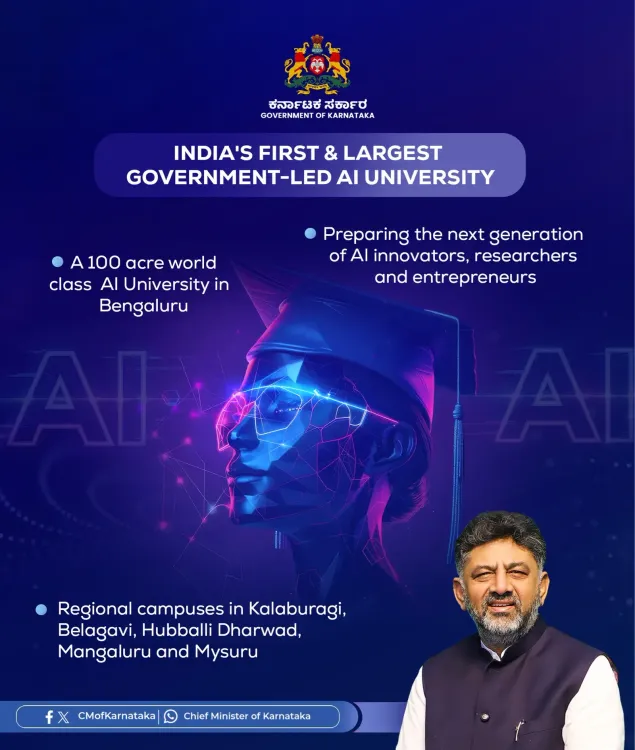
Chief Minister D. K. Shivakumar has announced what the Karnataka government calls India's first and largest government-led AI University in Bengaluru, to be built on a 100-acre campus focused on AI education, research, innovation, and entrepreneurship.
Key Takeaways
Shivakumar announced India's first and largest government-led AI University, to be located in Bengaluru .
The proposed campus will span 100 acres and is designed as a world-class centre for AI education, research, innovation, and entrepreneurship.
The announcement was made on 14 July 2026 through the official Chief Minister's Office of Karnataka account.
Bengaluru already hosts India's densest concentration of IT companies and premier research institutions, providing an established ecosystem for the project.
Key next steps include campus master-plan approval, land allocation, curriculum design, and regulatory clearances from the UGC .
No construction timeline, funding figure, or governance structure has been disclosed yet by the state government.
The Chief Minister's Office of Karnataka announced on Tuesday, 14 July 2026, that Chief Minister D. K. Shivakumar has unveiled plans for what the government describes as India's first and largest government-led Artificial Intelligence University, to be established in Bengaluru. The proposed institution will be set on a 100-acre campus and is envisioned as a world-class centre for AI education, research, innovation, and entrepreneurship.
Context
The announcement, made through the official Chief Minister's Office account on X, positions the proposed university as a flagship initiative to develop AI talent at scale. The post stated that the campus will 'become a centre of excellence for AI education, research, innovation, and entrepreneurship, preparing the talent that will shape tomorrow.' No timeline for construction or a launch date was specified in the post.
Bengaluru is already India's foremost technology hub, home to the Indian operations of dozens of global technology companies as well as premier institutions such as the Indian Institute of Science (IISc) and multiple Indian Institutes of Technology (IIT) campuses and affiliated programmes. The city's existing talent pipeline and R&D ecosystem make it a natural anchor for such a proposed institution.
Policy Backdrop
The announcement builds on a broader national push for AI readiness. In 2018, NITI Aayog released India's National Strategy for Artificial Intelligence, which outlined priorities across AI research, skilling, and responsible deployment. Since then, both central and state governments have progressively expanded public higher-education capacity in AI and related emerging technologies.
Karnataka has long maintained proactive policies in information technology and biotechnology, positioning itself as a preferred destination for technology investment and academic infrastructure. The proposed AI university would represent a significant escalation of that strategy, moving from IT parks and incubators toward dedicated degree-granting and research institutions under government ownership.
Indian states have increasingly announced domain-specific universities and research parks to address talent gaps in emerging technologies, and a government-led AI university of this proposed scale would mark a notable step in that trend.
Stakeholders and Impact
The primary beneficiaries of the proposed institution, if realised, would be AI researchers, STEM students, and technology startups seeking a trained workforce. A government-led institution at this scale could also attract international academic partnerships and provide a policy-aligned research environment distinct from private universities.
For Karnataka's startup ecosystem — which is concentrated heavily in Bengaluru's corridors such as Electronic City and Whitefield — a dedicated AI university could reduce the talent acquisition friction that many early-stage and growth-stage companies cite as a key constraint. Broader economic spillovers would depend on the curriculum design, research output, and industry linkages the institution establishes.
What's Next
Several critical steps remain before the university moves from announcement to operation. These include campus master-plan approvals, land allocation on the stated 100-acre footprint, curriculum finalisation, and any formal linkage with the national AI mission or existing institutions such as IISc or the IITs. Regulatory clearances from the University Grants Commission (UGC) and the state legislature will also be necessary for the institution to begin awarding degrees.
The government has not yet disclosed a construction timeline, funding allocation, or governance structure for the proposed university. Those details, once released, will determine how quickly the initiative can move from policy intent to functional campus.
Point of View
The initiative carries dual value: it aligns with the Congress-led government's emphasis on public institution-building and positions Karnataka ahead of rival states in the emerging race to anchor India's AI education infrastructure. The 100-acre scale and 'first-in-India' framing are politically significant, but the announcement's credibility will ultimately rest on the speed and transparency of implementation — land acquisition, funding, and UGC recognition being the hardest tests. If delivered, it could set a replicable template; if delayed, it risks becoming a cautionary note in India's long history of ambitious technology-education announcements.
NationPress
12 Oct 2026
Frequently Asked Questions
What is the Karnataka government AI university announced by CM Shivakumar?
Chief Minister D. K. Shivakumar has announced plans for India's first and largest government-led Artificial Intelligence University to be established in Bengaluru, Karnataka, on a 100-acre campus focused on AI education, research, innovation, and entrepreneurship.
Where will the Karnataka AI university be located?
The proposed AI university will be located in Bengaluru , the capital of Karnataka and India's primary information technology hub.
How big is the proposed AI university campus in Karnataka?
The proposed campus will span 100 acres , which the Karnataka government describes as the largest for a government-led AI university in India.
When was the Karnataka AI university announced?
The Chief Minister's Office of Karnataka announced the AI university on 14 July 2026 through its official account on X.
What will the Karnataka AI university focus on?
According to the official announcement, the university will serve as a centre of excellence for AI education, research, innovation, and entrepreneurship, with a stated goal of preparing talent for the future of artificial intelligence.