India's solar capacity hits 155 GW, a 55x rise in 12 years: Rijiju
Synopsis
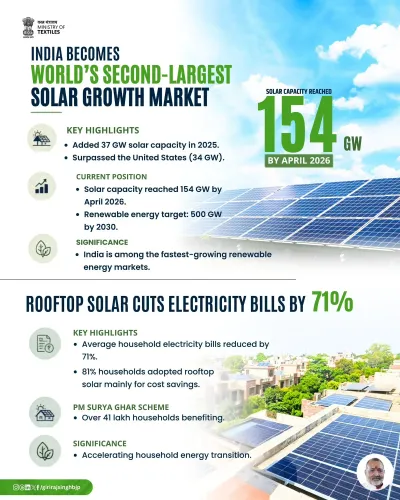
India's solar capacity has multiplied 55 times in 12 years — from 2.8 GW to 155 GW — a scale-up that places the country among the world's top solar markets. With 40 lakh homes now on rooftop solar and farmers doubling as energy producers, the numbers signal a structural shift, not just a policy milestone.
Key Takeaways
India's installed solar capacity grew from 2.8 GW in 2014 to 155 GW in 2026 — a 55-fold increase in 12 years .
Union Minister Kiren Rijiju shared the figures in a post on X on 6 June 2026 .
More than 40 lakh homes across India are now powered through solar energy initiatives.
The PM Surya Ghar Muft Bijli Yojana has connected 40 lakh homes to rooftop solar, according to Minister Hardeep Singh Puri .
India's broader target is 500 GW of non-fossil fuel capacity by 2030 , with solar as the primary driver.
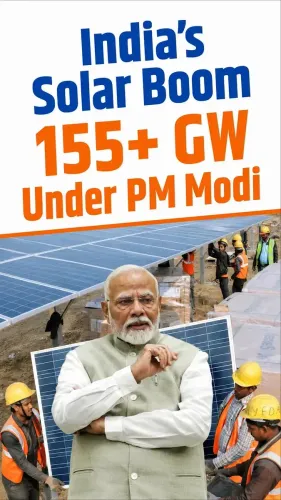
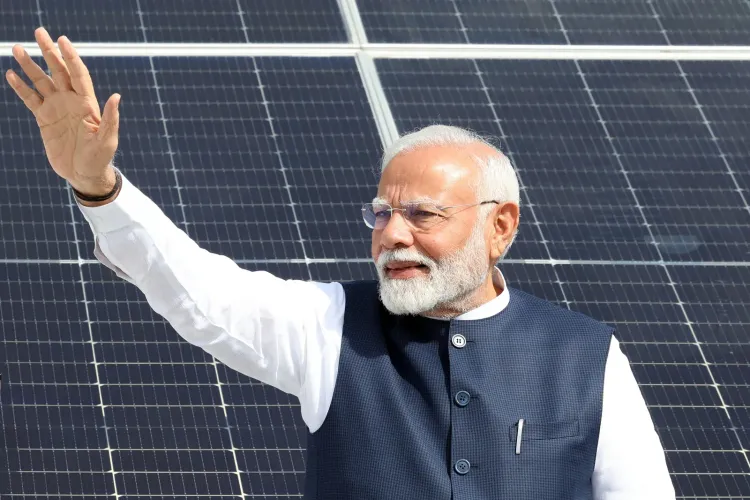
Union Minister Kiren Rijiju on Saturday, 6 June 2026 said India's installed solar energy capacity has surged from 2.8 GW in 2014 to 155 GW in 2026 — a nearly 55-fold increase over 12 years — attributing the milestone to Prime Minister Narendra Modi's leadership and the country's accelerating clean energy transition.
Key Developments
Rijiju shared the figures in a post on X, framing the expansion as evidence of India's rapid progress in renewable energy. He said the growth reflects the country's dual commitment to strengthening energy security and reducing dependence on fossil fuels. More than 40 lakh homes across the country are now powered through solar energy initiatives, according to the minister.
Farmers as Energy Producers
Rijiju also highlighted a structural shift in India's rural economy, noting that farmers are increasingly emerging as energy producers alongside their traditional role as food providers. The remark points to the expanding reach of decentralised solar infrastructure — particularly rooftop and agri-solar installations — into India's agricultural heartland.
PM Surya Ghar Scheme Milestone
The announcement follows a related milestone flagged in May 2026 by Union Petroleum and Natural Gas Minister Hardeep Singh Puri, who said India had crossed a historic threshold by connecting 40 lakh homes to rooftop solar under the PM Surya Ghar Muft Bijli Yojana. The scheme, Puri said, is designed to eliminate electricity bills for ordinary citizens and make them energy self-reliant, while also reducing the country's carbon footprint.
India's Broader Clean Energy Push
India has been aggressively expanding its renewable energy base as part of its commitments under the Paris Agreement and its domestic target of reaching 500 GW of non-fossil fuel capacity by 2030. Solar has emerged as the backbone of that push, with capacity additions accelerating sharply over the past four years driven by falling panel costs, policy incentives, and growing institutional capital flows into the climate-tech sector. Notably, the 155 GW figure places India among the world's top solar markets, alongside China and the United States.
The remarks come as India's climate-tech ecosystem gains momentum, backed by policy support and energy-security imperatives. How quickly the country closes the gap to its 500 GW target will depend on grid infrastructure upgrades, storage deployment, and continued manufacturing scale-up under the domestic PLI framework for solar modules.
Point of View
But the base effect matters — 2.8 GW in 2014 was a negligible starting point. The more telling number is whether India's annual addition rate is sufficient to reach 500 GW by 2030, a target that requires roughly doubling the current pace. The 40-lakh-homes figure also merits scrutiny: it conflates grid-connected rooftop solar with off-grid installations, which have very different implications for utility revenue and grid stability. The farmer-as-energy-producer framing is politically resonant but economically complex — agri-solar works only where land, water, and grid evacuation infrastructure align. India's solar story is real, but the hardest chapters — storage, transmission, and distribution reform — are still being written.
NationPress
21 Oct 2026
Frequently Asked Questions
How much has India's solar capacity grown since 2014?
India's installed solar capacity has grown from 2.8 GW in 2014 to 155 GW in 2026, a nearly 55-fold increase over 12 years, according to Union Minister Kiren Rijiju. The growth is attributed to policy support, falling equipment costs, and sustained government investment in renewable infrastructure.
What is the PM Surya Ghar Muft Bijli Yojana?
The PM Surya Ghar Muft Bijli Yojana is a central government scheme that subsidises rooftop solar installations for households, aiming to eliminate electricity bills for ordinary citizens. As of May 2026, the scheme had connected 40 lakh homes to rooftop solar, according to Union Minister Hardeep Singh Puri.
What is India's renewable energy target for 2030?
India has set a target of 500 GW of non-fossil fuel electricity capacity by 2030 as part of its Paris Agreement commitments. Solar energy is the primary driver of this push, and the country is now among the world's top solar markets with 155 GW of installed capacity.
How many homes in India are powered by solar energy?
More than 40 lakh homes across India are now powered through solar energy initiatives, according to Union Minister Kiren Rijiju. This figure includes homes connected under the PM Surya Ghar Muft Bijli Yojana rooftop solar scheme.
What role are farmers playing in India's solar expansion?
Farmers are increasingly emerging as energy producers in India's renewable ecosystem, particularly through agri-solar and decentralised rooftop installations, according to Rijiju. This dual role — as food and energy providers — is being promoted as part of rural energy self-reliance initiatives.