Smriti Irani Targets Opposition Over Parliament Debate Avoidance
Synopsis
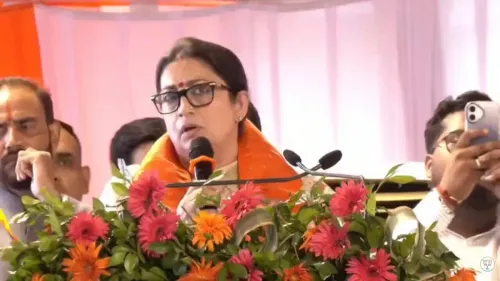
BJP leader Smriti Irani on November 3 posted a pointed Hindi remark on X, accusing unnamed opposition figures of avoiding parliamentary debate while making grand public statements — a recurring fault line in Indian politics.
Key Takeaways
Smriti Irani posted a sharp Hindi jab on November 3, 2026 targeting unnamed opposition figures.
The post reads: 'Those who are afraid of debate in Parliament are making big, big statements these days.' No individual, party, or specific session is named — the ambiguity is likely deliberate, maximising political reach.
Irani is a former Union Minister for Women and Child Development and Minority Affairs , lending the critique a practitioner's weight.
The BJP has consistently used the parliamentary-engagement-vs-public-statement contrast as a political frame against opposition parties.
Opposition responses on social media or ahead of the next parliamentary sitting are likely to follow.
A sharp political jab landed on social media late Tuesday night, as BJP leader Smriti Irani took aim at opposition figures she accused of avoiding parliamentary debate while making grand public statements. The remark, posted on November 3, 2026, cuts to a fault line that has defined Indian parliamentary politics for years.
In a crisp Hindi post, Irani wrote: 'Jo parliament mein debate se darte hain, suna hai aaj-kal vo badi-badi batein karte hain' — 'Those who are afraid of debate in Parliament, I hear they are making big, big statements these days.' No names. No bill number. Just a blade.
The Parliamentary Debate vs. Public Platform Argument
The charge is a recurring one in Indian political discourse, and it lands with particular force every time Parliament is in session — or conspicuously not. Ruling party leaders have long framed opposition politics through this lens: that critics who skip, disrupt, or boycott Lok Sabha and Rajya Sabha proceedings then amplify their positions through rallies, press conferences, and — increasingly — social media. The implication is accountability avoidance: the floor of the House, with its rules of procedure, cross-examination, and recorded Hansard, demands a different quality of argument than a microphone at a public event. Irani, a veteran of both Houses, has herself been a combative presence in parliamentary debates over the years, having served as Union Minister for Women and Child Development and Minority Affairs. That institutional record gives the jibe its edge — it is framed as a practitioner's critique, not a bystander's.What the Post Leaves Unsaid — and Why That May Be the Point
Irani names no opponent, cites no specific session, references no particular speech. That studied ambiguity is a deliberate political instrument: it allows the barb to be aimed at any opposition figure the reader already has in mind, maximising reach while limiting accountability for the specific claim. It also invites the target — whoever feels addressed — to respond, handing the BJP a platform for a second news cycle. Opposition parties can be expected to push back, either dismissing the comment as deflection from governance questions or cataloguing their own instances of parliamentary participation. Watch for any procedural notices ahead of the next scheduled sitting, and for whether any named opposition leader chooses to engage directly. In Indian politics, Parliament is not just a legislature — it is a legitimacy test. And right now, Smriti Irani is calling the bluff.Point of View
The provocation without specificity is a low-risk, high-reward move that keeps the ruling party's anti-opposition narrative active between sessions.
NationPress
4 Nov 2026
Frequently Asked Questions
What did Smriti Irani post about Parliament debate?
On November 3, 2026, Smriti Irani posted in Hindi on X saying, 'Those who are afraid of debate in Parliament are making big, big statements these days,' targeting unnamed opposition figures.
Who is Smriti Irani in Indian politics?
Smriti Irani is a senior BJP leader and former Union Minister who has held the portfolios of Women and Child Development and Minority Affairs, and has been a parliamentarian in both Lok Sabha and Rajya Sabha.
What is the BJP's argument about opposition and Parliament debates?
The BJP has long argued that opposition parties avoid or disrupt parliamentary debates and then amplify political positions through rallies and social media, framing this as accountability avoidance.
Why did Smriti Irani not name anyone in her post?
The post names no individual or party, a deliberate choice that lets the critique apply broadly and invites targeted opponents to self-identify by responding, extending the political impact.
What could happen next after this post?
Opposition parties are likely to respond on social media or through statements, and any procedural notices ahead of the next parliamentary sitting could indicate whether the debate moves from social media to the floor of the House.