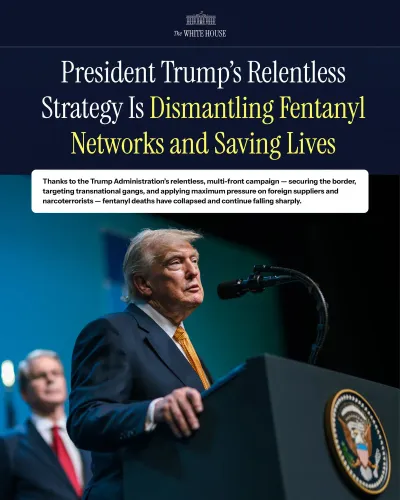
White House Credits Trump's ONDCP With Drop in US Drug Overdose Deaths

Synopsis
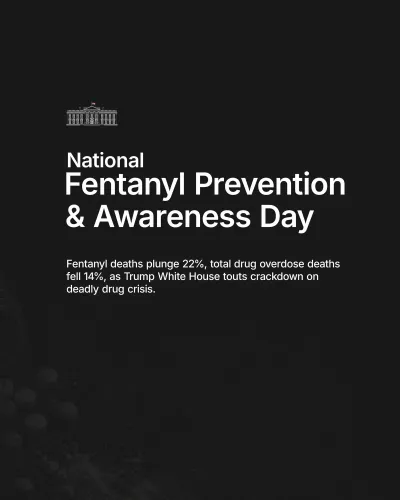
The White House claims President Trump's ONDCP has overseen a 'massive decrease' in drug overdose deaths since a Biden-era peak. The assertion, carrying partisan framing, awaits verification against forthcoming CDC provisional mortality data.
Key Takeaways
The White House posted on October 20, 2026 that Trump's ONDCP has overseen a 'massive decrease' in US drug overdose deaths.
The post attributes the peak in overdose deaths to the Biden administration era.
The ONDCP coordinates federal drug-control policy across agencies including the DEA, SAMHSA, and CBP.
Trump declared the opioid crisis a public health emergency in 2017 during his first term.
Specific 2025–2026 overdose statistics cited in the claim have not been independently verified.
The CDC's next provisional overdose data release will be the key benchmark for evaluating the White House's claim.
A stark public health claim landed from Washington, D.C. on Tuesday, October 20, 2026 — the White House declared that President Trump's drug-policy office has overseen a 'massive decrease' in overdose deaths since what it calls a peak under the Biden administration, framing the shift as thousands of American lives saved.
The post, from the official White House account, centres on President Donald J. Trump's Office of National Drug Control Policy (ONDCP) — the West Wing agency responsible for coordinating the federal government's sprawling anti-drug apparatus. The claim is direct: overdose deaths, which the White House attributes to a Biden-era peak, have declined sharply under Trump's current term.
What ONDCP Does — and Why Its Numbers Get Political Fast
The ONDCP is not a law-enforcement agency but a policy-coordination hub — it sets the National Drug Control Strategy, allocates resources across agencies including the DEA, SAMHSA, and Customs and Border Protection, and tracks mortality data through CDC provisional figures. Because overdose deaths are tracked with a lag and the causes are multifactorial — supply-chain disruption, treatment access, harm reduction — every administration tends to claim credit for downturns and assign blame for upswings. That dynamic is visible here. Trump's first term saw the administration declare the opioid crisis a public health emergency in 2017, focusing heavily on supply interdiction and border enforcement. The Biden administration, which took office in 2021, increased ONDCP funding and folded harm-reduction tools — such as expanded naloxone access and fentanyl test strips — into its strategy alongside enforcement. U.S. overdose deaths, driven first by prescription opioids, then heroin, and ultimately synthetic fentanyl, had been climbing steeply from the mid-2010s onward through both administrations.The Claim the White House Is Making — and What Remains Unverified
The White House's assertion of a 'massive decrease' and a Biden-era peak is a live political claim. Specific statistics for 2025–2026 have not been independently confirmed. CDC provisional overdose data, which typically carries a six-to-twelve month reporting lag, will be the authoritative benchmark against which any such claim will eventually be tested. Until those figures are published and peer-reviewed, the scale and causation of any decline remain contested ground. What is not in dispute: U.S. drug overdose deaths represent one of the most consequential public-health crises of the past two decades, claiming tens of thousands of American lives annually at their peak. Any genuine, sustained reversal in that trend would mark a significant policy achievement regardless of which administration's toolkit drove it. The next CDC provisional data release and any updated National Drug Control Strategy publication from ONDCP are the metrics to watch — they will either anchor or undercut the White House's claim with hard numbers.Point of View
Not a clinical characterisation. What makes the moment meaningful is structural: if CDC provisional data for 2025–2026 does confirm a sustained decline, it would mark the first durable reversal in the overdose crisis in nearly a decade, lending genuine policy weight to what is currently a partisan assertion. For India, which watches US fentanyl-interdiction pressure on global supply chains closely, any shift in Washington's enforcement posture has downstream consequences for precursor-chemical trafficking routes.
NationPress
20 Oct 2026
Frequently Asked Questions
What is ONDCP and what does it do?
The Office of National Drug Control Policy (ONDCP) is a White House agency that coordinates the US federal government's drug-control strategy, sets funding priorities, and tracks overdose mortality data across agencies like the DEA and SAMHSA.
Have US drug overdose deaths actually decreased under Trump?
The White House claims a 'massive decrease' since a Biden-era peak, but specific 2025–2026 figures have not been independently verified. The CDC's next provisional overdose data release will be the authoritative test of this claim.
What caused the US opioid and fentanyl overdose crisis?
US overdose deaths surged from the mid-2010s driven first by prescription opioids, then heroin, and ultimately synthetic fentanyl — a cheap, potent drug that is responsible for the vast majority of recent overdose fatalities.
What drug policies did the Trump administration pursue?
Trump declared the opioid crisis a public health emergency in 2017, emphasising supply interdiction and border enforcement. His current administration's ONDCP has continued that enforcement-forward approach.
How did Biden's drug policy differ from Trump's?
The Biden administration increased ONDCP funding and incorporated harm-reduction tools such as expanded naloxone access and fentanyl test strips alongside traditional supply-interdiction measures.