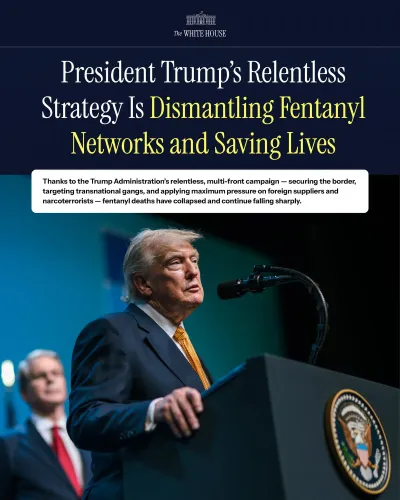
White House Claims Joint US-Mexico Push Saved Hundreds of Thousands from Fentanyl
Synopsis
The White House quoted President Biden claiming US-Mexico joint counternarcotics efforts saved hundreds of thousands of lives from fentanyl overdoses and stripped over $4 billion from drug cartels — figures released against the backdrop of long-running bilateral security cooperation dating to the 2007 Merida Initiative.
Key Takeaways
The White House quoted POTUS on September 22, 2026 claiming joint US-Mexico efforts saved 'hundreds of thousands of lives' from fentanyl overdoses.
The statement also claims over $4 billion has been stripped from drug cartels through these cooperative efforts.
US-Mexico counternarcotics cooperation is institutionally rooted in the Merida Initiative , launched in 2007 .
After 2013 , policy focus shifted from plant-based drugs to fentanyl precursor chemical networks , largely sourced from China and processed in Mexico.
A dedicated fentanyl task force and expanded sanctions on precursor networks were established in 2021 , forming the policy backbone behind current claims.
The next US-Mexico bilateral security dialogue and congressional appropriations decisions will be key indicators of whether these results translate into sustained policy investment.
Hundreds of thousands of lives saved. More than $4 billion stripped from cartel coffers. The White House on Tuesday, September 22, 2026, amplified a sweeping claim from President of the United States (POTUS) about the results of bilateral counternarcotics cooperation — numbers that, if they hold, would mark one of the most consequential drug-enforcement achievements in recent American history.
What the President Is Claiming — and Why It Matters Now
The post quotes the President directly: 'Our joint efforts have already saved hundreds of thousands of lives from lethal fentanyl overdoses and stripped over $4 billion from cartels.' The language is unambiguous — 'joint efforts' pointing squarely at US-Mexico bilateral cooperation as the engine of these results. Fentanyl, a synthetic opioid estimated to be roughly 100 times more potent than morphine, has driven the deadliest drug crisis in American history, with tens of thousands of overdose deaths recorded annually in the United States across the preceding decade.
Public messaging that attaches hard numbers to counternarcotics outcomes rarely emerges without a policy trigger. Statements of this scale typically accompany diplomatic reviews, congressional budget cycles, or upcoming bilateral security dialogues — all of which give the figures immediate political weight beyond the headline.
The US-Mexico Counternarcotics Architecture Behind the Numbers
The cooperation the President references has deep institutional roots. The Merida Initiative, launched in 2007, established the foundational framework for US security assistance to Mexico, funding interdiction technology, intelligence sharing, and law-enforcement capacity. After 2013, as fentanyl began displacing heroin in American street markets, the focus of that framework pivoted sharply — from plant-based drugs to synthetic opioids and the precursor chemical networks that feed them.
In 2021, the administration at the time stood up a dedicated fentanyl task force and expanded sanctions targeting the supply chain for precursor chemicals — largely sourced from China and routed through Mexico before being processed by drug cartels into finished product. The current claims build on that policy lineage, suggesting the enforcement architecture has matured enough to produce measurable financial damage to cartel operations.
$4 Billion from Cartels — The Stakes of Supply-Side Disruption
Stripping $4 billion from transnational criminal organisations is a claim that cuts to the core of supply-side drug strategy. Cartels are, at their base, financial enterprises — and sustained revenue disruption, if real, degrades their capacity to recruit, bribe, and operate. Law enforcement agencies and public health communities on both sides of the border have long argued that interdiction alone cannot solve demand-side addiction, but that crippling cartel economics buys time for treatment infrastructure to scale.
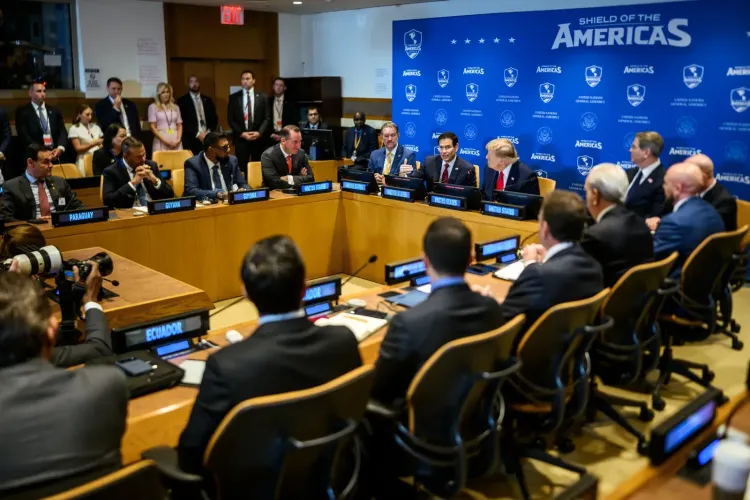
What to watch next: the US-Mexico bilateral security dialogue and any associated congressional appropriations for interdiction technology will be the clearest test of whether these figures translate into sustained political and budgetary commitment — or serve primarily as a diplomatic talking point ahead of a high-profile meeting.
Point of View
Likely ahead of a diplomatic or legislative moment that requires public justification. Attaching a dollar figure to cartel disruption is a deliberate framing choice: it repositions drug enforcement as a financial war, not just a law-enforcement operation, which resonates with both security hawks and fiscal conservatives in Congress. The claim also implicitly pressures Mexico to sustain its cooperation, since shared credit for success makes unilateral withdrawal politically costly for either side. Whether the figures survive independent scrutiny will determine whether this becomes a durable policy legacy or a contested talking point.
NationPress
23 Sept 2026
Frequently Asked Questions
What did the White House claim about fentanyl overdose deaths being prevented?
The White House quoted the President stating that joint US-Mexico efforts have 'already saved hundreds of thousands of lives from lethal fentanyl overdoses,' though the specific methodology behind this figure has not been independently detailed.
How much money has the US seized from drug cartels in fentanyl operations?
The White House post claims that over $4 billion has been stripped from drug cartels through joint US-Mexico counternarcotics efforts, framing it as a measure of supply-side disruption.
What is the Merida Initiative and how does it relate to fentanyl?
The Merida Initiative , launched in 2007 , is a US security assistance framework for Mexico covering drug interdiction and law-enforcement cooperation. After 2013, its focus evolved to address synthetic opioids like fentanyl as they overtook plant-based drugs in the US market.
How does fentanyl get into the United States from Mexico?
Fentanyl is primarily manufactured by drug cartels in Mexico using precursor chemicals largely sourced from China . The finished product is then trafficked across the US-Mexico border through various smuggling routes.
What comes next in US-Mexico drug enforcement cooperation?
Analysts and officials are watching the next US-Mexico bilateral security dialogue and associated congressional appropriations for interdiction technology, which will indicate whether the cooperation is being deepened or is primarily a diplomatic messaging exercise.