White House Claims Historic Murder Drop Under Trump in 2025-26
Synopsis
The White House declared on July 30, 2026 that US murders have reached a historic low in 2025 and are declining further in 2026, attributing the trend to the Trump Administration — a claim awaiting verification from official FBI crime data.
Key Takeaways
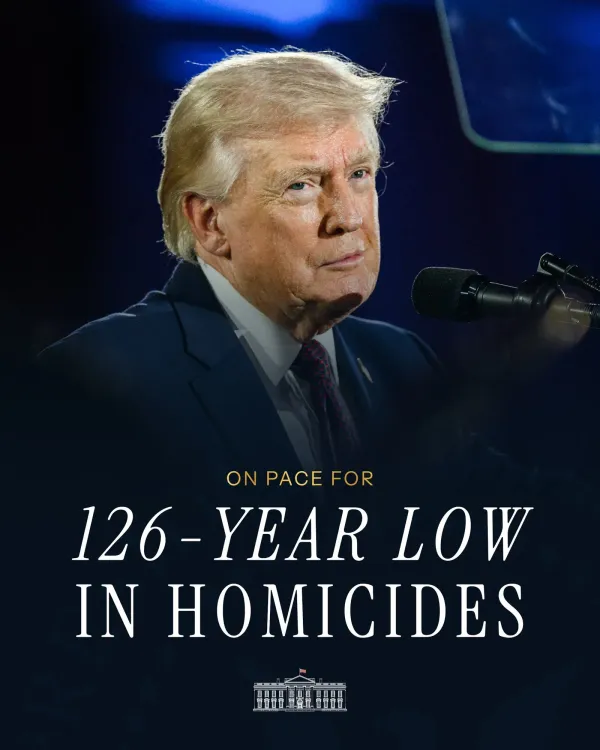
The White House posted on July 30, 2026 that US murders have hit a 'historic low' in 2025 , with numbers falling again in 2026 .
The administration credited President Trump directly for making 'Americans feel safe in major cities again.' No specific figures, cities, or policy mechanisms were cited in the post.
US murder rates surged sharply in 2020 before moderating in subsequent years — a trend predating Trump's return to office.
Official verification would require release of FBI Uniform Crime Reporting or Bureau of Justice Statistics data for 2025 and 2026, which has not yet occurred.
US administrations across party lines have a long history of citing crime data to claim public-safety credit.
The White House made a sweeping public-safety claim on Wednesday, July 30, 2026 — asserting that murders across the United States have hit a historic low in 2025 and are falling further into 2026, crediting the Trump Administration for making Americans feel safe in major cities again.
What the White House is claiming
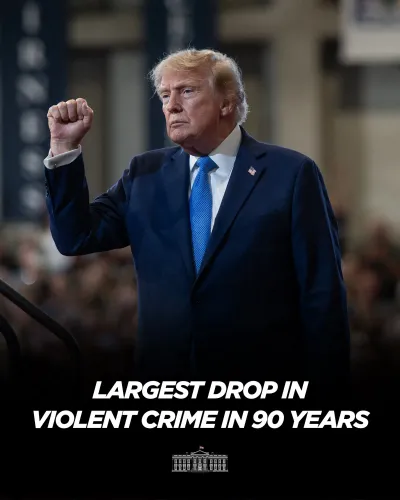
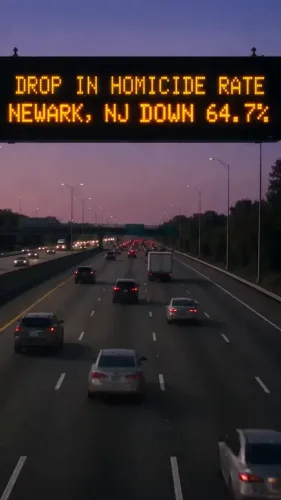
The official White House account posted: 'Since President Trump took office, murders have plummeted — a historic low in 2025 with numbers falling again in 2026. Americans can feel safe in major cities again thanks to the Trump Administration.' The post was accompanied by two images and framed the trend as a direct consequence of administration policy.
No specific figures, cities, or policy mechanisms were cited in the post itself. The claim of a 'historic low' is a strong benchmark — one that, if borne out by official data, would mark a significant reversal from the murder spike recorded nationally in 2020.
The longer arc of US murder rates
American homicide statistics have followed a turbulent trajectory over recent decades. Murders declined broadly from the early 1990s through the 2010s, then surged sharply in 2020 — a year marked by pandemic disruption and widespread civil unrest. That spike prompted intense political debate over urban policing and the 'defund the police' movement, which the Trump administration openly opposed both in its first term (2017–2021) and in its return to power.
US presidential administrations across party lines have routinely cited FBI Uniform Crime Reporting data or Bureau of Justice Statistics surveys to claim credit for public-safety gains. The credibility of Wednesday's claim will ultimately rest on those same official datasets — which have not yet been independently released for 2025 or 2026.
Why the attribution question matters
Claiming credit for crime trends is politically potent but analytically complex. Homicide rates are shaped by a dense web of factors — economic conditions, demographic shifts, policing strategies, gun policy, and local governance — that rarely yield clean cause-and-effect lines to any single administration. Trump's first term saw him campaign aggressively on law-and-order themes and push federal backing for local police departments, a posture his current administration has revived.
Urban residents and law enforcement agencies are the most direct stakeholders in any genuine crime reduction. If the numbers hold under scrutiny, the political dividend for the administration would be substantial — safety in major cities has been a defining anxiety for American voters for years.
The test is simple: when the FBI's official crime data lands, the numbers will either validate the claim or reframe it. Until then, the White House has put a very large stake in the ground.
Point of View
High-risk if it doesn't. Attributing a national homicide trend to a single administration is analytically contested territory; criminologists consistently point to multi-year, multi-causal dynamics that cut across presidential terms. The timing of the post — mid-2026, well before annual FBI crime reports are typically released — suggests the administration is getting ahead of the official data cycle, staking a political position before independent numbers can confirm or complicate it. For Indian observers tracking US domestic politics, this signals that public safety will remain a central pillar of Trump's political messaging heading into the next electoral cycle.
NationPress
13 Sept 2026
Frequently Asked Questions
Has the US murder rate really hit a historic low under Trump in 2025?
The White House made this claim on July 30, 2026, but official FBI Uniform Crime Reporting data for 2025 and 2026 has not yet been independently released to verify the assertion.
What was the US murder rate trend before Trump's second term?
US murders declined broadly from the early 1990s through the 2010s, then surged sharply in 2020 before moderating in subsequent years — a trend that began before Trump returned to office.
What policies has Trump used to address crime in the US?
Trump's administrations have emphasised federal backing for local police departments and strongly opposed the 'defund the police' movement, framing law and order as a central governance priority.
How do US presidents typically prove crime reduction claims?
Administrations usually cite annual FBI Uniform Crime Reporting data or Bureau of Justice Statistics victimization surveys, which are released on a lag and subject to independent analysis.
Why is it difficult to credit one administration for a drop in murders?
Homicide rates are shaped by economic conditions, demographic shifts, policing strategies, gun policy, and local governance — making clean attribution to any single administration analytically complex.