CM Samrat Choudhary Hails India as World's 2nd Largest Solar Market
Synopsis
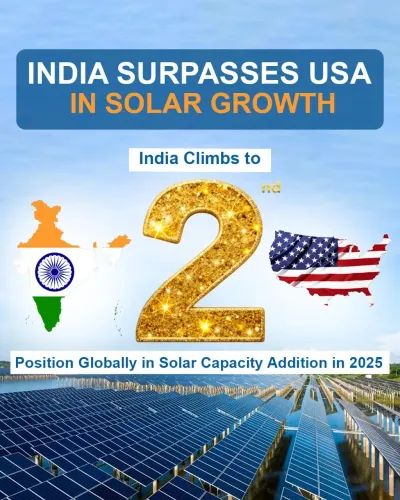
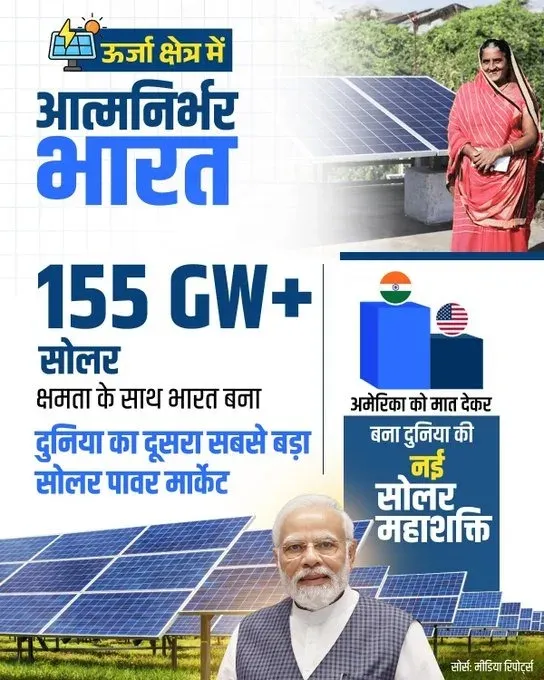
Bihar Chief Minister Samrat Choudhary has hailed India's rise as the world's second-largest solar market, citing an installed capacity of over 155 GW. Crediting PM Modi's leadership, he called the milestone a symbol of a self-reliant, green India — linking state and national ambitions on clean energy ahead of India's 2030 renewable targets.
Key Takeaways
Bihar CM Samrat Choudhary posted on 29 May 2026 celebrating India's rise as the world's second-largest solar power market.
India's installed solar capacity has crossed 155 GW , according to the post.
The milestone aligns with India's pledge to achieve 500 GW of non-fossil fuel capacity by 2030 , announced at COP26 in Glasgow .
The National Solar Mission (launched 2010 ) and the PM-KUSUM scheme (launched 2019 ) are among the central policy drivers behind the capacity surge.
PM Modi's Atmanirbhar Bharat framework and the International Solar Alliance have provided strategic direction to India's solar expansion.
State-level solar tenders and grid integration in Bihar remain key areas to watch as India pushes toward its 2030 clean energy goals.
Bihar Chief Minister Samrat Choudhary on Friday, 29 May 2026, celebrated a landmark milestone in India's clean energy journey, stating that the country has become the world's second-largest solar power market with an installed capacity exceeding 155 GW. The Chief Minister credited Prime Minister Narendra Modi's vision for driving India's renewable energy transformation.
Posting in Hindi on X, CM Choudhary wrote: 'ऊर्जा क्षेत्र में आत्मनिर्भर भारत की ओर देश ने एक और ऐतिहासिक उपलब्धि हासिल की है' ['Towards an energy self-reliant India, the country has achieved yet another historic milestone']. He described India's rise to become the world's second-largest solar market as a 'powerful symbol of a developed, self-reliant, and green India's bright future.'
Context
India's solar energy programme traces its origins to the National Solar Mission, launched in 2010 with an initial target of 20 GW by 2022 — a target later revised upward to 100 GW as the country's ambitions grew. The pace of capacity additions accelerated significantly through competitive tariff auctions, state-level procurement programmes, and manufacturing incentives under Production-Linked Incentive schemes. India is now the world's third-largest energy consumer and has consistently worked to reduce its dependence on imported fossil fuels.
At the COP26 summit in Glasgow in 2021, India committed to achieving 500 GW of non-fossil fuel capacity by 2030, a pledge that placed solar expansion at the centre of national energy planning. The International Solar Alliance, co-launched by India in 2015, further cemented the country's role as a global advocate for solar deployment across developing nations.
Policy Backdrop
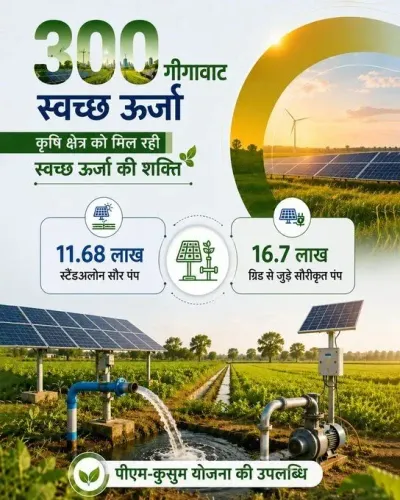
The PM-KUSUM scheme, introduced in 2019, extended solar benefits to farmers by promoting decentralised solar installations for agricultural use, broadening the programme's reach beyond large utility-scale projects. Central and state governments have worked in tandem through competitive auctions to drive down tariffs, making solar power among the cheapest electricity sources in the country. These policy levers collectively underpin the capacity surge that CM Choudhary highlighted in his post.
India's solar growth also supports its broader Paris Agreement obligations, positioning the country as a responsible actor in global climate diplomacy. The achievement places India alongside China — the world's largest solar market — in global rankings, a shift that reflects both the scale of domestic ambition and the effectiveness of sustained policy continuity since 2014.
Stakeholders and Impact
The milestone carries direct implications for solar developers, state power utilities, and rural households across India. Expanded capacity means greater grid availability, lower average power purchase costs for utilities, and improved electricity access in states that have historically faced supply deficits — including Bihar. For the agricultural sector, decentralised solar through schemes like PM-KUSUM reduces dependence on diesel pumps and erratic grid supply.
For Bihar specifically, state-level solar tenders and grid integration remain active areas of policy focus. The Chief Minister's public endorsement of the national milestone signals alignment between state and central priorities on clean energy, and may precede announcements on Bihar-specific renewable projects.
What's Next
With the 2030 deadline for India's 500 GW non-fossil fuel target approaching, attention will turn to whether the pace of capacity additions can be sustained — particularly as grid integration, storage infrastructure, and inter-state transmission remain logistical challenges. Parliamentary discussion on revised renewable targets and state-level auction pipelines are expected to intensify in the coming months. Bihar's own solar project tenders will be a key indicator of how national ambition translates into ground-level execution in one of India's most populous states.
Point of View
He ties economic nationalism to climate policy, a framing that has become a consistent BJP communication strategy. The 155 GW milestone, if verified, would represent a significant acceleration from India's earlier trajectory and would strengthen India's hand in international climate negotiations. For Bihar, a state historically dependent on the national grid and still expanding its own renewable footprint, the Chief Minister's public endorsement signals intent to position the state as a participant — not merely a beneficiary — of India's green energy story.
NationPress
13 Oct 2026
Frequently Asked Questions
Has India become the world's second-largest solar power market?
Bihar CM Samrat Choudhary's post on 29 May 2026 claims India has become the world's second-largest solar market with over 155 GW of installed capacity. This specific figure and ranking as of May 2026 have not been independently verified by NationPress.
What is India's solar energy target for 2030?
India has committed to achieving 500 GW of non-fossil fuel electricity capacity by 2030 , a pledge made by PM Modi at the COP26 summit in Glasgow in 2021 . Solar power is the primary driver of this target.
What is the National Solar Mission?
The National Solar Mission is a central government programme launched in 2010 to accelerate solar power deployment in India. Its initial target of 20 GW by 2022 was later revised to 100 GW as capacity additions outpaced early projections.
What is PM-KUSUM and how does it help farmers?
PM-KUSUM , introduced in 2019 , promotes decentralised solar power installations for agricultural use, helping farmers reduce dependence on diesel pumps and unreliable grid electricity. It is a key component of India's broader rural clean energy strategy.
What is Bihar's role in India's solar energy expansion?
Bihar is among the states where state-level solar project tenders and grid integration are active policy priorities. CM Samrat Choudhary's public support for national solar milestones signals the state's intent to align with central clean energy goals ahead of the 2030 deadline.