CM Samrat Choudhary Hails India's Solar Energy Leap Under Modi
Synopsis
Bihar Chief Minister Samrat Choudhary marked 12 years of Modi-led governance by highlighting India's clean energy achievements, including record solar capacity growth and farmer income opportunities through national solar schemes, positioning India as a global leader in the energy transition.
Key Takeaways
Bihar CM Samrat Choudhary praised PM Modi's 12-year governance record, specifically citing clean energy achievements on June 6, 2026 .
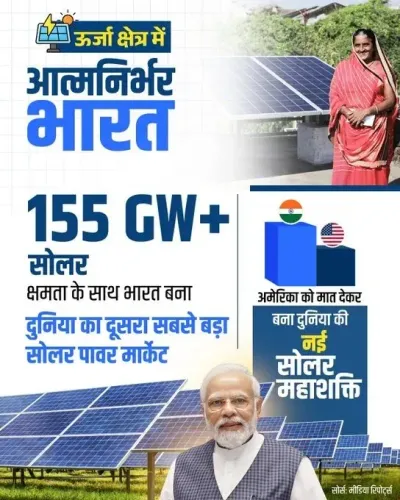
India's solar capacity has grown from under 3 GW in 2014 to tens of gigawatts, driven by central government policy.
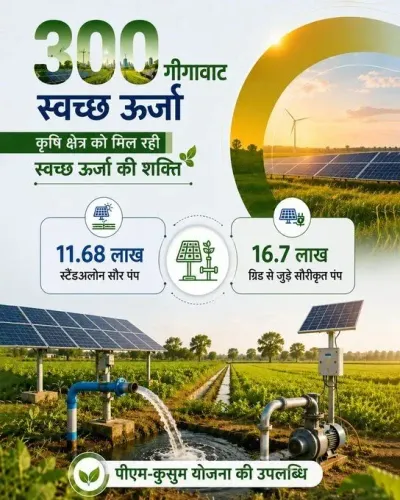
The PM-KUSUM scheme (launched 2019 ) enables farmers to install solar plants and earn income by selling surplus power to the grid.
India has pledged 500 GW of non-fossil fuel capacity by 2030 and net-zero emissions by 2070 .
The International Solar Alliance , co-founded by India and France in 2015 , now spans over 120 countries .
State-level solar rollout in Bihar and future COP targets remain key areas to watch.
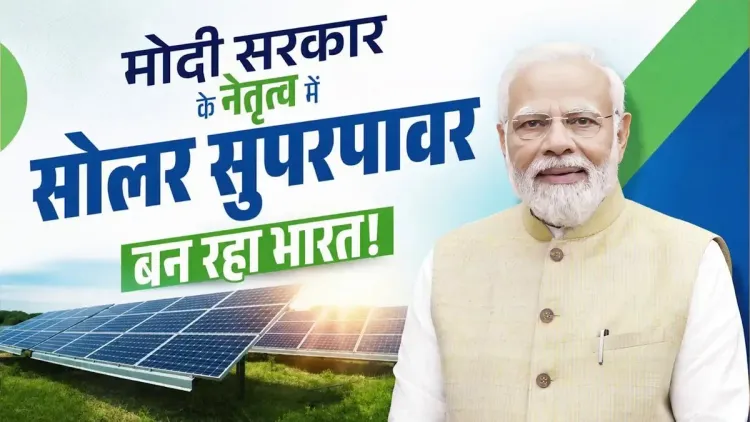
Bihar Chief Minister Samrat Choudhary on Saturday, June 6, 2026, credited Prime Minister Narendra Modi's leadership for what he described as unprecedented achievements in India's clean energy sector over the past 12 years, highlighting record growth in solar capacity and new income avenues for farmers.
Context
Posting on X, CM Choudhary wrote: '12 साल, विकास के अनगिनत आयाम और उपलब्धियों का स्वर्णिम अध्याय' ('12 years, countless dimensions of development and a golden chapter of achievements'). He stated that under Modi's visionary leadership, the country has achieved extraordinary milestones in clean energy, with record growth in solar capacity positioning India as a 'leading nation in global energy transition.'
The post also noted that 'millions of families are today benefiting from solar energy,' while farmers are accessing new income opportunities through energy production — a direct reference to farmer-centric solar schemes at the national level.
Policy Backdrop
India's solar journey has been marked by a series of escalating targets. At the 2015 Paris Climate Conference, India pledged 175 GW of renewable energy capacity by 2022. This ambition was later raised to 500 GW of non-fossil fuel capacity by 2030, announced at the 2019 UN Climate Summit.
The PM-KUSUM scheme, launched in 2019, has been a key instrument linking clean energy with rural livelihoods — enabling farmers to install solar pumps and grid-connected solar plants, reducing diesel dependence and creating supplementary income. India also co-launched the International Solar Alliance with France in 2015, now spanning over 120 countries, cementing its role in global solar diplomacy.
India's solar installed capacity has grown from under 3 GW in 2014 to tens of gigawatts in subsequent years, underpinning the country's long-term net-zero commitment for 2070.
Stakeholders and Impact
The twin beneficiaries highlighted in CM Choudhary's post — rural households and farmers — reflect the dual mandate of India's solar push: energy access and agrarian income support. The PM-KUSUM framework allows farmers to sell surplus solar power to the grid, effectively turning agricultural land into a source of clean-energy revenue.
For Bihar, one of India's most populous and largely agrarian states, the rollout of such schemes carries particular weight. State-level implementation of centrally-sponsored solar programmes remains a key area to watch, as rural electrification and farmer welfare are central political and development priorities for the state government.
What's Next
India's renewable energy trajectory will be closely watched ahead of future COP climate negotiations, where the country's progress against its 500 GW non-fossil fuel target will be scrutinised by international partners. At the state level, Bihar's own solar scheme rollout and any revised capacity announcements will be significant indicators of how national policy translates to ground-level impact.
CM Choudhary's post signals that clean energy achievements are being woven into the BJP's broader 12-year governance narrative — suggesting the theme will feature prominently in political messaging as India approaches the next electoral cycle.
Point of View
It taps into two of the party's strongest voter-facing narratives ahead of future electoral cycles. The emphasis on farmers as energy producers, not just consumers, reflects a maturing of the BJP's agrarian outreach — moving beyond subsidy messaging toward a self-reliance framework. Bihar, with its large rural electorate, makes this framing especially strategic for a state-level leader reinforcing alignment with the national leadership.
NationPress
14 Sept 2026
Frequently Asked Questions
What did Bihar CM Samrat Choudhary say about India's solar energy progress?
CM Samrat Choudhary stated that under PM Modi's leadership over 12 years, India has achieved unprecedented milestones in clean energy, with record solar capacity growth making India a leading nation in the global energy transition, and millions of families and farmers now benefiting from solar power.
What is the PM-KUSUM scheme and how does it help farmers?
PM-KUSUM, launched in 2019, is a central government scheme that helps farmers install solar pumps and grid-connected solar plants on their land, reducing diesel costs and allowing them to sell surplus electricity to the grid as an additional source of income.
What is India's renewable energy target for 2030?
India has pledged to achieve 500 GW of non-fossil fuel energy capacity by 2030, a target announced at the 2019 UN Climate Summit — up from an earlier pledge of 175 GW by 2022 made at the 2015 Paris Climate Conference.
What is the International Solar Alliance and what role does India play?
The International Solar Alliance is an initiative co-launched by India and France in 2015 to mobilise solar investment and technology across member nations. It now spans over 120 countries, with India playing a central founding and leadership role.
How has India's solar capacity changed since 2014?
India's solar installed capacity has grown from under 3 GW in 2014 to tens of gigawatts in subsequent years, reflecting the central government's sustained policy push on renewable energy as part of its energy security and climate strategy.