CM Samrat Choudhary Hails India's Green-Growth Balance Under Modi

Synopsis
Bihar Chief Minister Samrat Choudhary on World Environment Day credited PM Modi's leadership for balancing rapid development with environmental protection over 12 years, citing Mission LiFE, clean energy, natural farming, and water conservation as pillars of India's sustainability model.
Key Takeaways
Bihar CM Samrat Choudhary posted on World Environment Day, June 5, 2026 , praising India's development-environment balance under PM Modi .
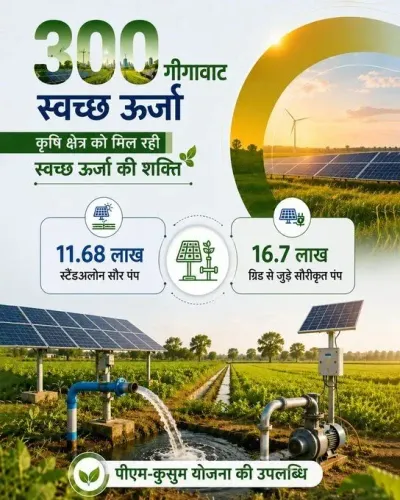
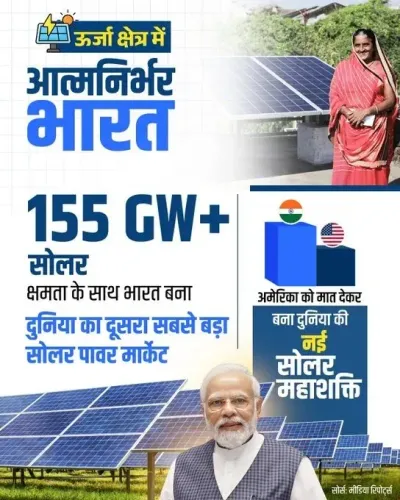
He cited 12 years of progress on green cover expansion, water conservation, clean energy, and natural farming.
Mission LiFE (Lifestyle for Environment), launched in 2022 , was specifically highlighted as a people's participation-based initiative.
India's climate commitments include a 33–35 per cent emission intensity reduction by 2030 and a net-zero target by 2070 announced at COP26 .
The statement signals political will for Bihar to align with central sustainability schemes including natural farming and Mission LiFE.
India's model is framed as a template for developing economies reconciling growth with ecological security.
Bihar Chief Minister Samrat Choudhary on Friday, June 5, 2026 — World Environment Day — credited Prime Minister Narendra Modi's leadership for establishing a new benchmark in balancing rapid development with environmental protection, saying India had demonstrated that growth and ecological security need not be in conflict.
Context
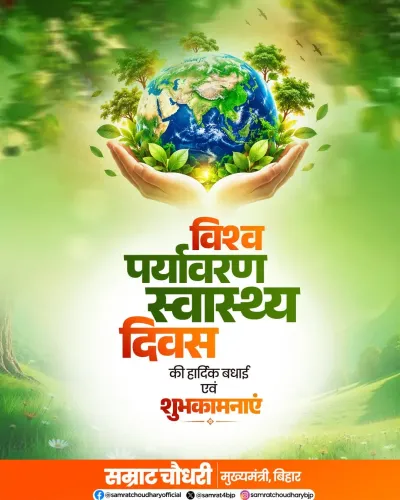
Posting in Hindi on the occasion of World Environment Day, CM Choudhary wrote: 'तेज विकास, सुरक्षित पर्यावरण' ('Fast development, secure environment'), framing the phrase as the defining principle of India's policy direction over the past decade. He specifically cited 12 years of work on green cover expansion, water conservation, clean energy, natural farming, and citizen-participation initiatives such as #MissionLiFE. The post coincides with the global observance of World Environment Day, lending the statement additional symbolic weight.
The Chief Minister described these efforts as a 'janbhagidari aadharit' (people's participation-based) model, underscoring the government's framing of environmental action as a mass movement rather than a top-down mandate.
Policy Backdrop
Mission LiFE — Lifestyle for Environment — was launched nationally in 2022 to promote climate-friendly habits at the individual and community level, positioning behavioural change as central to India's sustainability agenda. It sits alongside a longer chain of environmental commitments: the Swachh Bharat Mission launched in 2014, the International Solar Alliance co-founded in 2015, and India's first Nationally Determined Contributions under the Paris Agreement in 2015, which committed to a 33–35 per cent reduction in emission intensity by 2030.
India's announcement of a net-zero emissions target by 2070 at COP26 in Glasgow in 2021 further cemented the government's argument that a large developing economy can pursue ambitious growth while charting a credible climate pathway. Natural farming promotion, referenced explicitly by CM Choudhary, has been positioned as a means of reducing chemical inputs in agriculture while improving soil health and rural livelihoods.
Stakeholders and Impact
The statement carries particular resonance for Bihar, a state with significant agricultural dependence and a large rural population where both water conservation and natural farming programmes have scope for expansion. Farmers, state-level administrators, and urban communities engaged in clean-energy transitions are among the direct stakeholders of the central schemes CM Choudhary endorsed.
India's approach has also been presented internationally as a model for other developing nations seeking to reconcile infrastructure-led growth with ecological responsibility — an argument that gains renewed visibility each World Environment Day. The integration of domestic missions with global commitments such as the Paris Agreement reflects a dual accountability: to Indian citizens and to international climate forums.
What's Next
Attention will now turn to whether Bihar accelerates state-level adoption of schemes such as natural farming and Mission LiFE, particularly as updated forest survey data and renewable energy capacity reports are expected. CM Choudhary's public endorsement on a high-visibility occasion signals political will at the state level to align with the Centre's sustainability messaging.
As India continues to lay what CM Choudhary called 'a strong foundation for a safe, green and prosperous future for coming generations,' the test will be whether state governments translate that rhetoric into measurable on-ground outcomes in afforestation, clean energy uptake, and water conservation across districts like those in Bihar.
Point of View
The statement moves beyond ceremonial tribute toward a policy endorsement that also burnishes Bihar's credentials ahead of potential state-level scheme rollouts. The framing of development and environment as complementary rather than competing priorities is central to the BJP's answer to opposition critiques of ecological trade-offs in infrastructure expansion. It also positions India's climate diplomacy — built around the Paris Agreement and COP26 commitments — as a domestic political asset, not merely an international obligation.
NationPress
20 Oct 2026
Frequently Asked Questions
What did Bihar CM Samrat Choudhary say on World Environment Day 2026?
Bihar CM Samrat Choudhary praised PM Narendra Modi's leadership for balancing fast development with environmental protection over 12 years, citing green cover expansion, clean energy, water conservation, natural farming, and Mission LiFE as key achievements.
What is Mission LiFE and why is it significant?
Mission LiFE — Lifestyle for Environment — is a national programme launched in 2022 that encourages individuals and communities to adopt climate-friendly habits. It is significant because it frames environmental action as a people's movement rather than a government-only responsibility.
What are India's climate targets under PM Modi?
India committed to a 33–35 per cent reduction in emission intensity by 2030 under the Paris Agreement in 2015 and announced a net-zero emissions target by 2070 at COP26 in Glasgow in 2021.
How does natural farming relate to India's environment policy?
Natural farming reduces dependence on chemical fertilisers and pesticides, improving soil health and cutting agricultural emissions. The central government has promoted it as part of its broader sustainable development agenda.
Why did CM Samrat Choudhary post about the environment on June 5?
June 5 is observed globally as World Environment Day, making it a high-visibility occasion for political leaders to reaffirm their commitment to environmental causes and align with national and international sustainability messaging.