CM Samrat Choudhary Hails India's 2.7 GW Rooftop Solar Surge
Synopsis
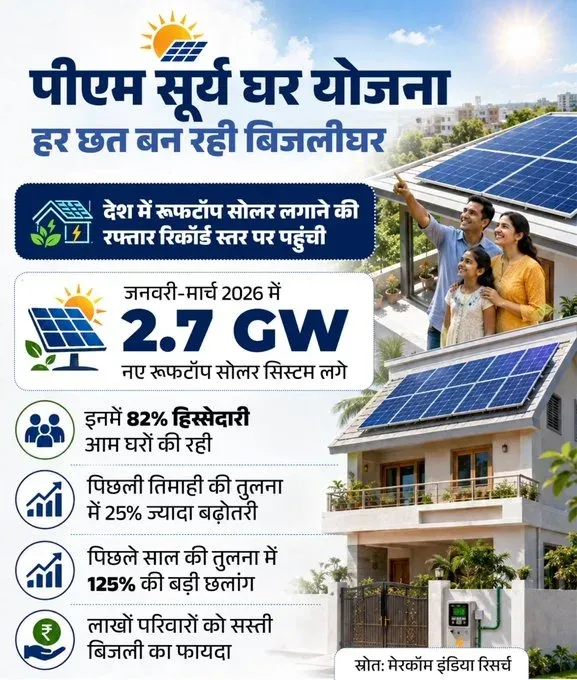
Bihar Chief Minister Samrat Choudhary highlighted India's addition of 2.7 GW rooftop solar capacity in January-March 2026, calling clean energy a mass public movement and crediting PM Modi's vision for driving the country's renewable energy and energy self-reliance goals.
Key Takeaways
Bihar CM Samrat Choudhary posted on 30 May 2026 praising India's rooftop solar progress.
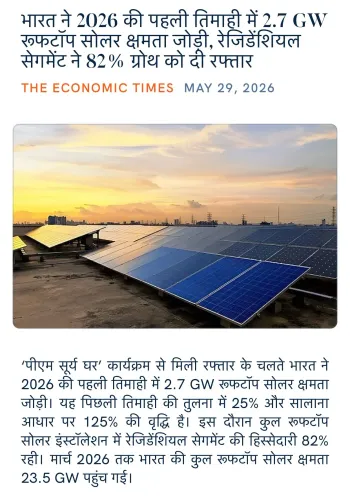
India added 2.7 GW of rooftop solar capacity between January and March 2026 .
CM Choudhary described clean energy as a 'movement of public participation' benefiting millions of households.
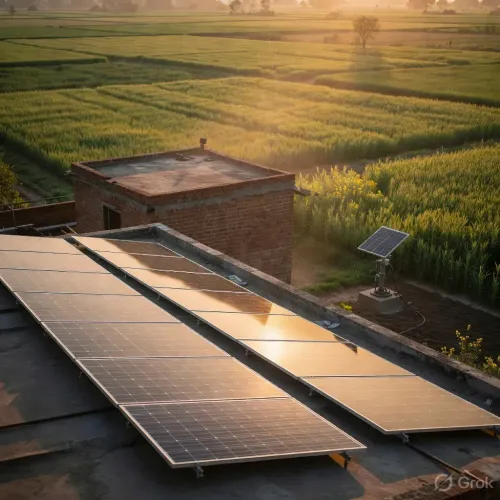
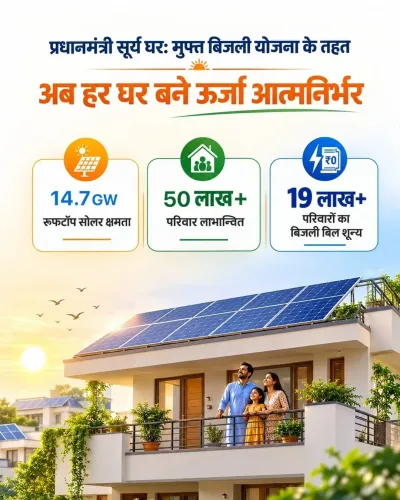
Household rooftops are being positioned as both energy sources and income generators via net metering.
India has committed to 500 GW non-fossil fuel capacity by 2030 and net-zero emissions by 2070.
The Rooftop Solar Programme and the International Solar Alliance form the central policy architecture behind this expansion.
Bihar Chief Minister Samrat Choudhary on Saturday, 30 May 2026, praised India's renewable energy momentum, highlighting the addition of 2.7 GW of rooftop solar capacity between January and March 2026 as evidence that clean energy has become a mass civic movement under Prime Minister Narendra Modi's leadership.
Context
Posting on X, CM Choudhary wrote in Hindi: 'हरित ऊर्जा के क्षेत्र में भारत लगातार नए कीर्तिमान स्थापित कर रहा है' ['India is continuously setting new records in the field of green energy']. He cited the 2.7 GW rooftop solar addition in the January-March 2026 quarter as proof that clean energy has now become 'a movement of public participation' (जनभागीदारी का आंदोलन).
The Chief Minister noted that millions of household rooftops are no longer merely meeting electricity needs but are also becoming 'a new source of income' — a reference to net-metering arrangements that allow households to sell surplus power back to the grid.
Policy Backdrop
India's rooftop solar push is anchored in the central Rooftop Solar Programme, which promotes decentralised solar installations on homes and buildings to boost citizen participation and reduce dependence on grid-supplied fossil-fuel power. The programme is one of several instruments through which the government has pursued its broader renewable energy targets.
The country's solar ambitions trace back to the Jawaharlal Nehru National Solar Mission launched in 2010, which initially targeted 20 GW of solar capacity by 2022. At the 2015 Paris climate negotiations, India raised its sights to 175 GW of renewable energy by 2022. Most recently, at COP26 in 2021, Prime Minister Modi committed India to 500 GW of non-fossil fuel capacity by 2030 and net-zero emissions by 2070.
India is also a co-founder of the International Solar Alliance, launched in 2015 to accelerate solar adoption globally — a diplomatic signal of the country's self-positioning as a leader in clean energy transition.
Stakeholders and Impact
Urban and peri-urban households stand as the most direct beneficiaries of rooftop solar expansion, gaining both reduced electricity bills and potential income through net metering. State power utilities, including those in Bihar, are simultaneously tasked with integrating this decentralised generation into the grid — a logistical and financial challenge that varies significantly by state.
Renewable energy developers and solar module manufacturers also benefit from sustained policy demand, while falling module prices globally have made rooftop installations increasingly accessible to middle-income households. The emphasis on household-level participation reflects a deliberate strategy to link energy security with environmental targets across successive national plans.
What's Next
Quarterly capacity data from the Ministry of New and Renewable Energy will be closely watched to assess whether the 2.7 GW single-quarter addition represents a sustained acceleration or a seasonal peak. Any revisions to subsidy structures under the rooftop solar scheme in the next Union Budget will be a key signal of the government's continued commitment to citizen-level clean energy adoption.
As India moves toward its 2030 target of 500 GW non-fossil fuel capacity, the pace of rooftop solar deployment — and the income-generation narrative around it — is likely to feature prominently in both national policy discourse and state-level political messaging.
Point of View
The messaging shifts rooftop solar from a technocratic policy to a populist economic story. This framing is consistent with the BJP's broader strategy of linking flagship central schemes to tangible citizen benefits at the grassroots. The Bihar angle is notable: a state not traditionally associated with renewable energy leadership is now visibly participating in the national solar story, suggesting the Centre's messaging infrastructure is functioning across the federal tier.
NationPress
18 Oct 2026
Frequently Asked Questions
How much rooftop solar capacity did India add in early 2026?
According to Bihar CM Samrat Choudhary's post, India added 2.7 GW of rooftop solar capacity between January and March 2026 .
What is India's rooftop solar scheme?
The Rooftop Solar Programme is a central government scheme that promotes decentralised solar installations on homes and buildings, allowing households to generate their own electricity and earn income by selling surplus power back to the grid through net metering.
What is India's renewable energy target for 2030?
At COP26 in 2021 , Prime Minister Narendra Modi committed India to achieving 500 GW of non-fossil fuel capacity by 2030 and net-zero emissions by 2070.
Who is Samrat Choudhary?
Samrat Choudhary is the Chief Minister of Bihar and a senior leader of the Bharatiya Janata Party (BJP) .
How can households earn income from rooftop solar in India?
Under net metering arrangements, households with rooftop solar panels can feed surplus electricity back into the grid and receive credit or payment from their state power utility, turning their rooftops into a source of additional income.