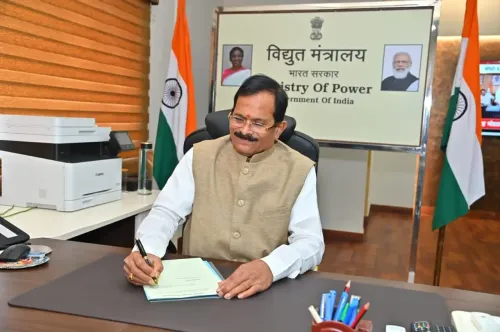
Giriraj Singh Shares India's 2.7 GW Rooftop Solar Q1 2026 Growth
Synopsis
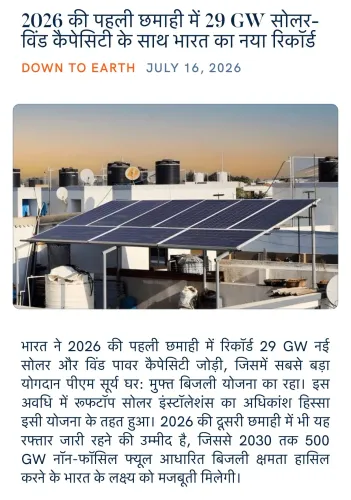
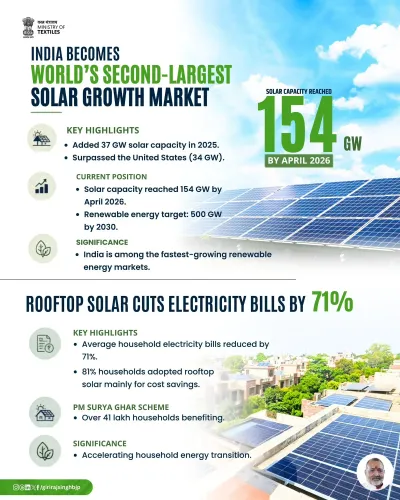
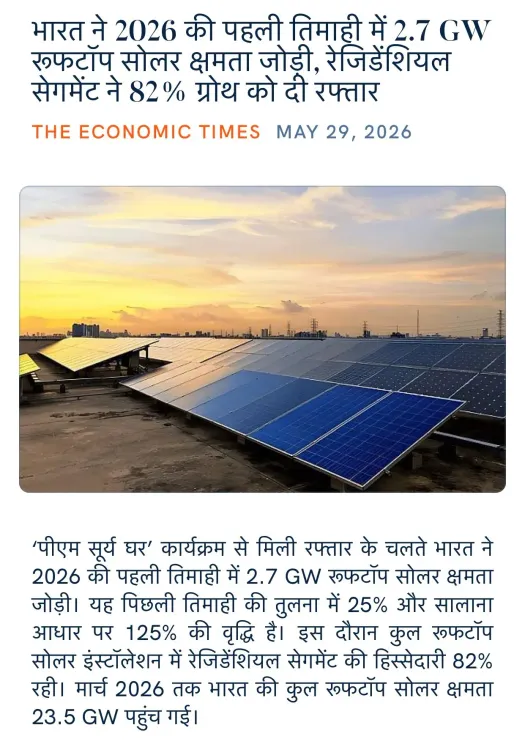
India added 2.7 GW of rooftop solar capacity in the first quarter of 2026, with the residential segment recording 82 per cent growth, according to data shared by Union Textiles Minister Giriraj Singh via the NaMo App on 29 May 2026.
Key Takeaways
India added 2.7 GW of rooftop solar capacity in Q1 2026 , per data shared by Giriraj Singh .
The residential segment drove 82 per cent growth during the quarter.
The PM Surya Ghar Muft Bijli Yojana , launched in 2024 , provides central financial assistance for household rooftop solar installations.
India targets 500 GW of non-fossil fuel capacity by 2030 and net-zero emissions by 2070 .
The Ministry of New and Renewable Energy (MNRE) is the nodal agency monitoring rooftop solar deployment nationwide.
Falling module prices and sustained policy support are identified as key drivers of the residential surge.
Union Textiles Minister Giriraj Singh on Friday, 29 May 2026, shared data indicating that India added 2.7 GW of rooftop solar capacity in the first quarter of 2026, with the residential segment driving an 82 per cent growth surge, posting the update via the NaMo App.
Context
The post, shared in Hindi, highlights a significant milestone in India's decentralised renewable energy push: 'भारत ने 2026 की पहली तिमाही में 2.7 GW रूफटॉप सोलर क्षमता जोड़ी' ['India added 2.7 GW rooftop solar capacity in the first quarter of 2026']. The residential segment is cited as the primary engine, recording 82 per cent growth during the period. The data point underscores the accelerating pace of household-level solar adoption across the country.
While Giriraj Singh heads the Ministry of Textiles, senior BJP leaders routinely amplify flagship government achievements across sectors through party and government digital platforms, including the NaMo App. The post reflects the ruling dispensation's effort to publicise renewable energy milestones as part of a broader governance narrative.
Policy Backdrop
India's rooftop solar programme has deep policy roots. The Jawaharlal Nehru National Solar Mission, launched in 2010, first established structured targets for grid-connected and rooftop solar deployment. At the 2015 Paris climate summit, India announced an updated target of 100 GW of solar capacity by 2022, including a 40 GW rooftop component.
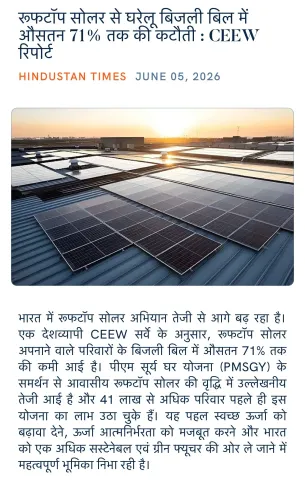
The most recent and significant policy lever is the PM Surya Ghar Muft Bijli Yojana, launched in 2024 under Prime Minister Narendra Modi. The scheme provides central financial assistance for residential rooftop solar installations, directly targeting household electricity bills and incentivising adoption at the grassroots level. Falling solar module prices combined with sustained central and state subsidies have together created the conditions for the residential segment's sharp uptick.
The Ministry of New and Renewable Energy (MNRE) is the nodal body overseeing rooftop solar policy, target-setting, and quarterly monitoring. India's broader ambition is to achieve 500 GW of non-fossil fuel capacity by 2030 and net-zero emissions by 2070.
Stakeholders and Impact
The primary beneficiaries of the residential rooftop surge are Indian households, who gain reduced electricity bills through net metering arrangements and direct subsidy support under PM Surya Ghar. Solar engineering, procurement, and construction (EPC) companies are also seeing expanded order books as demand accelerates.
State electricity distribution companies (discoms) face a dual dynamic: rooftop solar reduces transmission losses and peak grid demand, but also requires upgrades to net-metering infrastructure and billing systems. The 82 per cent residential growth rate, if sustained, would place significant pressure on discoms to modernise grid-edge management across states.
What's Next
Quarterly capacity reports from the MNRE will be closely watched to see whether the Q1 2026 momentum carries into subsequent quarters. Any revisions to subsidy structures or state-level implementation guidelines ahead of the next Union Budget could either accelerate or temper the residential segment's trajectory.
India's ability to sustain this pace will depend on supply chain stability for solar modules, grid readiness at the distribution level, and continued consumer awareness outreach. The 2.7 GW quarterly addition, if replicated consistently, would significantly advance India's cumulative rooftop solar targets and its commitments under the Paris Agreement.
Point of View
If verified by MNRE's quarterly report, would represent a material inflection point for the PM Surya Ghar scheme, which has been a flagship of the Modi government's second-term energy agenda. The post also signals the party's intent to frame rooftop solar not merely as an environmental policy but as a direct household welfare measure, linking energy savings to the broader 'Modi delivers' communication strategy. Analysts will watch whether this momentum translates into verifiable cumulative capacity data that closes the gap on India's long-pending 40 GW rooftop target.
NationPress
21 Oct 2026
Frequently Asked Questions
How much rooftop solar capacity did India add in Q1 2026?
According to data shared by Union Textiles Minister Giriraj Singh, India added 2.7 GW of rooftop solar capacity in the first quarter of 2026.
What is PM Surya Ghar Muft Bijli Yojana?
PM Surya Ghar Muft Bijli Yojana is a central government scheme launched in 2024 that provides financial assistance to households for installing rooftop solar panels, aimed at reducing electricity bills through net metering.
Why is the residential segment important for India's rooftop solar growth?
The residential segment directly empowers individual households with lower electricity costs and reduced grid dependence. Its 82 per cent growth in Q1 2026 indicates that central subsidies and falling module prices are successfully driving mass adoption beyond commercial and industrial users.
What is India's overall renewable energy target?
India aims to achieve 500 GW of non-fossil fuel electricity capacity by 2030 and net-zero carbon emissions by 2070 , with rooftop solar forming a key decentralised pillar of this strategy.
Which ministry oversees India's rooftop solar programme?
The Ministry of New and Renewable Energy (MNRE) is the nodal ministry responsible for policy, target-setting, and monitoring of India's rooftop solar programme, including the residential subsidy scheme.