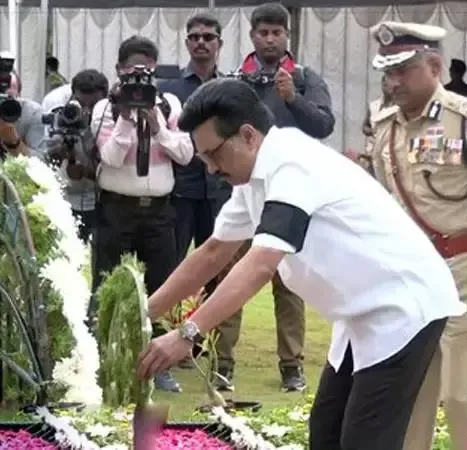
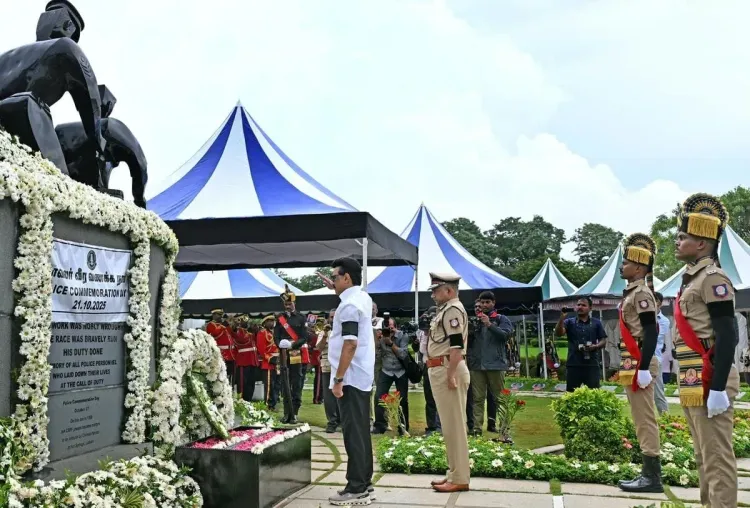
Stalin Salutes Fallen Officers on Police Commemoration Day
Synopsis
DMK president M. K. Stalin marked Police Commemoration Day on 21 October 2026 with a heartfelt Tamil tribute, saluting officers who died in the line of duty and describing the police as the 'fortress of trust and security' of society.
Key Takeaways
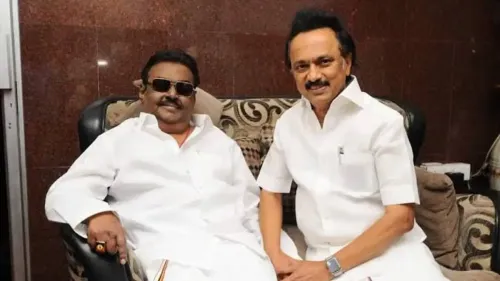
Stalin , DMK president and former Tamil Nadu Chief Minister, posted a solemn tribute on 21 October 2026 for Police Commemoration Day.
He described the police as 'the fortress of trust and security of our society' — not merely a law-enforcement body.
Police Commemoration Day is observed every year on 21 October , tracing back to the ambush at Hot Springs, Ladakh on 21 October 1959 in which ten CRPF personnel were killed.
Stalin offered a vīravaṇakkam (hero's salute) to all officers who lost their lives in the line of duty.
The tribute is consistent with a broader national tradition of political leaders from all parties honouring police sacrifices on this date.
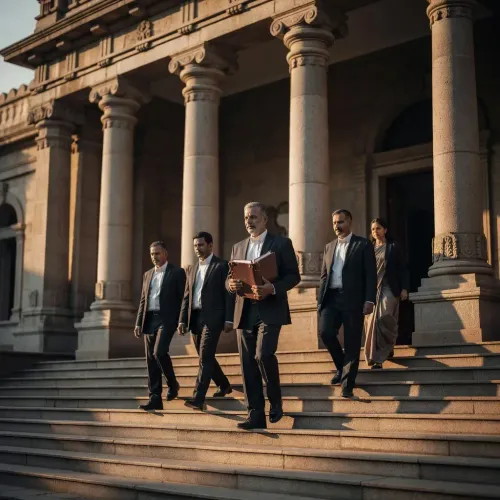
Every year on 21 October, India pauses to remember the men and women in uniform who paid the ultimate price in service of public safety — and DMK president M. K. Stalin marked Police Commemoration Day 2026 with a solemn tribute to officers who laid down their lives on duty.
Posting in Tamil on X, Stalin called the police force 'not merely an institution that upholds the law, but the fortress of trust and security of our society.' He offered his vīravaṇakkam — a hero's salute — to every officer who, 'facing dangers for the safety of the people and for a peaceful life, performed their duty with dedication and gave their precious lives.'
What Police Commemoration Day marks
Police Commemoration Day is observed every year on 21 October across India to honour police personnel killed in the line of duty. The date traces back to 21 October 1959, when a patrol of Central Reserve Police Force personnel was ambushed at Hot Springs in Ladakh, resulting in the deaths of ten officers — one of the gravest single-day losses in Indian policing history. Since then, the day has grown into a nationwide observance, with ceremonial parades, wreath-laying, and welfare announcements for the families of fallen officers.
A tribute that cuts across party lines
Tributes from political leaders on Police Commemoration Day have become a consistent feature of India's civic calendar, with leaders across the spectrum acknowledging the sacrifices of state and central police forces. For Stalin, whose DMK governs Tamil Nadu, the message carries an added layer: the party directly oversees the welfare of the state's police personnel, making such observances as much a governance statement as a ceremonial one.
Stalin's framing — police as a 'fortress of trust' — emphasises the social contract between law enforcement and the communities they serve, a note that resonates beyond politics at a moment when police-public relations remain a subject of ongoing national conversation.
Point of View
Such messaging does double duty — it is both a civic acknowledgement and a signal of governance priorities around police welfare. The framing of police as a 'fortress of trust' rather than merely a coercive institution reflects a rhetorical shift that several state governments have leaned into amid ongoing debates about police reform and accountability. Whether this year's observance in Tamil Nadu is accompanied by any concrete welfare announcements for officers' families will determine whether the tribute carries policy weight beyond the ceremonial.
NationPress
21 Oct 2026
Frequently Asked Questions
What is Police Commemoration Day and why is it observed on 21 October?
Police Commemoration Day is observed on 21 October every year to honour Indian police personnel killed in the line of duty. The date marks the 1959 Hot Springs ambush in Ladakh, where ten CRPF personnel were killed — one of the deadliest single-day losses in Indian policing history.
What did MK Stalin say on Police Commemoration Day 2026?
M. K. Stalin called the police 'not merely an institution that upholds the law, but the fortress of trust and security of our society.' He offered a hero's salute to all officers who gave their lives protecting the public.
How do Indian political leaders observe Police Commemoration Day?
Leaders across parties typically post written tributes, attend wreath-laying ceremonies, and sometimes announce police welfare measures. It has become a consistent feature of India's civic calendar on 21 October each year.
What does 'vīravaṇakkam' mean?
Vīravaṇakkam is a Tamil term meaning a hero's salute — a respectful bow offered to honour someone who has shown exceptional courage or sacrifice, often used when paying tribute to martyrs.