Stalin Hails V.P. Singh on Birth Anniversary as Social Justice Icon
Synopsis
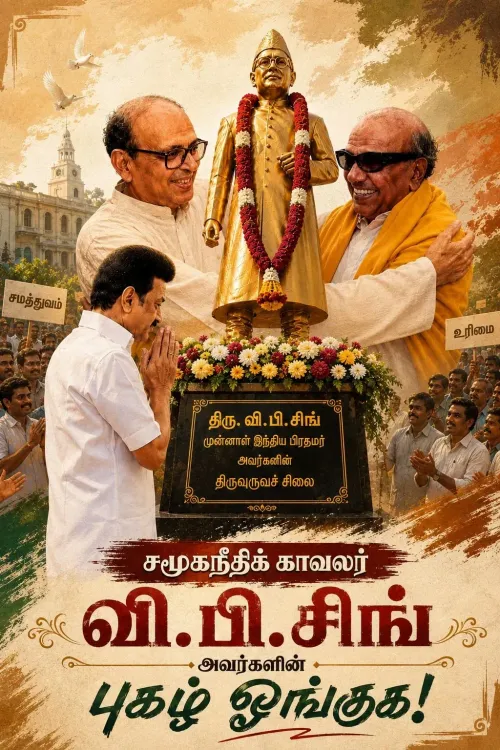
DMK president M. K. Stalin on 25 June 2026 honoured former Prime Minister V. P. Singh on his birth anniversary, drawing a parallel between V. P. Singh's sacrifice of power for the Mandal Commission's OBC reservations and the DMK's own social justice ideology, and recalling his solidarity with Kalaignar M. Karunanidhi.
Key Takeaways
Stalin posted a Tamil tribute to former PM V.
Singh on his birth anniversary on 25 June 2026 .
Singh as a 'guardian of social justice from the north' who treated the Prime Minister's office as secondary to social justice principles.
He drew a direct ideological parallel between V.
Singh's philosophy and the DMK's stated position that 'social justice policy matters more than power.' V.
Singh's government implemented Mandal Commission recommendations on 7 August 1990 , granting 27 per cent OBC reservations in central government jobs.
The DMK was part of V.
Singh's National Front coalition (1989–1990), and Stalin recalled V.
Singh's solidarity with Kalaignar M.
Karunanidhi during difficult times.
The tribute comes amid active national debates on a caste census and expansion of reservation quotas, reinforcing DMK's advocacy on both fronts.
DMK president M. K. Stalin on Thursday, 25 June 2026, paid tribute to former Prime Minister V. P. Singh on his birth anniversary, calling him a guardian of social justice who rose from northern India and embodied the same principles that define the Dravida Munnetra Kazhagam.
Writing in Tamil on X, Stalin described V. P. Singh as someone who treated the Prime Minister's office as secondary to the cause of social justice — 'பிரதமர் பதவியையே துச்சமாகக் கருதி' (regarding even the Prime Minister's post as trivial) — in pursuit of equity. He offered his 'veeravanakkam' (heroic salute) to the former premier.
Context
Stalin drew a direct parallel between V. P. Singh's political philosophy and that of the DMK, stating: 'Just like the DMK, he lived by the principle that power and positions are not important — social justice policy is what matters.' He also recalled that V. P. Singh stood shoulder-to-shoulder with DMK patriarch M. Karunanidhi (referred to as Kalaignar) during difficult times, describing it as 'true ideological companionship.'
Stalin noted that V. P. Singh was a Prime Minister who 'loved Tamil Nadu and was loved by Tamils,' underscoring the emotional and political bond between the former national leader and the Dravidian movement.
Policy Backdrop
V. P. Singh served as Prime Minister from 1989 to 1990 at the head of the National Front government, of which the DMK was a key constituent. On 7 August 1990, his government announced the implementation of the Mandal Commission recommendations, extending 27 per cent central-government reservations to Other Backward Classes — a landmark moment in India's social justice history.
Though his tenure lasted barely a year, the Mandal decision cost him his government and ultimately his prime ministership, a sacrifice Stalin's tribute explicitly honours. The DMK's own decades-long reservation policy in Tamil Nadu predates the Mandal move and made the party a natural ideological ally of V. P. Singh's agenda.
Stakeholders and Impact
OBC communities across India continue to regard V. P. Singh's Mandal implementation as the defining federal act of social justice in post-independence India. For Dravidian parties, invoking his legacy reinforces their claim to be the original and consistent champions of caste-based equity.
Stalin's tribute also carries contemporary resonance: national debates on a caste census and potential expansion of reservation quotas have intensified in recent years, and DMK has been among the most vocal advocates for both. Linking V. P. Singh's sacrifice to that current campaign strengthens the party's ideological positioning ahead of future electoral cycles.
What's Next
The DMK's messaging around V. P. Singh's birth anniversary is consistent with its broader strategy of building cross-regional coalitions anchored on social justice. Observers will watch for DMK statements on any proposed caste census legislation or quota revision bills in Parliament, as well as possible joint platforms with like-minded parties from northern and central India in the run-up to the next general election.
Point of View
Stalin positions his party as the consistent, cross-regional custodian of social justice at a moment when the caste census debate is reshaping national politics. The invocation of Kalaignar's personal bond with V. P. Singh also serves to legitimise DMK's claim to a pan-India social justice legacy, not just a Tamil one. This kind of cross-regional tribute is a recurring DMK tool for coalition-building ahead of parliamentary contests.
NationPress
24 Sept 2026
Frequently Asked Questions
Who is V. P. Singh and why is he remembered?
V. P. Singh served as Prime Minister of India from 1989 to 1990 and is best remembered for implementing the Mandal Commission recommendations, which extended 27 per cent reservations in central government jobs and education to Other Backward Classes — a decision that cost him his government but defined his legacy as a social justice leader.
Why did M. K. Stalin pay tribute to V. P. Singh?
DMK president M. K. Stalin paid tribute on V. P. Singh's birth anniversary, highlighting his sacrifice of the Prime Minister's office for the cause of OBC reservations and drawing a parallel with the DMK's own social justice principles.
What is the connection between DMK and V. P. Singh?
The DMK was a constituent of V. P. Singh's National Front coalition government (1989–1990). V. P. Singh also maintained a close political relationship with DMK patriarch Kalaignar M. Karunanidhi , which Stalin recalled in his tribute.
What is the Mandal Commission?
The Mandal Commission submitted its report in 1980 , recommending 27 per cent reservations for Other Backward Classes in central government services and public-sector institutions. V. P. Singh announced its implementation on 7 August 1990 , making it one of the most consequential social policy decisions in independent India.
What is the significance of Stalin's tribute in today's political context?
The tribute comes amid an intensifying national debate on conducting a caste census and potentially expanding reservation quotas. By invoking V. P. Singh, DMK reinforces its position as a leading advocate for social equity and signals its intent to build cross-regional alliances on the issue ahead of future elections.