Joshi Hails India's Clean Energy Rise Under Modi
Synopsis
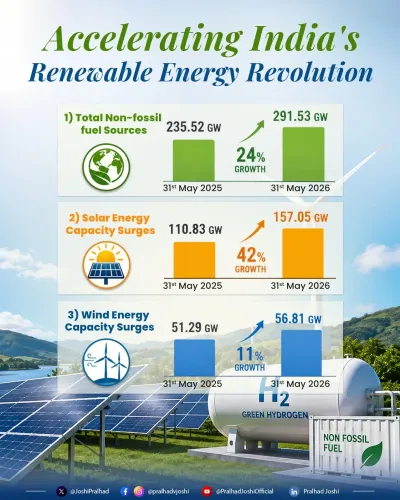
Union Minister Pralhad Joshi on 17 June 2026 declared India has achieved one of the world's fastest clean energy transformations under PM Modi, citing twelve years of solar, wind and policy milestones that have turned chronic power shortages into renewable ambition on a global scale.
Key Takeaways
Union Minister Pralhad Joshi on 17 June 2026 credited PM Narendra Modi's twelve-year leadership with turning India into a renewable energy superpower.
India's solar mission, launched in 2010 with a 20 GW target, was scaled up significantly after 2014 through competitive auctions and dedicated solar parks.
At COP26 (2021) , India committed under its Panchamrit pledges to achieve 500 GW non-fossil capacity by 2030 and net-zero by 2070 .
The International Solar Alliance , co-founded by India and France in 2015 , now has over 120 member countries mobilising global solar investment.
The National Green Hydrogen Mission and state-level renewable purchase obligation compliance are the next key milestones to watch.
Joshi's statement is expected to anchor the government's climate communications ahead of COP31 .
Union Minister of New and Renewable Energy Pralhad Joshi on Wednesday, 17 June 2026, credited Prime Minister Narendra Modi's twelve-year tenure with transforming India from a nation plagued by power deficits into what he described as a renewable energy superpower, calling the shift one of the world's fastest clean energy transformations.
Context
Joshi's post frames India's energy journey as a decisive break from chronic shortages that defined the pre-2014 era. Writing on X, he stated that over the last twelve years India has achieved 'one of the world's fastest clean energy transformations, driving innovation, affordability and sustainability at an unprecedented scale.' The statement arrives as the government prepares for a fresh cycle of international climate diplomacy ahead of COP31.
The minister oversees two portfolios — Consumer Affairs and New and Renewable Energy — making his commentary on the sector both ministerial and political. His remarks signal the ruling dispensation's intent to campaign on its clean energy record ahead of the next electoral cycle.
Policy Backdrop
India's renewable push has roots in the Jawaharlal Nehru National Solar Mission, launched in 2010 with an initial target of 20 GW of solar capacity. After 2014, the government dramatically scaled ambitions, revising the overall renewable energy target to 175 GW by 2022 and backing it with competitive auction mechanisms, dedicated solar park schemes and domestic manufacturing incentives.
At COP26 in 2021, India announced its Panchamrit commitments — a five-point climate pledge that included achieving 500 GW of non-fossil fuel capacity by 2030 and reaching net-zero emissions by 2070. India also co-founded the International Solar Alliance with France in 2015, a treaty-based body that now counts over 120 member countries and aims to mobilise large-scale solar investments globally.
Falling technology costs, state-level renewable purchase obligations and a push to reduce dependence on coal imports have together underpinned the capacity additions across solar and wind sectors since 2014.
Stakeholders and Impact
The beneficiaries of this transition span a wide spectrum: large renewable project developers who have gained from transparent competitive auctions, state electricity distribution companies (discoms) managing a changing generation mix, and rural households that have gained access to electricity for the first time through off-grid and decentralised solar schemes.
Affordability has been a recurring theme in government messaging, with solar tariffs falling sharply over the decade through competitive bidding. Innovation in domestic manufacturing — incentivised through production-linked schemes — has also been positioned as a job-creation lever alongside the climate rationale.
What's Next
Attention in the sector is now turning to the National Green Hydrogen Mission, which aims to position India as a global hub for green hydrogen production and export. Compliance by states with renewable purchase obligations and any upward revision of the 2030 non-fossil capacity target ahead of COP31 will be closely watched by investors and climate negotiators alike.
Joshi's public assertion of India's superpower status in renewables is likely to set the tone for the government's climate communications through the remainder of 2026, as New Delhi seeks to consolidate its standing as a leading voice in the global energy transition.
Point of View
Timed to reinforce the BJP's governance narrative on energy security as India approaches another climate summit cycle. By invoking a twelve-year arc, the minister frames the entire renewable energy story as a Modi-era achievement, eliding the earlier policy foundations while spotlighting the scale-up that followed 2014. The 'superpower' framing is also a bid for international credibility — positioning India not merely as a developing nation meeting climate obligations but as a model for emerging economies. Whether the claim withstands scrutiny will depend on verified capacity and access data that independent audits are yet to confirm for 2026.
NationPress
16 Sept 2026
Frequently Asked Questions
What did Pralhad Joshi say about India's renewable energy progress?
Pralhad Joshi said India has achieved one of the world's fastest clean energy transformations over the last twelve years under PM Modi, moving from power deficits to becoming a renewable energy superpower driven by innovation, affordability and sustainability.
What is India's renewable energy target for 2030?
Under its Panchamrit commitments announced at COP26 in 2021, India has pledged to achieve 500 GW of non-fossil fuel electricity capacity by 2030 and reach net-zero emissions by 2070.
What is the International Solar Alliance?
The International Solar Alliance is a treaty-based international organisation co-founded by India and France in 2015 to mobilise solar energy investments globally; it now has over 120 member countries.
What is the Jawaharlal Nehru National Solar Mission?
It is India's flagship solar programme, launched in 2010 with an initial target of 20 GW of solar capacity, which was significantly scaled up after 2014 through competitive auctions, solar parks and rooftop schemes.
What is the National Green Hydrogen Mission?
The National Green Hydrogen Mission is India's policy initiative to develop green hydrogen production and export capacity, positioning the country as a global hub in the next phase of the clean energy transition.