Assam CM Relief Fund draws online donations amid floods
Synopsis
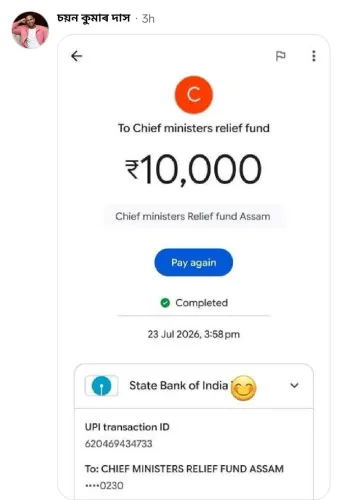
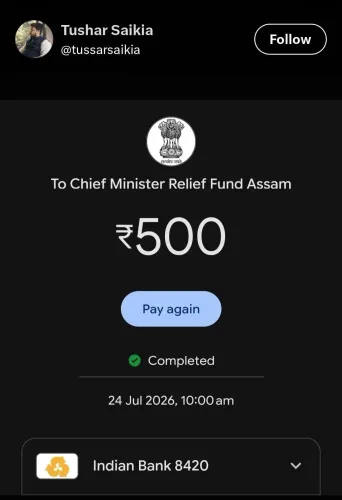
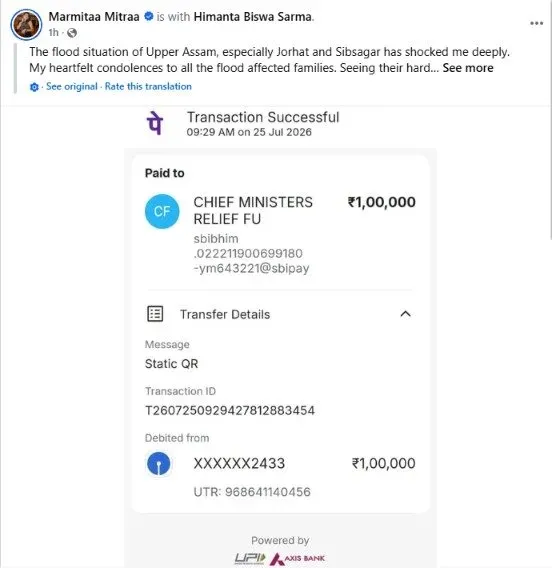
The Chief Minister's Office of Assam announced on 25 July 2026 that people across the state are contributing online to the Chief Minister's Relief Fund, reflecting public solidarity with families hit by monsoon flooding along the Brahmaputra basin.
Key Takeaways
The Chief Minister's Office of Assam reported on 25 July 2026 that online donations to the Chief Minister's Relief Fund are flowing in from across the state.
The fund is a long-standing government mechanism providing immediate assistance to victims of natural calamities in Assam .
Online donation channels have been promoted in recent years to allow contributions from the diaspora and citizens outside Assam .
Assam is one of India's most flood-prone states due to annual monsoon inundation of the Brahmaputra and its tributaries.
Flood-affected families are the primary beneficiaries, relying on the fund for immediate relief including food and shelter.
Transparency in fund disbursement and utilisation reporting remains a key concern for civil society observers.
The Chief Minister's Office of Assam on Saturday, 25 July 2026 reported that residents from across the state are contributing online to the Chief Minister's Relief Fund, channelling public solidarity toward families displaced and affected by the ongoing monsoon floods.
Context
The post from the official Chief Minister's Office of Assam account describes a sustained wave of online contributions to the relief fund, framing the response as a collective expression of solidarity. The fund is a government-managed mechanism designed to provide immediate financial assistance to victims of natural calamities, including the annual flooding that strikes Assam during the monsoon season.
Chief Minister Himanta Biswa Sarma, who has led the state since May 2021, oversees disaster relief operations and has previously made public appeals for contributions during flood emergencies. The office's post, accompanied by four images, signals an active fundraising push during what appears to be a significant flood event this season.
Policy Backdrop
The Chief Minister's Relief Fund has existed in Assam for several decades as a standing instrument for disaster response, supplementing budgetary allocations with voluntary public contributions. In recent years, state authorities have promoted online donation channels to widen participation beyond the state's borders, enabling the diaspora and citizens from other parts of India to contribute directly.
This approach reflects a broader national pattern in which both official machinery and citizen solidarity are mobilised to manage seasonal disasters. Assam's geography — shaped by the Brahmaputra river and its tributaries — makes it one of India's most flood-prone states, with annual inundation causing extensive damage to agriculture, homes, and infrastructure across districts.
Stakeholders and Impact
The primary beneficiaries of the fund are flood-affected families who rely on state assistance for immediate relief — food, shelter, and emergency support — while longer-term recovery efforts are organised separately. Donors include ordinary residents of Assam, members of the state's diaspora, and citizens from other Indian states moved by the scale of the crisis.
Online donation platforms have lowered the barrier for participation, making it possible for contributions to flow in from anywhere in the country. The public visibility of such drives also serves to maintain awareness of the humanitarian situation on the ground, sustaining pressure on authorities to disburse funds promptly and transparently.
What's Next
Attention will now turn to how swiftly the state government disburses collected funds to affected households, and whether detailed contribution figures and utilisation reports are made public. Observers and civil society groups in Assam have historically called for greater transparency in relief fund accounting.
With the monsoon season still active, further flood events remain a possibility, and the state's ability to combine public generosity with efficient administrative delivery will be closely watched. Any announcements on new flood mitigation infrastructure or early-warning system upgrades ahead of the next monsoon cycle will also be significant markers of the government's longer-term disaster preparedness strategy.
Point of View
Demonstrating executive engagement during disasters. For CM Himanta Biswa Sarma, whose tenure has coincided with several severe flood seasons, the emphasis on citizen solidarity also subtly distributes moral responsibility for relief outcomes beyond the state machinery. The longer-term test, however, will be how rigorously disbursement data is published and whether affected families receive timely, traceable assistance.
NationPress
24 Oct 2026
Frequently Asked Questions
What is the Chief Minister's Relief Fund in Assam?
The Chief Minister's Relief Fund in Assam is a government-managed fund used to provide immediate financial assistance to victims of natural calamities such as floods and cyclones. It is activated during major disaster events and accepts voluntary public contributions.
How can I donate to the Assam CM Relief Fund online?
Online donation facilities for the Assam Chief Minister's Relief Fund have been made available in recent years to allow residents, diaspora members, and citizens from other states to contribute digitally. The official government portal of Assam is the recommended channel for such contributions.
Who is the Chief Minister of Assam in 2026?
Himanta Biswa Sarma has been the Chief Minister of Assam since May 2021 and oversees state-level disaster relief operations including appeals for public contributions during flood emergencies.
Why does Assam flood every year?
Assam floods annually during the monsoon season primarily because of the Brahmaputra river and its numerous tributaries, which overflow their banks under heavy rainfall, inundating agricultural land, homes, and infrastructure across the state.
How is the Assam CM Relief Fund money used?
Funds collected are intended for immediate relief to flood-affected families, covering needs such as food, temporary shelter, and emergency support. Civil society groups have called for transparent public reporting on how and when the money is disbursed.