Assam CMO: State ranks 2nd in CSE 2026 environment report
Synopsis
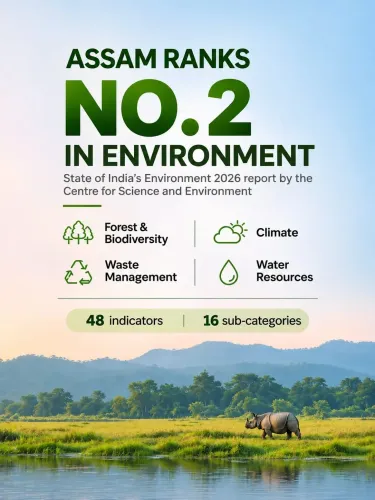
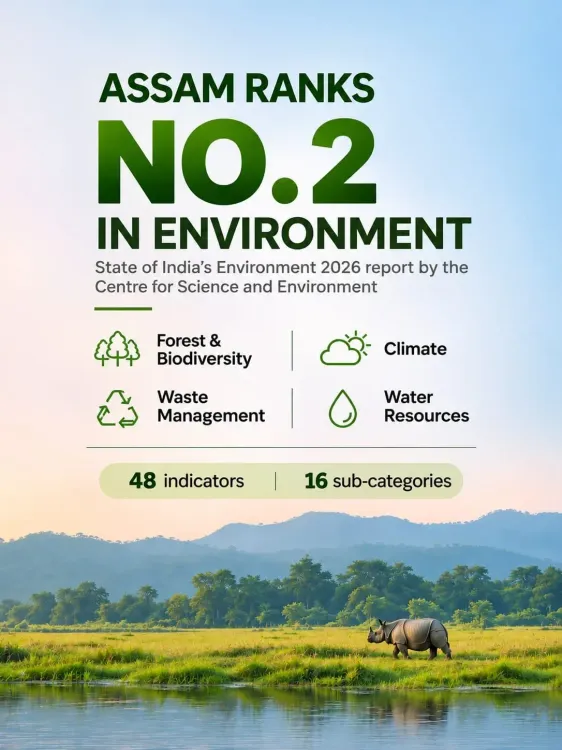
Assam's Chief Minister's Office said the state ranked second nationally in the Environment category of CSE's State of India's Environment 2026 report, assessed on 48 indicators. It credited CM Himanta Biswa Sarma with reclaiming over 18,000 hectares of forest land and expanding protected areas.
Key Takeaways
The Chief Minister's Office of Assam said the state secured 2nd rank nationally in the Environment category of CSE's State of India's Environment 2026 report.
The office said the ranking was assessed across 48 indicators covering forests, climate, waste and water.
It credited CM Dr Himanta Biswa Sarma with reclaiming 18,000+ hectares of forest land.
The CMO also cited expanded protected areas and stronger wildlife protection and afforestation.
The announcement was made on 27 November 2026.
Second place on a national environment scorecard is the kind of number state governments wait for, and the Chief Minister's Office of Assam claimed it on Friday, 27 November 2026. The office said Assam had secured the 2nd rank nationally in the Environment category of the Centre for Science and Environment's State of India's Environment 2026 report. It credited Chief Minister Dr Himanta Biswa Sarma with reclaiming 18,000+ hectares of forest land and widening protected areas.
In the post, the office said the ranking was assessed across 48 indicators covering forests, climate, waste and water. It added that the state had 'reclaimed 18,000+ hectares of forest land, expanded protected areas and strengthened wildlife protection and afforestation efforts, reaffirming its commitment to conserving its rich natural heritage and biodiversity.'
What the 48-indicator environment scorecard covers
The Centre for Science and Environment, a Delhi-based research organisation, publishes the annual State of India's Environment report ranking states on ecological performance. According to the Assam CMO, the 2026 Environment category pulled together forests, climate, waste and water into a single national ranking in which Assam finished second.
Scorecards of this kind routinely shape how state governments are judged on the ecology-versus-development bargain. Northeastern states often sit high on forest-linked metrics because of existing cover. Assam is home to globally known habitats such as Kaziranga and Manas, which sit at the centre of its wildlife-protection story.
Forest land, protected areas and the 1972 wildlife law
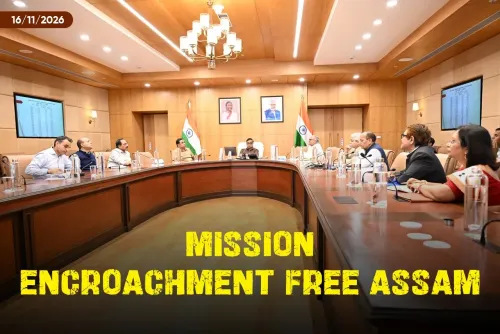
The CMO tied the ranking to three concrete lines of work: reclaiming encroached forest, expanding protected areas, and stepping up afforestation and wildlife protection under Dr Sarma, Chief Minister since 2021. Those claims sit alongside older national frameworks. Assam has participated in the National Mission for a Green India since 2014, a programme meant to enhance forest and ecosystem services. Protected-area expansion and management also run through the Wildlife (Protection) Act, 1972.
On the ground, the state forest department and local communities are the usual stakeholders in reclamation and afforestation. The office did not, in this post, publish a district-wise break-up of the 18,000+ hectares or the full CSE score sheet.
The next documents that will test the ranking
What comes next is documentary, not ceremonial. The complete CSE 2026 report, with state-wise scores, and any new Assam budget provisions for afforestation or protected areas, will show how the second-place tag was built and whether it holds. Rankings of this sort influence perceptions of governance as much as they record tree cover.
For a biodiversity-rich state still balancing growth with green cover, finishing second is both a scoreboard moment and a reminder that reclaimed hectares have to stay forests.
Point of View
000-plus hectares hold, and how the full CSE 2026 tables break down, will decide if this is a durable policy signal or a one-cycle ranking spike.
NationPress
27 Nov 2026
Frequently Asked Questions
What rank did Assam get in CSE's 2026 environment report?
According to the Chief Minister's Office of Assam, the state secured the 2nd rank nationally in the Environment category of CSE's State of India's Environment 2026 report. The office said the assessment covered 48 indicators on forests, climate, waste and water.
Who announced Assam's CSE environment ranking?
The Chief Minister's Office of Assam announced the ranking on 27 November 2026. It credited Chief Minister Dr Himanta Biswa Sarma for forest reclamation, protected-area expansion and wildlife protection.
How much forest land did Assam say it reclaimed?
The Assam CMO said the state has reclaimed 18,000+ hectares of forest land. The same post also cited expanded protected areas and stronger afforestation and wildlife protection.
What is the State of India's Environment report?
It is an annual publication of the Centre for Science and Environment, a Delhi-based research organisation. It evaluates Indian states on environmental parameters such as forests, climate, waste and water.
Who is the Chief Minister of Assam?
Dr Himanta Biswa Sarma has been Chief Minister of Assam since 2021. The CMO linked the 2026 environment ranking to conservation steps taken under his leadership.