CM Assam Highlights PMAY Gains, Kokrajhar Families Share Stories

Synopsis
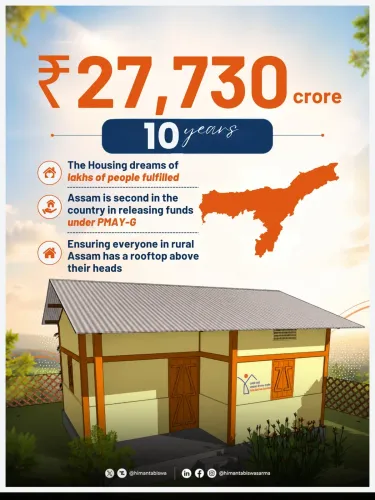
The Chief Minister's Office of Assam spotlighted Pradhan Mantri Awas Yojana beneficiaries in Kokrajhar on 21 October 2026, sharing video testimonies of families who have received homes under the decade-old central housing scheme.
Key Takeaways
The Chief Minister's Office of Assam posted beneficiary testimonies from Kokrajhar on 21 October 2026 highlighting PMAY outcomes.
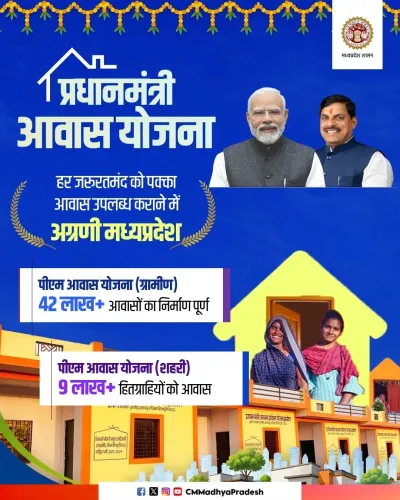
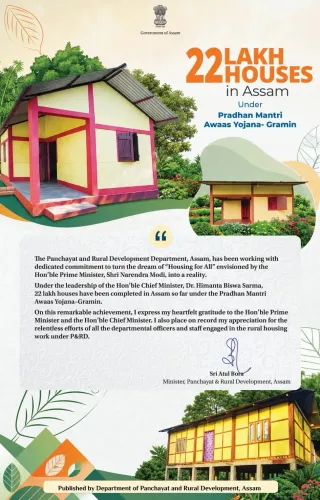
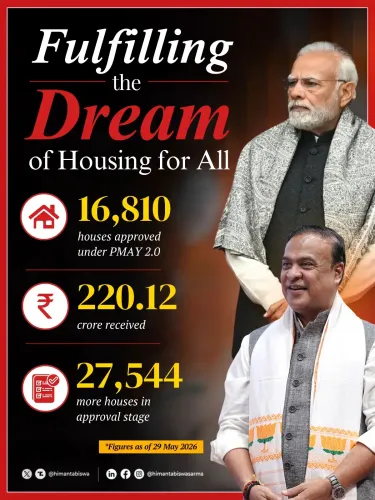
Pradhan Mantri Awas Yojana was launched in 2015 to provide permanent housing to eligible families across India, with Assam participating since inception.
Kokrajhar , part of the Bodoland Territorial Region in western Assam, has historically faced displacement pressures, making housing delivery there symbolically significant.
The post amplifies an ongoing central scheme rather than announcing new allocations or policy changes.
Assam's state agencies implement PMAY alongside other welfare programmes, with periodic reviews of sanctioned and completed houses.
Thousands of families across Assam are trading uncertainty for ownership — and the Chief Minister's Office of Assam wants the country to hear it directly from them. On Wednesday, 21 October 2026, the CMO shared a video featuring residents of Kokrajhar speaking about what receiving a home under Pradhan Mantri Awas Yojana (PMAY) has meant for their lives.
The post carried a straightforward message: 'A roof over every head, a life of dignity for every family.' It pointed to the scheme as a vehicle through which 'thousands of households across Assam and the nation are stepping into a secure and empowered future' — and let the testimonies from Kokrajhar do the talking.
Why Kokrajhar carries weight in this story
Kokrajhar sits in the heart of the Bodoland Territorial Region in western Assam — a district marked by a mixed Bodo, Bengali and other-community population that has historically faced displacement pressures and conflict-related housing instability. When families here speak of owning a home, the stakes behind those words run deeper than bricks and mortar. The district serves as a visible symbol of the scheme's reach into communities that have long been on the margins of formal housing.
PMAY's decade-long arc in Assam
Pradhan Mantri Awas Yojana was launched nationwide in 2015 under both the Ministry of Housing and Urban Affairs and the Ministry of Rural Development, with the stated goal of providing pucca (permanent, structurally sound) houses to every eligible household. The original deadline of 2022 was extended as implementation scaled up across states, and Assam has been a participating state since the scheme's inception, channelling allocations through state agencies to rural and urban beneficiaries alike.
The CMO's framing on Wednesday places emphasis not just on construction numbers but on human outcomes — dignity, security, empowerment — reflecting a deliberate shift in how the state communicates welfare delivery. Featuring beneficiary voices rather than bureaucratic progress charts is part of that register.
Ground reality versus the headline
It is worth noting what Wednesday's post is and is not. It is a state-level communication exercise amplifying a long-running central scheme — not an announcement of fresh allocations, revised targets, or new policy. Specific completion figures for Assam and the precise testimonies in the video could not be independently verified. What the post does confirm is that the Assam government continues to actively promote PMAY at the district level, with Kokrajhar serving as the storytelling anchor this cycle.
For communities still waiting on their sanctions, the message from Dispur is clear: the pipeline is moving, and the state is watching.
Point of View
The Assam government signals that PMAY's reach is penetrating historically underserved communities, lending the post political resonance beyond routine welfare promotion. This fits a broader pattern of BJP-led state governments using testimonial-style communication to humanise flagship central schemes ahead of electoral cycles. The real test, as always, will be in independently verified completion and quality figures — which the post does not provide.
NationPress
21 Oct 2026
Frequently Asked Questions
What is Pradhan Mantri Awas Yojana?
Pradhan Mantri Awas Yojana (PMAY) is a central government housing scheme launched in 2015 to provide permanent, structurally sound homes to eligible rural and urban households across India.
How is PMAY implemented in Assam?
Assam has participated in PMAY since 2015, implementing the scheme through state agencies for both rural and urban beneficiaries, with periodic reviews of sanctioned and completed houses.
Why is Kokrajhar significant in the context of housing schemes?
Kokrajhar is part of the Bodoland Territorial Region in western Assam and has a mixed population that has historically faced displacement, making housing delivery there particularly meaningful.
Did the Assam government announce new PMAY houses in this post?
No. The Chief Minister's Office of Assam shared testimonies from existing PMAY beneficiaries in Kokrajhar; no new allocations or policy changes were announced.
When was PMAY's original deadline and was it extended?
PMAY's original completion deadline was 2022, but it was extended beyond that as implementation scaled up across participating states including Assam.