CM Assam: PMAY-G Homes for 22 Lakh Families

Synopsis
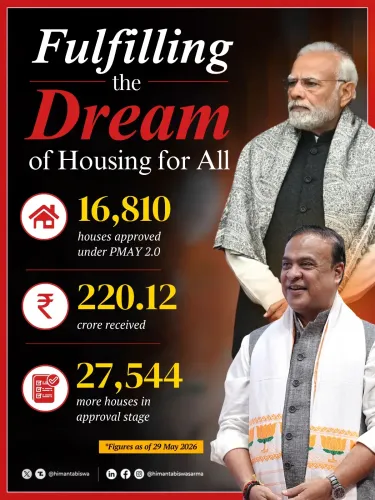
The Chief Minister's Office of Assam has highlighted that over 22 lakh rural families in the state are set to receive permanent homes under PMAY-G, crediting Prime Minister Modi's vision and CM Himanta Biswa Sarma's leadership in driving the scheme's implementation.
Key Takeaways
The Chief Minister's Office of Assam released a 60-second video on 2 July 2026 showcasing PMAY-G progress in the state.
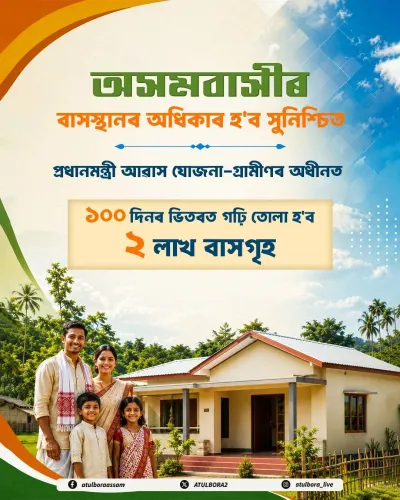
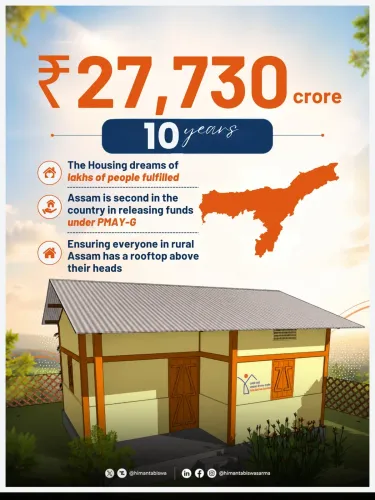
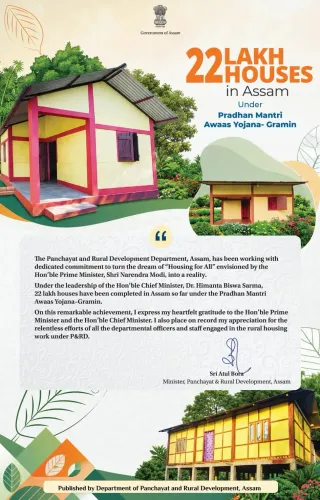
Over 22 lakh families across Assam are stated to be benefiting from permanent homes under the scheme.
PMAY-G was launched in 2016 as a restructured rural housing programme with a national target of 2.95 crore houses.
The post tags Union Minister Shivraj Singh Chouhan and Atul Bora , signalling active coordination between the state and the Union Ministry of Rural Development.
PMAY-G uses Aadhaar-linked transfers and geo-tagged monitoring to track construction progress at the beneficiary level.
Saturation of all eligible rural households in Assam remains the programme's stated long-term objective.
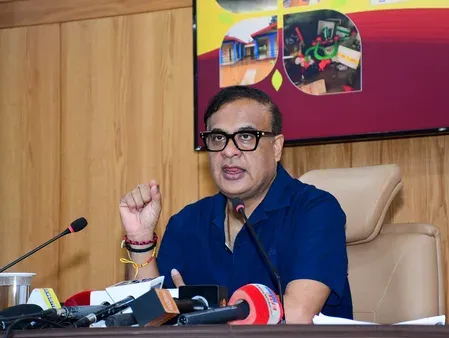
The Chief Minister's Office of Assam on Thursday, 2 July 2026, released a short video highlighting the progress of Pradhan Mantri Awas Yojana-Gramin (PMAY-G) in the state, stating that over 22 lakh families across Assam are receiving permanent homes under the scheme.
Context
The post, shared from the official CMOfficeAssam account, describes the scheme's rollout in a 60-second video under the caption 'From Vision to Reality.' It credits the initiative to the vision of Prime Minister Narendra Modi and the leadership of Chief Minister Dr. Himanta Biswa Sarma. The post also tags Union Minister Shivraj Singh Chouhan and Atul Bora, indicating coordination between the state government and the Union Ministry of Rural Development.
Policy Backdrop
PMAY-G was launched in 2016 by the Ministry of Rural Development as a restructured successor to the Indira Awas Yojana, with an initial national target of 2.95 crore pucca houses by 2022. The scheme provides eligible rural families — those living in kutcha or damaged housing — with financial assistance to construct a permanent dwelling with basic amenities. Subsequent phases extended the programme's timeline and shifted its focus toward saturation of remaining eligible households.
Assam, a northeastern state with a predominantly rural population, has been among the key focus states for PMAY-G implementation. The scheme operates through Aadhaar-linked direct benefit transfers and geo-tagged construction monitoring to ensure accountability at each stage of house construction.
Stakeholders and Impact
The stated beneficiary count of over 22 lakh families represents a significant share of Assam's rural population. For these households, a pucca house under PMAY-G means not only shelter but access to linked entitlements such as toilets under Swachh Bharat Mission, cooking gas connections under Ujjwala Yojana, and electricity under Saubhagya — schemes that are often converged at the beneficiary level. State rural development departments bear primary responsibility for beneficiary selection, fund disbursement tracking, and construction quality verification.
The tagging of Union Minister Shivraj Singh Chouhan, who holds the rural development portfolio, and Atul Bora in the post signals active inter-governmental coordination and suggests the video may be part of a broader outreach campaign to showcase scheme delivery in Assam.
What's Next
The Ministry of Rural Development periodically releases updated cumulative completion figures for PMAY-G across states. For Assam, the next milestones to watch include any phase-specific targets announced in the state budget or assembly sessions, as well as the release of verified completion data from the ministry's AwaasSoft management information system. Saturation of all eligible rural households in the state remains the stated long-term goal of the programme.
Point of View
The post reinforces the 'double-engine government' narrative — positioning both the Centre and state as co-authors of on-ground delivery. The 22-lakh figure, if borne out by ministry data, would represent a substantial share of Assam's rural housing backlog and strengthen the ruling dispensation's welfare-governance credentials in a state with significant tribal and rural constituencies. Analysts will watch whether the outreach is followed by verified completion data, which would distinguish genuine saturation from aspirational messaging.
NationPress
1 Oct 2026
Frequently Asked Questions
What is PMAY-G and who benefits from it in Assam?
PMAY-G, or Pradhan Mantri Awas Yojana-Gramin, is a central government scheme that provides financial assistance to eligible rural families living in kutcha or damaged houses to build a permanent pucca home. In Assam, the Chief Minister's Office has stated that over 22 lakh rural families are benefiting from the scheme.
How many families in Assam have received homes under PMAY-G?
According to the Chief Minister's Office of Assam, over 22 lakh families across the state are receiving permanent homes under PMAY-G as of July 2026.
Who is responsible for implementing PMAY-G in Assam?
PMAY-G is implemented through coordination between the Union Ministry of Rural Development and the Assam state rural development department. Chief Minister Dr. Himanta Biswa Sarma leads state-level implementation and monitoring.
When was PMAY-G launched and what is its national target?
PMAY-G was launched in 2016 as a restructured version of the Indira Awas Yojana, with an initial national target of 2.95 crore pucca houses. The programme has since been extended with additional phases focused on saturating remaining eligible rural households.
What other government schemes are linked to PMAY-G houses?
PMAY-G houses are often converged with other central schemes. Beneficiaries typically also receive toilets under Swachh Bharat Mission, cooking gas connections under Ujjwala Yojana, and electricity connections under the Saubhagya scheme.