Assam CM Office highlights PMAY-G's impact on rural families

Synopsis
The Chief Minister's Office of Assam spotlighted a PMAY-G beneficiary story on 24 October 2026, illustrating how the central rural housing scheme is translating the 'Housing for All' promise into pucca homes for the state's economically weaker families, with a focus on remote and tribal areas.
Key Takeaways
PMAY-G is the central government's flagship rural housing scheme, restructured from the Indira Awas Yojana in 2016 .
The Chief Minister's Office of Assam shared a beneficiary testimonial on 24 October 2026 to showcase ground-level delivery of the scheme.
Assam's implementation focuses on reaching remote and tribal areas where the rural housing deficit is most acute.
State agencies in Assam are responsible for beneficiary identification, construction monitoring, and fund utilisation under PMAY-G.
The scheme is framed as both a housing and a social dignity intervention for economically weaker families.
Beneficiary storytelling by CM offices is an increasingly common tool to validate scheme delivery and communicate progress to citizens.
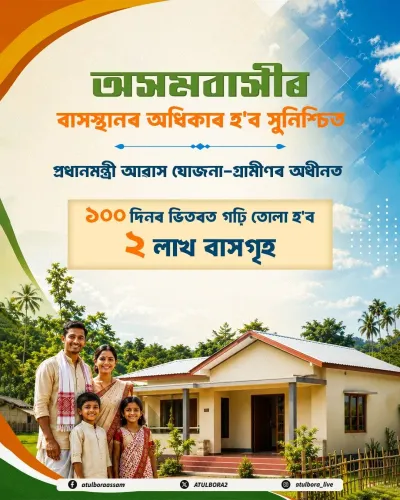
For families in rural Assam who have spent generations in makeshift shelters, a pucca house is not just bricks and mortar — it is proof that the state sees them. The Chief Minister's Office of Assam on Saturday, 24 October 2026, shared a beneficiary's story to spotlight how the Pradhan Mantri Awas Yojana - Gramin (PMAY-G) is converting that long-held aspiration into a concrete reality for economically weaker households across the state.
From Indira Awas to PMAY-G: a scheme rebuilt for scale
PMAY-G did not emerge from scratch. It was restructured in 2016 from the older Indira Awas Yojana, sharpened with cleaner beneficiary targeting, geo-tagged construction monitoring, and direct benefit transfers to cut out middlemen. The core promise stayed the same — a pucca house for every eligible below-poverty-line rural household — but the machinery around it got a significant overhaul. Assam, with its vast stretches of remote terrain and tribal settlements, sits squarely at the centre of that ambition.
Assam's rural housing challenge and what the scheme targets
Implementation in Assam has concentrated on reaching households in remote and tribal areas where the rural housing deficit has historically been steepest. State agencies carry the responsibility for beneficiary identification, construction monitoring, and fund utilisation — meaning the quality of delivery depends as much on state machinery as on central allocations. The CM Office's decision to amplify a personal beneficiary experience signals an effort to put a human face on what can otherwise read as bureaucratic progress reports.
The post frames the scheme's impact in two registers: the joy of having a safe home and the dignity of a more secure life — a deliberate pairing that positions PMAY-G not merely as an infrastructure intervention but as a social uplift measure for the state's most vulnerable families.
Why beneficiary storytelling matters in scheme delivery
State CM offices across India have increasingly turned to ground-level testimonials to communicate central scheme delivery. It serves a dual purpose: it validates implementation to citizens and it signals accountability upward to the Centre. For PMAY-G specifically, where sanctioned targets and completed houses can diverge sharply on paper, a beneficiary video carries a different kind of weight — it is the scheme made visible, one household at a time.
The broader 'Housing for All' agenda that PMAY-G anchors remains one of the flagship welfare commitments of the national government, making state-level progress stories politically and programmatically significant well beyond Assam's borders.
Every pucca roof raised in rural Assam is a data point in a national promise — and the state is now making sure those data points have names and faces.
Point of View
The communication subtly elevates PMAY-G from an infrastructure metric to a social contract — a framing that resonates with the 'Viksit Bharat' narrative the national government has been building. For Assam specifically, visible progress on rural housing in tribal and remote belts carries both electoral and developmental weight, making these beneficiary stories strategically as well as substantively significant.
NationPress
24 Oct 2026
Frequently Asked Questions
What is Pradhan Mantri Awas Yojana Gramin?
Pradhan Mantri Awas Yojana - Gramin (PMAY-G) is a central government scheme launched in 2016 to provide pucca houses to eligible below-poverty-line rural households across India. It was restructured from the earlier Indira Awas Yojana with improved beneficiary targeting and direct benefit transfers.
How is PMAY-G being implemented in Assam?
In Assam, PMAY-G implementation focuses on reaching remote and tribal areas with high rural housing deficits. State agencies handle beneficiary identification, construction monitoring, and fund utilisation under the scheme.
Who is eligible for PMAY-G benefits in Assam?
Economically weaker and below-poverty-line rural households in Assam are eligible for PMAY-G. Beneficiary lists are prepared by state agencies using socio-economic data.
What is the difference between PMAY-G and the old Indira Awas Yojana?
PMAY-G replaced the Indira Awas Yojana in 2016 with stronger beneficiary targeting, geo-tagged construction monitoring, and direct benefit transfers to reduce leakages and improve delivery efficiency.
What does 'pucca house' mean under PMAY-G?
A pucca house under PMAY-G refers to a permanent, structurally sound dwelling with durable walls and a roof, as opposed to a kutcha or makeshift structure. The scheme funds construction of such houses for eligible rural families.