Assam's Moridhal GP wins national Clean & Green Panchayat rank
Synopsis
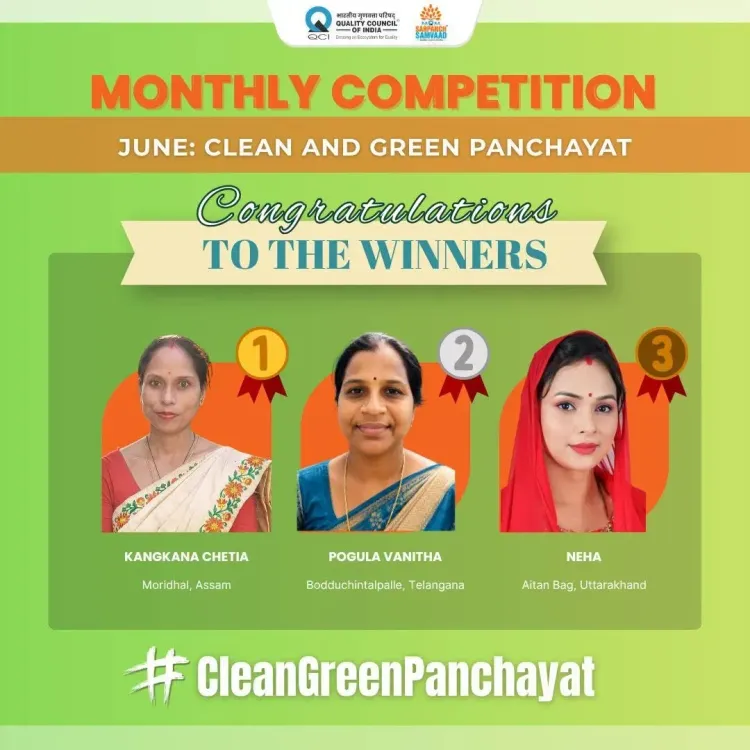
The Chief Minister's Office of Assam on 17 July 2026 congratulated Kangkana Chetia Devi, President of Moridhal Gram Panchayat in Dhemaji, for winning the national first rank in Sarpanch Samvaad's June 2026 Clean & Green Panchayat competition, calling it a matter of pride for Assam's Panchayati Raj Institutions.
Key Takeaways
Moridhal Gram Panchayat in Dhemaji, Assam ranked 1st nationally in the June 2026 'Clean & Green Panchayat' competition by Sarpanch Samvaad.
Kangkana Chetia Devi , President of Moridhal GP, received congratulations from the Chief Minister's Office of Assam on 17 July 2026 .
The competition is organised by Sarpanch Samvaad , a platform for elected panchayat representatives across India, on a monthly basis.
The achievement is rooted in a national policy push that includes Swachh Bharat Mission-Gramin (launched 2014) and the 73rd Constitutional Amendment of 1992 framework for Panchayati Raj Institutions.
Dhemaji is a district in upper Assam bordering Arunachal Pradesh, making this recognition notable for a geographically peripheral rural body.
The Chief Minister's Office of Assam on Friday, 17 July 2026 congratulated Smt. Kangkana Chetia Devi, President of Moridhal Gram Panchayat in Dhemaji district, for securing the first position nationally in the June 2026 edition of the 'Clean & Green Panchayat' competition organised by Sarpanch Samvaad. The office described the achievement as 'a matter of pride for Assam's Panchayati Raj Institutions.'
Context
Moridhal Gram Panchayat is located in Dhemaji, a district in upper Assam that borders Arunachal Pradesh. The recognition places a rural body from one of Assam's more remote districts at the top of a national monthly ranking, underscoring that competitive governance frameworks are reaching beyond urban and peri-urban panchayats.
Sarpanch Samvaad is a platform that facilitates interaction and peer learning among elected panchayat representatives across India. Its monthly 'Clean & Green Panchayat' competition evaluates gram panchayats on parameters related to sanitation, waste management, and greenery at the village level.
Policy Backdrop
The competition sits within a broader national push to incentivise local governance outcomes through rankings and public recognition. Swachh Bharat Mission-Gramin, launched in 2014, introduced annual cleanliness rankings for gram panchayats and remains a central pillar of rural sanitation policy. The 73rd Constitutional Amendment of 1992 had earlier established the foundational framework for Panchayati Raj Institutions, assigning them responsibilities that include environmental upkeep and sanitation.
Assam has participated in national panchayat performance frameworks that link local governance outcomes to central schemes such as Swachh Bharat and Rashtriya Gram Swaraj Abhiyan. Monthly competitions of this kind extend that logic to a faster, more granular recognition cycle, rewarding consistent performance rather than only annual results.
Stakeholders and Impact
Smt. Kangkana Chetia Devi's national first-place finish draws attention to elected women representatives leading rural governance in Assam. Her role as Gram Panchayat President places her among the grassroots officeholders who directly implement sanitation and green-cover initiatives in their villages.
For the Dhemaji community, the recognition can translate into heightened visibility within state and central government funding pipelines, as performance rankings often inform resource allocation under rural development schemes. Neighbouring gram panchayats in upper Assam may also draw motivation to participate in subsequent rounds of the competition.
What's Next
Attention will now turn to whether Moridhal GP can sustain its standing in subsequent monthly rounds and whether Assam's state government moves to institutionalise 'Clean & Green' parameters within its own panchayat evaluation and incentive systems. Central and state authorities have increasingly used such performance-linked visibility to push rural bodies toward measurable sanitation and environmental outcomes.
The broader pattern suggests that results from competitions like this one feed into annual national panchayat awards cycles, meaning Kangkana Chetia Devi's June 2026 win could position Moridhal GP favourably for larger year-end recognitions as well.
Point of View
And they generate political capital for the ruling establishment by associating it with village-level success stories. The recognition of a woman panchayat president adds a layer of symbolic value aligned with national priorities around women's leadership in local self-government. Sustained state attention to such rankings could accelerate Assam's integration of clean-and-green metrics into its own panchayat evaluation and funding frameworks.
NationPress
17 Jul 2026
Frequently Asked Questions
Who is Kangkana Chetia Devi?
Kangkana Chetia Devi is the President of Moridhal Gram Panchayat in Dhemaji district, Assam . She secured the national first position in the June 2026 'Clean & Green Panchayat' competition organised by Sarpanch Samvaad.
What is the Clean and Green Panchayat competition?
The 'Clean & Green Panchayat' competition is a monthly national contest organised by Sarpanch Samvaad , a platform for elected panchayat representatives across India, that recognises gram panchayats for outstanding performance in sanitation, cleanliness, and greenery.
What is Sarpanch Samvaad?
Sarpanch Samvaad is a platform that facilitates interaction and peer learning among elected panchayat representatives across India. It organises competitions and initiatives to promote best practices in rural local governance.
Where is Moridhal Gram Panchayat located?
Moridhal Gram Panchayat is located in Dhemaji district , a region in upper Assam that shares a border with Arunachal Pradesh.
How does the Clean and Green Panchayat ranking connect to national schemes?
The competition aligns with the broader framework of Swachh Bharat Mission-Gramin , launched in 2014 , which introduced cleanliness rankings for gram panchayats. Such monthly competitions extend this performance-linked incentive model to a faster recognition cycle at the village level.